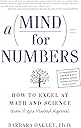
A Mind for Numbers: How to Excel at Math and Science (Even If You Flunked Algebra)
Product ID: 76267989
⭐4.5/5 rating from 6,650+ readers
🎯Proven learning strategies
📚300+ problem-solving methods
Desertcart purchases this item on your behalf and handles shipping, customs, and support to Belgium.
🧠 Master math & science with creativity — don’t just learn, transform!
A Mind for Numbers is a bestselling guide by Dr. Barbara Oakley that reveals effective, creative learning techniques to excel in math and science. Backed by a 4.5-star rating from over 6,600 readers, this book demystifies complex subjects and empowers professionals and students alike to overcome learning obstacles and thrive.


| Best Sellers Rank | #177,076 in Books ( See Top 100 in Books ) #117 in Study Skills #191 in Self-Help for the Workplace #227 in Algebra & Trigonometry |
| Customer Reviews | 4.5 out of 5 stars 6,736 Reviews |
U**Y
This book made me love MATH!
A mind for numbers. Why this book is great for those afraid of math: - • The advice is concise and to the point. • The tips do work amazingly, and I can confirm from experience. • It will provide a new and efficient way of learning math. • It explains how even a noob can excel at math. • It breaks age old myths around studying. • It provides a better and efficient strategy for studying math. This book literally made me fall in love with math. Math is the subject which caused a great deal of discomfort to me, that even the thought of it gave me headaches. I was afraid of doing math. The math textbook scared me more than any of the ghost stories or horror movies. I decided to change that but didn't know how. So, I picked up this book. The book does work wonders. The title may suggest that it only talks about math, but it discusses about learning in general, but with a bit more emphasis on Math. I can say that this book does work if you apply the principles mentioned. This talks about how your present way of learning may prove detrimental to your memory and your studies. It also talks about various hurdles faced by students and gives excellent advice on how to overcome them. There are quite a few memorization techniques described that'll help you learn formulas and make your concentration much better. It proves why doing less is more when it comes to math and studying in general. The advice given very is actionable and can be implemented right after you finish the book. The study techniques are backed by research and you experience the changes in your learning routine if you apply the principles given. They are not that hard to implement and don't take much time or effort on your side either. The chapters are to the point and there are no filler pages, it doesn’t drag at all. This book does help you become a better student. It breaks various myths around studying and describes the most efficient way of studying. If you're afraid of doing math and always hated it as a kid, this book can be a life saver. This is the kind of book you wish you’d had read as a kid.
S**A
Help to build good habits
Best book for those who want to learn anything , the book is not about maths it's about learning process
S**I
Book quality
Book quality is good also it's content go for it but little overpriced I think.
S**H
Quality
It's GOOD,Print Quality is Excellent,the book looked a Bit Bend actually but...it wasn't a big deal.(Book looks glossy cause I covered it with Plastic Bind).Quality is Unmatched
A**Y
An eyeopener about learning effectively
A great book for learning just about any subject or skill, not just math and science. It really wish I had read this book when I was in high school!
K**R
Excellent book for students
The book is for all students who is struggling in study and it will be game changer .it's really easy to read
T**A
A useful book
Although I read many self improvement book but I can rarely apply all the ideas of that book but this book present ideas in a doable way. I noticed how I highlighted my notes and books and after I read a particular line of this book I minimised my highlights. It present logical reasoning to many of the points and it would be a good books for students preparing for competitive exam. But I had some problems not particularly from the book but some contrasting ideas, and the author talked about how she was influenced by Cal Newport ,she tells us to use pomodoro but cal idea of deep work with extended time contrasts it’s ideas. But over all the book was helpful
S**T
NON-MATHS PERSON MUST READ IT ONCE. AND HAVE YOUR FAITH AND CONFIDENCE BACK.
REINSTEAL THE LOST CONFIDENCE OF YOUR OVER NUMBER. REQUEST TO READ THOSE WHO THINK THEMSELVES AS NOT A MATHS PERSON.
M**O
Una mente per numeri
Libro arrivato in buone condizioni. I consigli di questo libro sono la creatività e la pianificazione del tempo, utile per non procrastinare nello studio. Consigliato e piacevole da leggere.
F**.
Importante ferramenta de melhorar as técnicas de aprendizado
Acredito que conheci o livro pelo mesmo modo que a maioria, que foi através do curso "Learning How To Learn" no Coursera. O conteúdo de ambos é bem próximo, mas acho que o livro traz mais detalhes e conteúdo adicional. Importante ferramenta para quem entende que estudar melhor é mais importante do que a quantidade de estudo, mostrando evidências científicas dos métodas mais eficazes. A linguagem do livro é relativamente simples e leve e mesmo alguém que tem nível avançado de inglês consegue entender os principais conceitos e ideias. A versão para Kindle está excelente - só é mais difícil as vezes a parte das ilustrações, mas nada que desabone a versão e nem o conteúdo do livro.
ジ**ン
Great!
This book is wonderful. A lot of techniques, a lot of explanations and analogies easy to understand, a lot of inspiriting words... I wish I had a book like this one earlier, when I was a student 20 years ago! I would have mastered high school and college! Easily!
P**L
and recommendations are very useful for everybody who wants to be a SMART 21st ...
A Mind for Numbers is written for students of math and science, but Barbara Oakley’s perspective, interviews, and recommendations are very useful for everybody who wants to be a SMART 21st Century lifelong learner. It is a practical book that reflects the best knowledge about how our brains process things – both logically and creatively, from the details up AND from the ideas down. I strongly recommend it to anyone who wants to learn better – or who wants to help a scholar who wants to excel and LEARN in school. Oakley uses good teaching/learning approaches in this book. It is peppered with stories and even pictures that bring lessons to life. The stories are from very successful scientists – many of whom struggled to learn or were even written off by their teachers. They are stories that say – “persist, be smart about how you learn, and you will succeed.” This, of course, is the learning mindset that is so crucial for discovery and living an unstoppable life. Oakley also distributes insights about her core topics – building up and reinforcing the key ideas throughout the book. Ultimately, she concludes that 10 practices are critical (she calls them “Ten Rules of Good Studying.” They apply to lifelong learning as well as to learning for school – especially to information and processes you want to remember: Use recall. Don’t just review what you want to remember. Actively pull your insights out of your own brain. This, of course, is a key practice in my Unstoppable You. Oakley offers many reinforcements of this important way to support learning Test Yourself. This is something anyone can do about any topic you want to remember. For kids it’s flash cards, for adults it might be asking yourself what you know about a topic before a meeting or reading, and then doing it again afterwards. Chunk information. Organizing ideas and facts into categories, pictures and diagrams, songs, and other mental files can help you remember and understand at a deeper level. Connecting ideas to what you know and to each other creates more neural connections and thus more ways to find what you need when you need it. Space repetition. Oakley practices this by revisiting and enhancing these 10 rules throughout this book. The lesson is to work on something for a shorter period of time (30 minutes?) and then do something less demanding. When you return to the learning project later, you will be fresher and your automatic system (she calls it your “diffused processing mode”) will have done some undercover work to process your initial learning. Alternate different problem-solving techniques. She talks about how this works in math – work on equations for a while, then on verbal problems, then do a test, etc. The point is, don’t get stuck on one way of learning something. Get a variety of perspectives – some big picture, some detailed. This “interleaving” is a pretty valuable approach for any topic. Take breaks. When you are stuck or tired from focusing on solving a problem/learning, stop and do something that isn’t so taxing. Your automatic (diffused) processing will continue to work on the problem unconsciously and you will be able to have a new perspective when you come back to it. Use explanatory questioning and simple analogies. Try explaining what you are learning in a simple way – preferably to someone else. Tell them what it is “like” (an example she gives if that the flow of electricity is like the flow of water). This more deeply engrains the knowledge in your brain and may get you some clarifying questions. Focus. This is a very important and often broken rule. It is clear that your brain can’t work on more than one complex problem at a time. So, as many others suggest, turn off the phones, text messaging, loud music, and create a space where you can concentrate. Eat your frogs first. That is, do the hardest things first when you have the energy. Make a mental contrast. This is equivalent to the imagination quality presented in Unstoppable You: see where you want to be and compare it the where you are. Let this be motivating. There are many specific tips and encouraging comments in this book. And for students, there is a lot of good help related to working with teachers, studying with others, dealing with procrastination, taking tests, dealing with anxiety, letting go of the need to be perfect in order to be open to insights and to correct errors in thinking, remembering facts and methods, and more. Oakley is a very respected educator who came to the sciences by accident when she was in military service. We should be glad that she discovered math and science and became curious about how to be a master learner and teacher in these areas. We all benefit from her perspective, examples, and tips.
S**E
👍
Lovely book for kids who are not into mathematics. Great strategies to help kids at Mathematics.
Trustpilot
4 days ago
1 month ago