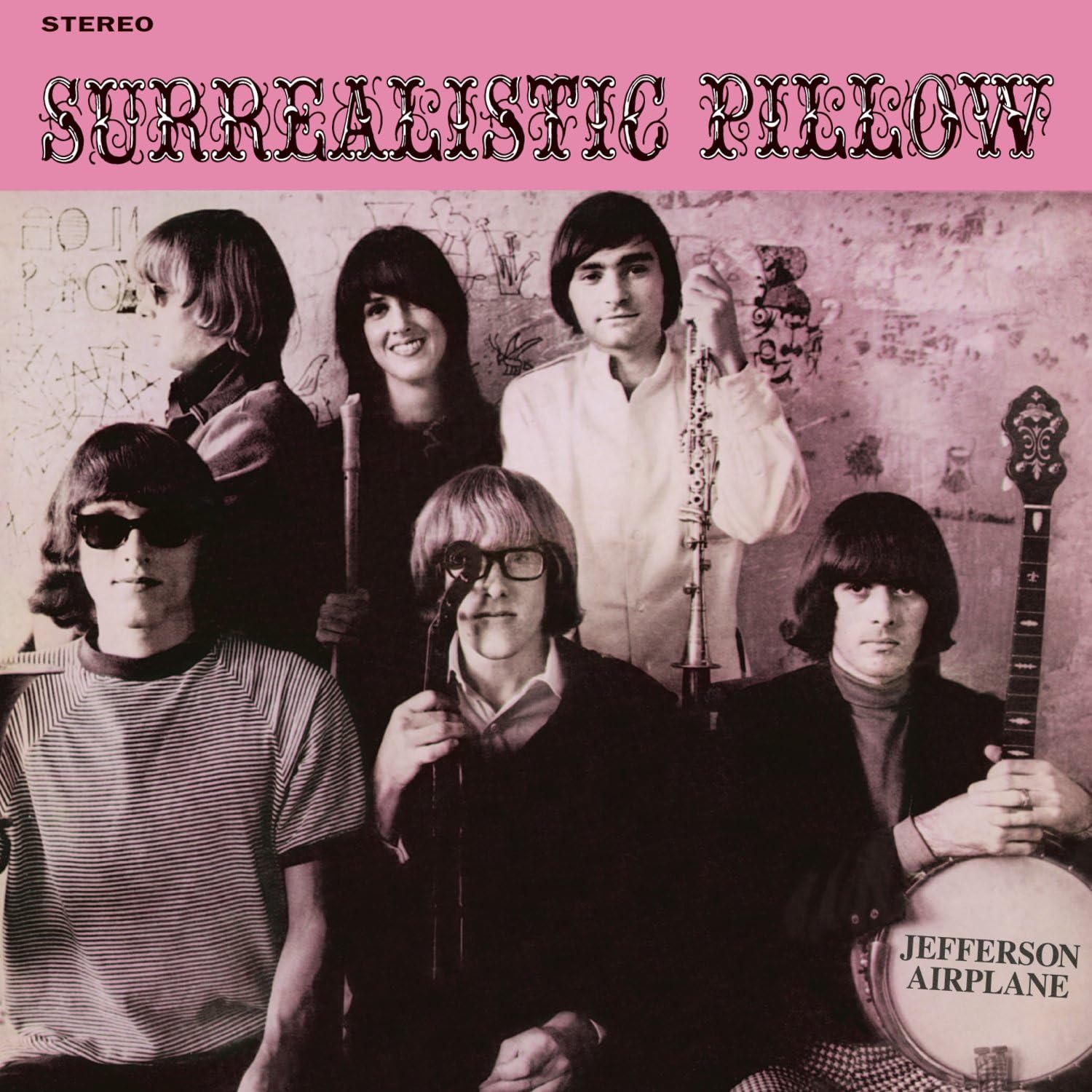
Surrealistic Pillow
Product ID: 6146505
Details
- BrandLEGACY
- ColorMulticolor
- Item Weight3.2 ounces
- Number of Items1
- UPC766481153948
Buy anything from 5,000+ international stores. One checkout price. No surprise fees. Join 2M+ shoppers on Desertcart.
Desertcart purchases this item on your behalf and handles shipping, customs, and support to Belgium.
. Review: One of the greatest Albums of the Sixties - “Surrealistic Pillow ” is not only one of the best albums of 1967, but also of the entire 60s decade. For most people it was their introduction to Jefferson Airplane and to be honest, most thought it was their first album. Their actual first LP had been “Jefferson Airplane Takes Off “ in late 1966, but it produced no hits to introduce the band on the radio and sold mostly on the West Coast. Then Signe Tole Anderson was the female lead singer. When she left after having a child, Grace Slick from the Great Society replaced her, making the Airplane essentially a different group. She had also brought two songs with her that had been part of her former band’s repertoire, “Somebody To Love”, written by her brother-in-law Darby Slick and “White Rabbit”, which she had composed. San Francisco had a rapidly developing music scene which had begun in 1965 as many musicians who had been part of the folk revival saw that it was winding down and were drawn to the energy and excitement of the pop and rock scene which had been revitalized after the British Invasion. In fact, Marty Balin had met Paul Kantner at The Drinking Gourd, a folk club on San Francisco’s Union Street in 1965 and decided to form a band together. There were not many venues for the kind of folk-rock group they were planning so Balin talked some friends into putting up money to buy a nearby pizza restaurant and turned it into a rock club, The Matrix, that soon became the hip place to go for new music. The band itself went through the usual personnel and other changes and by late 1966 had a record contract with RCA. This was an unusual choice as RCA was the big label in country music and had Elvis on their roster, but a friend, Rod McKuen had recommended RCA after he had signed with them. They were almost immediately the top band in San Francisco at a time when the Grateful Dead were the Warlocks and Janis Joplin had not yet joined Big Brother. There never was a San Francisco sound. It was just a number of bands, each doing their own thing, which was a very San Francisco thing to do. (I covered much of their formative period in reviews of “Jefferson Airplane Takes Off” and the Great Society’s CD and feel it would be too much to go into in detail here). It was fortunate that the Airplane and the Great Society had played many gigs together, making Grace Slick familiar with their songs because they had to go to L.A. to record the second album just two weeks after she first joined them onstage. Marty Balin wrote a couple of the most memorable songs in L.A. while recording the album. That the result was so remarkable seems almost impossible, but in 1966 and 1967 there was a lot of creative magic in the air. It also helped that the band had been playing together on stage for over a year now at every important concert and “happening” in San Francisco (and even a stint in Chicago). You can hear this in the tight playing by Jorma Kaukonen’s lead guitar, Jack Casady’s bass and Spencer Dryden’s percussion. They were the motor, joined by Kantmer’s rhythm guitar, that drove the songs that Balin and Slick sang. Dryden himself had only joined the group in mid ‘66, replacing Skip Spence, whose growing drug problems had caused too many issues. Dryden was a session drummer who had also been in The Peanut Butter Conspiracy, an early L.A. psychedelic band. RCA gave them staff producer Rick Jarrard, who became controversial with members of the band, but whose creative decisions I believe added greatly to the success of the album both commercially and creatively. He kept the band to standard length songs except in cases like “Comin’ Back To Me” where the song had to be extended to “breathe” and produce its effect. This kept the album comprehensible to an audience raised on pop songs - remember, this was 1967, not ‘68 or ‘69. He used a lot of reverb, which produces an effect shorter than echo but still allows the sound to fade gradually. This is notable in many of the songs and I believe gives them more depth and presence. I’d hate to hear the songs without it. He also worked with them on their harmonies, keeping them closely together; although there were bands who coils sing live in four or five part harmonies (the Association, the Mamas & the Papas) Jefferson Airplane had not been together with their new vocalist long enough to do this naturally. This resulted in a very clean, defined sound that the band members felt didn’t sound like them live. It’s true that many hands-on producers could make bands sound like an entirely different genre than they actually were, but that’s not the case here. “Surrealistic Pillow Is true to the essence of the group’s sound, it’s just a little more crisp and practiced. Left to their own devices on their next album, “After Bathing at Baxters”, they produced an interesting, glorious experiment that didi sound more like a live concert, but which few people bought. “Surrealistic Pillow” is beautifully diverse in its styles without ever sounding confusing, like a band that is just trying out different things.. It all holds together as the work of a single band with different aspects to its sound. It opens with “She Has Funny Cars”, drums, guitars, staggered time signatures and great vocal weaving with Slick and Balin. Then comes “Somebody To Love”, a sensational introduction to Slick’s powerful voice. voice. In the spring of 1967 it was like a bolt out of the blue on Top 40 radio and zoomed to the top five in June when “Sgt. Pepper” had just come out. The Great Society had done it slower, with a sadder feeling about wanting somebody to love; here, with Jorma’s guitar and Grace’s delivery it’s more of a challenge. “My Best Friend’ is somewhat in the vein of Sopwith Camel or the Lovin’ Spoonful, a bit of old-fashioned whimsey. Then the two quiet songs that close side one, both written by Balin during the early November ‘66 recording period. “Today” is a yearning love song that builds to a passionate declaration, without a second theme or elaboration as a pop song would. ”Comin’ Back To Me ” is introduced by a delicate acoustic guitar joined by Grace’s recorder and is a foggy, poetic, dreamlike reverie of great feeling. It was really daring to end Side One with a song like this but it’s one of the great ballads of rock. Side two opens with the almost dissonant rock of a song whose title Jorma Kaukonen said were just words he saw in the Sports Section, but which somehow express the song’s sense. “D.C.B.A.-25 is closer to the band’s older folk-rock sound with nice harmonies in the vocals. “How Do You Feel” continues in the same vein with even more elaborate harmonies that sound a bit like the Mamas & the Papas”. Jorma’s hypnotic instrumental “Embryonic Journey” is a perfect miniature that seems to have endless depth despite its short length. Then “White Rabbit” another of rock’s remarkable songs, a dramatic trip to Wonderland that was banned by many radio stations but got to #8 anyway. I don’t know whose idea it was to make it a bolero (it had a long extended instrumental opening by the Great Society and was sung in a slightly Middle Eastern style) but that gave it a unique power for a 2 ½ minute song. The album ends with “Plastic Fantastic Lover” performed in a suitably mechanistic way. Well chosen bonus tracks from the same time period include the essential mono versions of the two hits for those who want to hear them exactly as they probably first did. Review: A great Album by a Great Group - This is such a great record. It came quickly and in great condition.



| ASIN | B0000A0DRY |
| Best Sellers Rank | #4,001 in CDs & Vinyl ( See Top 100 in CDs & Vinyl ) #64 in Classic Psychedelic Rock #87 in Folk Rock (CDs & Vinyl) #92 in Vocal Pop (CDs & Vinyl) |
| Customer Reviews | 4.8 4.8 out of 5 stars (2,452) |
| Date First Available | February 10, 2007 |
| Is Discontinued By Manufacturer | No |
| Item model number | 2193798 |
| Label | Legacy Recordings |
| Language | English |
| Manufacturer | Legacy Recordings |
| Number of discs | 1 |
| Original Release Date | 2003 |
| Product Dimensions | 5.5 x 0.4 x 4.9 inches; 3.2 ounces |
| Run time | 58 minutes |
J**F
One of the greatest Albums of the Sixties
“Surrealistic Pillow ” is not only one of the best albums of 1967, but also of the entire 60s decade. For most people it was their introduction to Jefferson Airplane and to be honest, most thought it was their first album. Their actual first LP had been “Jefferson Airplane Takes Off “ in late 1966, but it produced no hits to introduce the band on the radio and sold mostly on the West Coast. Then Signe Tole Anderson was the female lead singer. When she left after having a child, Grace Slick from the Great Society replaced her, making the Airplane essentially a different group. She had also brought two songs with her that had been part of her former band’s repertoire, “Somebody To Love”, written by her brother-in-law Darby Slick and “White Rabbit”, which she had composed. San Francisco had a rapidly developing music scene which had begun in 1965 as many musicians who had been part of the folk revival saw that it was winding down and were drawn to the energy and excitement of the pop and rock scene which had been revitalized after the British Invasion. In fact, Marty Balin had met Paul Kantner at The Drinking Gourd, a folk club on San Francisco’s Union Street in 1965 and decided to form a band together. There were not many venues for the kind of folk-rock group they were planning so Balin talked some friends into putting up money to buy a nearby pizza restaurant and turned it into a rock club, The Matrix, that soon became the hip place to go for new music. The band itself went through the usual personnel and other changes and by late 1966 had a record contract with RCA. This was an unusual choice as RCA was the big label in country music and had Elvis on their roster, but a friend, Rod McKuen had recommended RCA after he had signed with them. They were almost immediately the top band in San Francisco at a time when the Grateful Dead were the Warlocks and Janis Joplin had not yet joined Big Brother. There never was a San Francisco sound. It was just a number of bands, each doing their own thing, which was a very San Francisco thing to do. (I covered much of their formative period in reviews of “Jefferson Airplane Takes Off” and the Great Society’s CD and feel it would be too much to go into in detail here). It was fortunate that the Airplane and the Great Society had played many gigs together, making Grace Slick familiar with their songs because they had to go to L.A. to record the second album just two weeks after she first joined them onstage. Marty Balin wrote a couple of the most memorable songs in L.A. while recording the album. That the result was so remarkable seems almost impossible, but in 1966 and 1967 there was a lot of creative magic in the air. It also helped that the band had been playing together on stage for over a year now at every important concert and “happening” in San Francisco (and even a stint in Chicago). You can hear this in the tight playing by Jorma Kaukonen’s lead guitar, Jack Casady’s bass and Spencer Dryden’s percussion. They were the motor, joined by Kantmer’s rhythm guitar, that drove the songs that Balin and Slick sang. Dryden himself had only joined the group in mid ‘66, replacing Skip Spence, whose growing drug problems had caused too many issues. Dryden was a session drummer who had also been in The Peanut Butter Conspiracy, an early L.A. psychedelic band. RCA gave them staff producer Rick Jarrard, who became controversial with members of the band, but whose creative decisions I believe added greatly to the success of the album both commercially and creatively. He kept the band to standard length songs except in cases like “Comin’ Back To Me” where the song had to be extended to “breathe” and produce its effect. This kept the album comprehensible to an audience raised on pop songs - remember, this was 1967, not ‘68 or ‘69. He used a lot of reverb, which produces an effect shorter than echo but still allows the sound to fade gradually. This is notable in many of the songs and I believe gives them more depth and presence. I’d hate to hear the songs without it. He also worked with them on their harmonies, keeping them closely together; although there were bands who coils sing live in four or five part harmonies (the Association, the Mamas & the Papas) Jefferson Airplane had not been together with their new vocalist long enough to do this naturally. This resulted in a very clean, defined sound that the band members felt didn’t sound like them live. It’s true that many hands-on producers could make bands sound like an entirely different genre than they actually were, but that’s not the case here. “Surrealistic Pillow Is true to the essence of the group’s sound, it’s just a little more crisp and practiced. Left to their own devices on their next album, “After Bathing at Baxters”, they produced an interesting, glorious experiment that didi sound more like a live concert, but which few people bought. “Surrealistic Pillow” is beautifully diverse in its styles without ever sounding confusing, like a band that is just trying out different things.. It all holds together as the work of a single band with different aspects to its sound. It opens with “She Has Funny Cars”, drums, guitars, staggered time signatures and great vocal weaving with Slick and Balin. Then comes “Somebody To Love”, a sensational introduction to Slick’s powerful voice. voice. In the spring of 1967 it was like a bolt out of the blue on Top 40 radio and zoomed to the top five in June when “Sgt. Pepper” had just come out. The Great Society had done it slower, with a sadder feeling about wanting somebody to love; here, with Jorma’s guitar and Grace’s delivery it’s more of a challenge. “My Best Friend’ is somewhat in the vein of Sopwith Camel or the Lovin’ Spoonful, a bit of old-fashioned whimsey. Then the two quiet songs that close side one, both written by Balin during the early November ‘66 recording period. “Today” is a yearning love song that builds to a passionate declaration, without a second theme or elaboration as a pop song would. ”Comin’ Back To Me ” is introduced by a delicate acoustic guitar joined by Grace’s recorder and is a foggy, poetic, dreamlike reverie of great feeling. It was really daring to end Side One with a song like this but it’s one of the great ballads of rock. Side two opens with the almost dissonant rock of a song whose title Jorma Kaukonen said were just words he saw in the Sports Section, but which somehow express the song’s sense. “D.C.B.A.-25 is closer to the band’s older folk-rock sound with nice harmonies in the vocals. “How Do You Feel” continues in the same vein with even more elaborate harmonies that sound a bit like the Mamas & the Papas”. Jorma’s hypnotic instrumental “Embryonic Journey” is a perfect miniature that seems to have endless depth despite its short length. Then “White Rabbit” another of rock’s remarkable songs, a dramatic trip to Wonderland that was banned by many radio stations but got to #8 anyway. I don’t know whose idea it was to make it a bolero (it had a long extended instrumental opening by the Great Society and was sung in a slightly Middle Eastern style) but that gave it a unique power for a 2 ½ minute song. The album ends with “Plastic Fantastic Lover” performed in a suitably mechanistic way. Well chosen bonus tracks from the same time period include the essential mono versions of the two hits for those who want to hear them exactly as they probably first did.
B**E
A great Album by a Great Group
This is such a great record. It came quickly and in great condition.
K**I
"...too many days I've left unstoned..."
Most of the members of Jefferson Airplane have always said that Jerry Garcia played on, sang on, named and produced SURREALISTIC PILLOW, facts denied by RCA's named producer Rick Jarrard and Airplane drummer Spencer Dryden. Hence, Garcia was never given producer's credit; but he was named as "spiritual advisor" to the album. As metaphysician to the acid-rock age, Dr. Garcia did a great job. SURREALISTIC PILLOW spawned not one but two classic anthems of the Summer of Love (for those of you too young to know, that would be 1967), "Somebody To Love" and "White Rabbit," covers of songs originally sung by The Great Society. Thus, not only did Jefferson Airplane attain flight speed (their first album, JEFFERSON AIRPLANE TAKES OFF literally got them off the ground), but it ensured them a permanent place in the Rock pantheon as the definitive interpreters of "the San Francisco sound." While SURREALISTIC PILLOW is not the prime example of the band's preferred overtly political, dense musical style (that would be their fourth album, CROWN OF CREATION), SURREALISTIC PILLOW is, far and away, their best work. A group with intense internal stresses, this album found the band in a fleeting moment of dynamic suspension. The Airplane would never sound so unified and yet so eclectic ever again. SURREALISTIC PILLOW has wandered, but not too far, from Jefferson Airplane's folk/blues/vocal harmony roots. Although they sing and play together, each member of the band has a distinctive sound, all of which mesh perfectly on this album. "She Has Funny Cars" opens the album with a jungle beat, wailing guitars, and offbeat lyrics, immediately followed by the anthematic "Somebody To Love" (written by Darby Slick but sung by Grace Slick). Grace's voice has been described by some as "steely" and by others as "a silken-sailed clipper ship," and everyone is both right and wrong. The former I. Magnin model's powerful contralto both challenges and invites her bandmates (and the listener) to keep pace, being all at once playful, petulant, demanding, ingenuous, and erotic. "My Best Friend" is a nice vocal harmony number that goes well with whatever everybody was smoking that long-ago summer; and "Today" and "Comin' Back To Me" are paeans to lost love, the former from the perspective of the leaving party, and the latter from the one left behind (and still tear-inducing). The oddly named "3/5 of a Mile in 10 Seconds" and "DCBA-25" are drug songs, pure and simple, from that innocently luminescent time where no harm was done to anyone, the consciousness expanded, and God was seen on a daily basis. Both songs presage the Airplane's emergent distinctive style, musically and thematically. "How Do You Feel" revisits the tenor of "My Best Friend," to be followed by what many people consider the best song on the album, guitarist Jorma Kaukonen's brief (less than two minutes), beautiful, complex, finger-picking instrumental masterpiece, "Embryonic Journey." The original album closes with the Lewis Carroll-inspired cautionary drug anthem, "White Rabbit" and then singer Marty Balin's "Plastic Fantastic Lover," which he claims to be about television, but transcends itself into a song about free love. The bonus tracks "In The Morning," "JPP McStep B. Blues," "Go To Her," "Come Back Baby" and mono AM radio mixes of "White Rabbit" and "Somebody To Love" were all recorded during the SURREALISTIC PILLOW sessions, but never used. Each spotlights and highlights the amazing talents of the members of Jefferson Airplane, and each has its rightful home on this disc. SURREALISTIC PILLOW belongs next to The Beatles' SGT. PEPPER'S LONELY HEARTS CLUB BAND, the Beach Boys' PET SOUNDS, Jimi Hendrix's ARE YOU EXPERIENCED?, Cream's DISRAELI GEARS, and The Doors' THE DOORS as a definitive addition to the canon of ageless rock albums released in that one amazing year of 1967.
W**Y
Recommend
An awesome record, fast shipping and the record feels of good quality. I did not receive the record warped or scratched and was packaged very securely. Even so I do recommend using a record weight and a system that allows you to adjust the pitch, bass, and midrange to extract the hi fi out of the album. I also tested the record on a basic system without the ability to adjust it sounded good and will get you where you want to be but it does sound dull and whatever you do don’t play it on a suitcase player it will make you cry lol. I love the 60s vibe highly recommend.
M**A
Posseggo già un CD dei Jefferson ma avevo sentito pareri molto lusinghieri su questo album, che testimonia l'evoluzione musicale negli USA in quello che a mio parere è il periodo più bello della musica rock e che ci ha dato capolavori immortali sui due lati dell'Atlantico. I brani sono tutti di buon livello e la voce di Grace Slick spicca su un tappeto musicale sempre ricco. Un CD da avere.
G**A
Ótimo produto mas poderia vir melhor embalado
G**A
Heerlijk om te genieten van muziek uit mijn jeugd vele oude herinneringen ophalen
T**S
Deras hittar finns på denna
B**E
Die Qualität des Vinyls ist ersklassig. Kein knistern oder knacken. Und absolut gerade Scheibe. Das hat man selten. Für die grandiose Psychedelic Band Jefferson Airplane gilt das gleiche. Wer eine musikalische Zeitreise in die Endsechziger und die "Vibes" dazu haben möchte, der kommt an Surealistic Pillow nicht vorbei. Klasse Schallplatte.
Trustpilot
3 weeks ago
1 week ago