
Desertcart purchases this item on your behalf and handles shipping, customs, and support to Belgium.
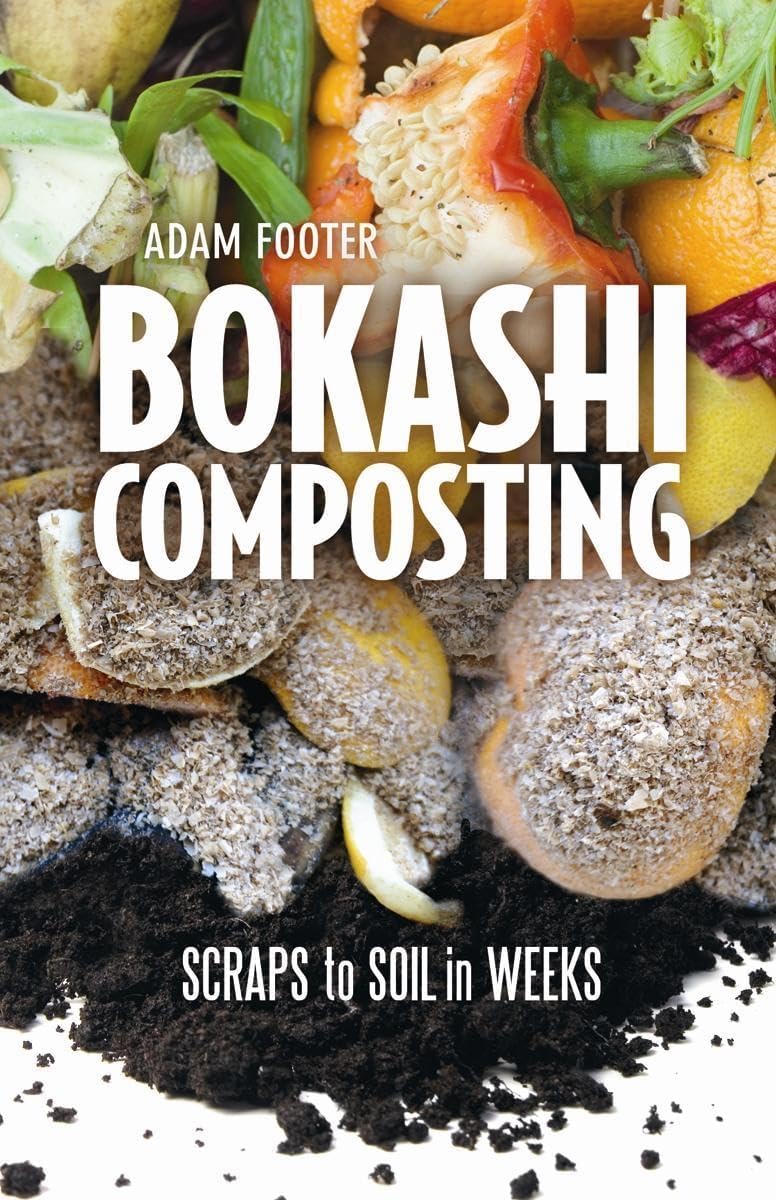
The safe, clean, and convenient way to compost all your food scraps. Bokashi is Japanese for "fermented organic matter." Bokashi composting is a safe, quick, and convenient way to compost in your kitchen, garage, or apartment, using a specific group of microorganisms to anaerobically ferment all food waste (including meat and dairy). Since the process takes place in a closed system, insects and smell are controlled, making it ideal for urban or business settings. The process is very fast, with compost usually ready to be integrated into your soil or garden in around two weeks. While bokashi has enjoyed great popularity in many parts of the world, it is still relatively unknown in North America. From scraps to soil, Bokashi Composting is the complete, step-by-step, do-it-yourself guide to this amazing process, with comprehensive information covering: Background-the history, development and scientific basis of the technique Getting started-composting with commercially available products or homemade systems Making your own-system plans and bokashi bran recipes using common materials and locally sourced ingredients Growing-improving your soil with fermented compost and bokashi juice. This essential guide is a must-read for gardeners, homeowners, apartment dwellers, traditional composters, and anyone who wants a safe, simple, and convenient way to keep kitchen waste out of the landfill. Review: Worth the read before trying to bokashi compost - I would definitely recommend reading this book first before trying to attempt bokashi composting or buying a bucket/supplies. I wanted to buy a pre-made bucket, but I ended up learning to make my own, which I think would work the best. A lot of the commercial composters have snap lids, etc. and I was worried they wouldn't seal well. I used these 2 gallon buckets from desertcart since they are a size I couldn't find at my local hardware store (they also came in fun colors): https://www.desertcart.com/dp/B0CKH2VQLL?ref_=ppx_hzsearch_conn_dt_b_fed_asin_title_1 If you order twice, you get six total, perfect for making 2-3 buckets. I used this size because the 5 gallon would take too long to fill with a 2 person household. 5 gallon buckets are easier to find at any home depot and would be cheaper however. FYI... Bokashi composting is not glamorous. It's cutting up your scaps, which can be messy, depending on the food types, and then smooshing them into a bucket with EM mix. The fermenting process is a weird smell. The lids seal though, so there is no odor in the househould. I've tried using the fermented 'pre-compost' and it has had good results in the garden. Kinda a gross messy process, but works, cuts down greenhouse gases/waste. It's worth it if you're willing to do it. Review: Poor science but good hands-on instruction - This book --- like the modern incarnation of bokashi composting --- has its good and bad points. I'll start with the book's strengths. Adam Footer does a fine job of not padding the book the way so many non-fiction authors do, and instead presents the facts in an easy-to-read, short text that I was able to consume during one rainy afternoon. He also includes lots of photos, and even though they're black and white, I appreciate the sheer quantity of hands-on pictorials. After reading the book, I feel like I'll easily be able to set up a bokashi bucket and produce my own compost using his method. Okay, so what didn't I like? The method seems to attract a lot of pseudoscientists, and the chapter titled "The Science" made me cringe. There's no attempt to cut through the commodification of the method to determine whether you really do need all of the types of microorganisms found in the store-bought starter solutions, although the author firmly tells us that a homemade Lactobacillus starter (using whey from yogurt, for example) won't be as effective. Meanwhile, Footer uses words like "consortium" to refer to the supposedly symbiotic relationship existing within the commercial starter...but gives very little information on how the consortium is supposed to be better than plain old whey. Then we hit the point where the author promises that the commercial starter will "reeducate other 'wild' microbes" --- that's where I had to force myself to keep on reading. In the end, I'd say that if you enjoy publications by Acres USA, then chances are you'll love this book. But if you like your science in a little bit of a purer form, you'll need to read Bokashi Composting critically and to run a few tests of your own to determine whether anything the author writes about is worth believing. However, since this appears to be one of the few or perhaps the only print book in English on the topic, you might as well pick it up and take a look. Just take what you read with a grain of salt.
| Best Sellers Rank | #1,082,997 in Books ( See Top 100 in Books ) #248 in Urban Gardening (Books) #563 in Sustainable Agriculture (Books) #818 in Organic & Sustainable Gardening & Horticulture |
| Customer Reviews | 4.4 out of 5 stars 267 Reviews |
M**H
Worth the read before trying to bokashi compost
I would definitely recommend reading this book first before trying to attempt bokashi composting or buying a bucket/supplies. I wanted to buy a pre-made bucket, but I ended up learning to make my own, which I think would work the best. A lot of the commercial composters have snap lids, etc. and I was worried they wouldn't seal well. I used these 2 gallon buckets from Amazon since they are a size I couldn't find at my local hardware store (they also came in fun colors): https://www.amazon.com/dp/B0CKH2VQLL?ref_=ppx_hzsearch_conn_dt_b_fed_asin_title_1 If you order twice, you get six total, perfect for making 2-3 buckets. I used this size because the 5 gallon would take too long to fill with a 2 person household. 5 gallon buckets are easier to find at any home depot and would be cheaper however. FYI... Bokashi composting is not glamorous. It's cutting up your scaps, which can be messy, depending on the food types, and then smooshing them into a bucket with EM mix. The fermenting process is a weird smell. The lids seal though, so there is no odor in the househould. I've tried using the fermented 'pre-compost' and it has had good results in the garden. Kinda a gross messy process, but works, cuts down greenhouse gases/waste. It's worth it if you're willing to do it.
H**R
Poor science but good hands-on instruction
This book --- like the modern incarnation of bokashi composting --- has its good and bad points. I'll start with the book's strengths. Adam Footer does a fine job of not padding the book the way so many non-fiction authors do, and instead presents the facts in an easy-to-read, short text that I was able to consume during one rainy afternoon. He also includes lots of photos, and even though they're black and white, I appreciate the sheer quantity of hands-on pictorials. After reading the book, I feel like I'll easily be able to set up a bokashi bucket and produce my own compost using his method. Okay, so what didn't I like? The method seems to attract a lot of pseudoscientists, and the chapter titled "The Science" made me cringe. There's no attempt to cut through the commodification of the method to determine whether you really do need all of the types of microorganisms found in the store-bought starter solutions, although the author firmly tells us that a homemade Lactobacillus starter (using whey from yogurt, for example) won't be as effective. Meanwhile, Footer uses words like "consortium" to refer to the supposedly symbiotic relationship existing within the commercial starter...but gives very little information on how the consortium is supposed to be better than plain old whey. Then we hit the point where the author promises that the commercial starter will "reeducate other 'wild' microbes" --- that's where I had to force myself to keep on reading. In the end, I'd say that if you enjoy publications by Acres USA, then chances are you'll love this book. But if you like your science in a little bit of a purer form, you'll need to read Bokashi Composting critically and to run a few tests of your own to determine whether anything the author writes about is worth believing. However, since this appears to be one of the few or perhaps the only print book in English on the topic, you might as well pick it up and take a look. Just take what you read with a grain of salt.
A**V
great in depth discussion about Bokashi and composting
Clear the water to desmitify what is this about and how to you rally do it. Clear and precise explanation
D**N
Basics to Bokashi, good information!
Good book that will educate you on how to start composting using the Bokashi system! Although the information covered in this book can be found on the internet with a lot of researching, this book is a "one-stop-shop" of information. Call me old school, but I'm the type of person who likes hard copy books and take comfort in knowing that I can get the information I need by having a physical reference book. If your interested in learning more about Bokashi then I highly recommend this book.
N**N
It works!
We use Bokashi now for 3 or 4 years and it is a wonder in the garden. (Im the gardener for our condo). We put it in the compost bin, and cover with a layer of soil instead of digging it into the garden. Then twice or three tims a year put the finished bokashi out in all the besa, or use it to improve our sandy soil in new beds, or mix it with last years old fall leaves to make a mix for new plants etc... Its great and easier than making regular compost. But... It is a hassel to get the right combi of how much bokashi to use and it does not smell pleasant in any sense! And it takes a little more time in the kitchen, to cut up peelings etc to a fairly small size, which we find to work better. We also use EM with a garden hose sprayer, which is a lot less hassel and works beautifully to fertilize trees and bushes as well as the veggie patch.
S**E
Bokashi was a waste of time and money for me
Not worth it. The book is only okay. There needs to be much more information but there just isn't. There aren't many English language books on the subject, however, so for a basic education it is okay. Not hard to read, but there are some opinions given that are not backed up with anything close to proof and explorations of alternatives or trouble shooting are nearly nil. I am a very experienced composter and also raise worms for composting. This did nothing as far as getting the food broken down faster for the worms and did not seem to improve the quality of my regular compost at all. Burying it in spots in my garden didn't seem to be any better than just burying the food as-is, which is also a great method if you have a good sized garden. The one bright spot, which isn't covered in the book, is that I found the bokashi bran is awesome if I sprinkle some in the chicken coop when I add more wood shavings (I use the deep bedding method). It vastly improved the smell of the coop and greatly reduced the flies. So for that reason it was worth it for me, but I only found that purpose when I found a similar looking product at the farm supply store and thought it might be the bran and just tried it myself.
T**L
An excellent resource for those intereseted in Bokashi composting!
I just tonight carried my third Bokashi bucket to the garden. That's nearly 40 lbs of kitchen waste, including meat scraps and bones, that didn't stink up my trashcan or go to the landfill! Before long I will have eliminated the need for an entire bag of commercial fertilizer at almost no cost (I like to make my own Bokashi bran.) It goes to show how Bokashi composting can be both frugal and ecologically responsible. But as a fan of all forms of composting, I take exception to the suggestion that other better known forms of composting are inferior as they may produce greenhouse gasses. While each form of composting has its advantages and limitations, all methods of composting are hugely beneficial and none should be discouraged. Nevertheless, this book is one of the best references on Bokashi composting I've read to date and should be on any serous gardener's "must read" list.
K**.
Fantastic Educational Composting Book !
The Bokoshi way of composting is brand new to us. We got this book to help us understand the "Bokoshi Way" and really appreciate that its written in a manner very easy to understand, and then to get the Bokoshi system set up and functioning. We're excited about being able to give back to Mother Earth what she's been so generous in giving to us !
J**P
Interessante
De todos os livros sobre este assunto é o melhor.
K**R
Not using standard metric units
they could have used scientific and international accepted standard units I.e. metric units instead of oz and gallons etc.to follow the recipes.
T**N
Amazing product
It’s the first time I do the transform the kitchen wast to compost. It’s amazing just after three weeks, I could see the liquid and use that for my plant inside the house. I will buy more.
G**A
Very useful.
This method is useful to simplify and speed up vermicomposting.
M**C
Decepcionantepresentación n
Contenido bueno pero algunas fotos en color hubiesen sido mucho mas instructivas que en gris para el bokashi o compost !!
Trustpilot
4 days ago
1 week ago