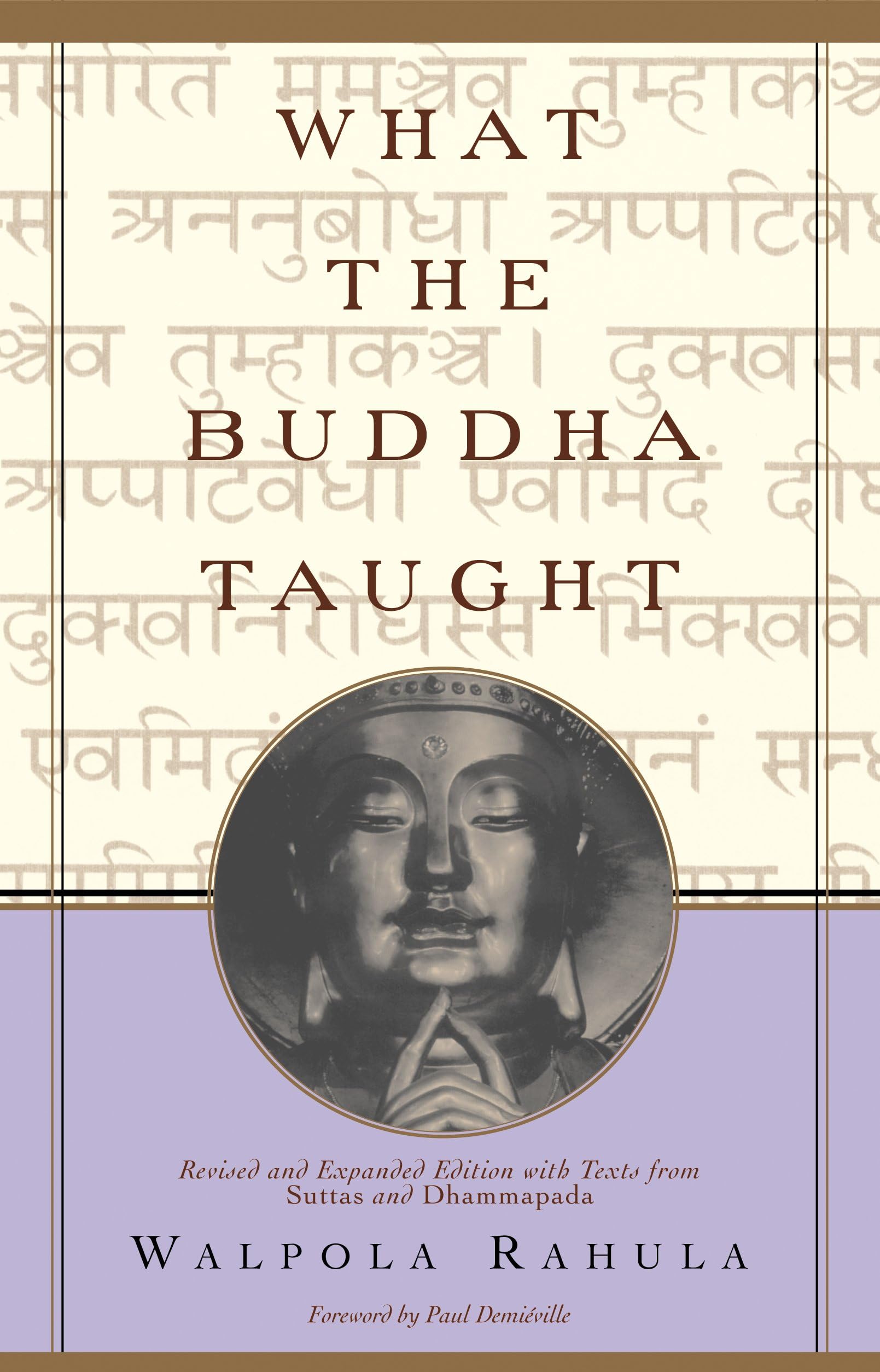
What the Buddha Taught: Revised and Expanded Edition with Texts from Suttas and Dhammapada
Product ID: 5473394
Desertcart purchases this item on your behalf and handles shipping, customs, and support to Belgium.
This comprehensive, compact, lucid, and faithful account of the Buddha’s teachings persistently enjoys great popularity in colleges, universities, and theological schools both here and abroad. “An exposition of Buddhism conceived in a resolutely modern spirit.”—from the Foreword. “For years,” says the Journal of the Buddhist Society, “the newcomer to Buddhism has lacked a simple and reliable introduction to the complexities of the subject. Dr. Rahula’s What the Buddha Taught fills the need as only could be done by one having a firm grasp of the vast material to be sifted. It is a model of what a book should be that is addressed first of all to ‘the educated and intelligent reader.’ Authoritative and clear, logical and sober, this study is as comprehensive as it is masterly.” A classic introductory book to Buddhism, What the Buddha Taught, contains a selection of illustrative texts from the original Pali texts, including the Suttas and the Dhammapada (specially translated by the author), sixteen illustrations, and a bibliography, glossary, and index. Review: Wholesome, insightful and inspiring: Highly recommended. - At the center of Buddhism lies practice. Of finding through our own experience our "light" (Buddha Nature) within. I keep reminding myself that, as I live in a Western culture, and we are stuck in our thinking caps. That said: As long as we practice, reflect and feel, I make sure I get daily doses of "Buddhist thought". This book is a wonderful option for that daily injection. What I particularly appreciate is (1) the description of Buddhism through original teachings, yet made very accessible without simplifying. Where words become confusing if translated, they are left as is - as one important example. Words tend to enable sloppy processing. (2) Stressing the uniqueness of true Buddha teachings: There is no guru, there is no authority. This is a path to find your own answers within yourself, and when you do, deeply, you'll see that there's where we all come together as one. Preaching from pulpits - in which ever form, relying on appearances and conventions in speech, dress, looks (and it all depends on which little group you happen to enter at any one time) tend to be more important than actually see compassion, reverence and protection of life, non-discrimination/non-judgment, is increasingly a growing problem in our world, and not just from one view. With our super connectedness and information tsunami gurus appear with strong and simplistic messaging, and the mob-rule of herd mentality means many of us stop being able to truly see who is getting harmed, as we're so convinced in us being right. Buddhism is the one teaching that asks you to stay focus on one thing: love, compassion (kaduna) and making sure you only agree what you yourself after careful pondering and reflections find to be 'true'. This book is a wonderful introduction, and reminder, of the very Heart of Buddhism. Highly recommended. Review: Immense, clear, beautifully stated, for all levels of understanding - "What The Buddha Taught" is a serious academic work taught by a master of the religion/philosophy— really breaks down Theravada Buddhism, including the more intellectually demanding theories such as the Doctrine of Non-Self (anatta) and what karma is and isn’t. Rahula also points out how very radical the Buddha’s ideas were in his time and place, especially his teachings on god/s and human soul/s (or lack thereof), as well as his astonishingly forward-thinking on how married couples should treat each other, how teachers should treat their students, and social castes should think of each other all as equals. There is a little bit of history here, describing the surrounding culture, that is very helpful. Rahula is also a linguist and translator and his explanations of how mis-translations in the past (sometimes hundreds of years old) have mis-represented and caused confusion about Buddhism, especially in the West, provide great clarity for concepts that are themselves deeply philosophical and yet immediately graspable. His explanation of the Four Noble Truths is like a cool drink of water. Highly recommended to all people, from students of religion to literally anyone who is curious about psychology, philosophy, the human condition, or simple seekers for the remedy to daily unhappiness.
| Best Sellers Rank | #10,540 in Books ( See Top 100 in Books ) #1 in Buddhist History (Books) #47 in Asian History (Books) |
| Customer Reviews | 4.6 out of 5 stars 2,113 Reviews |
O**Y
Wholesome, insightful and inspiring: Highly recommended.
At the center of Buddhism lies practice. Of finding through our own experience our "light" (Buddha Nature) within. I keep reminding myself that, as I live in a Western culture, and we are stuck in our thinking caps. That said: As long as we practice, reflect and feel, I make sure I get daily doses of "Buddhist thought". This book is a wonderful option for that daily injection. What I particularly appreciate is (1) the description of Buddhism through original teachings, yet made very accessible without simplifying. Where words become confusing if translated, they are left as is - as one important example. Words tend to enable sloppy processing. (2) Stressing the uniqueness of true Buddha teachings: There is no guru, there is no authority. This is a path to find your own answers within yourself, and when you do, deeply, you'll see that there's where we all come together as one. Preaching from pulpits - in which ever form, relying on appearances and conventions in speech, dress, looks (and it all depends on which little group you happen to enter at any one time) tend to be more important than actually see compassion, reverence and protection of life, non-discrimination/non-judgment, is increasingly a growing problem in our world, and not just from one view. With our super connectedness and information tsunami gurus appear with strong and simplistic messaging, and the mob-rule of herd mentality means many of us stop being able to truly see who is getting harmed, as we're so convinced in us being right. Buddhism is the one teaching that asks you to stay focus on one thing: love, compassion (kaduna) and making sure you only agree what you yourself after careful pondering and reflections find to be 'true'. This book is a wonderful introduction, and reminder, of the very Heart of Buddhism. Highly recommended.
J**T
Immense, clear, beautifully stated, for all levels of understanding
"What The Buddha Taught" is a serious academic work taught by a master of the religion/philosophy— really breaks down Theravada Buddhism, including the more intellectually demanding theories such as the Doctrine of Non-Self (anatta) and what karma is and isn’t. Rahula also points out how very radical the Buddha’s ideas were in his time and place, especially his teachings on god/s and human soul/s (or lack thereof), as well as his astonishingly forward-thinking on how married couples should treat each other, how teachers should treat their students, and social castes should think of each other all as equals. There is a little bit of history here, describing the surrounding culture, that is very helpful. Rahula is also a linguist and translator and his explanations of how mis-translations in the past (sometimes hundreds of years old) have mis-represented and caused confusion about Buddhism, especially in the West, provide great clarity for concepts that are themselves deeply philosophical and yet immediately graspable. His explanation of the Four Noble Truths is like a cool drink of water. Highly recommended to all people, from students of religion to literally anyone who is curious about psychology, philosophy, the human condition, or simple seekers for the remedy to daily unhappiness.
A**R
Good, but... Too Good?
This is a very good description of the Buddha's teachings, but it left me wondering if this was an ancient religion that would not accept what has been learned from the realities of science and the "new" world. He paints a clear picture of the development and growth of Buddhism and separates the differences between sects very well. At the same time, he makes it very clear that there are some questions, the answers to which some may not want to hear from the Buddha's point of view. And to compond the issue he leaves it somewhat unclear what is finally meant in the teachings. One obvious example is the choice of whether we have a self that last after the body dies. There are some very clear points made that the Buddha did not recognize the existnace of this self and also an excellent description (with an analogy to fire) of why this self could not exist. Yet at the end of the book he talks again about the circle of life (Samsarra) and the fact that we come back again and again until we reach a pure and true state of being. I was left wondering what the constant was in these cycles. All in all, this is a very good read and a great look into the Buddha's teaching from the heart of one who lives them today. But for the layman, this may serve to make you look elsewhere for the road to eternal peace.
X**X
The best introduction to Buddhism!
This book came reccommended to me by someone who, in addition to being a Buddhist and Kung Fu practicioner for many years, also graduated from an East Asian Studies program, with a focus in this field. To say that I would trust his word on the subject is an understatement. Anyway, he was 100% right. Going into it, I knew next to nothing of Buddhism, other than the bastardized teachings in my High School's week long session on "World Religions" (which basically outlined Christianity, Judaism, and Islam, then spent a few seconds on Hindu and Buddhism (as if they're the same?) They also presented to me great misinformation on the topic, and almost seemed to be presenting the philosophy in Christianized terms (using words such as "salvation" and "afterlife.") So, I sought out this book to learn the real ways of The Buddha. And what I found was great. The writing is superb, the author gives constant reference and notes to different Buddhist texts (in 2 original languages, to then construct an appropriate English translation), and analyzes them in accordance with the traditions and teachings of The Buddha. The layout is neat and efficient, and presents material in a very simple and cumulative manner. The book is also short enough that it creates an excellent digestable "first bite" of Buddhism. This is not to say, however, that it is in any way sparse, as it is quite thorough and I intend to read it several times over to truly let all of the fascinating information sink in. If you have skimmed the surface as I had, this is the best way to get yoruself started and knowledgable on the topic. If you *think* you know something about Buddhism, this is going to be the best way to clarify everything for you. Heck, I bet even someone who outright calls themselves a Buddhist would find some very valuable lessons and analyses in this book. Five stars all the way.
C**E
Great for those familiar with buddhism but want to know more
Upon first starting to read this book, I was a little intimidated. I was worried the material inside would be out of my grasp, seeing as I had very little insight into buddhism. But rest assured, if you know enough about true buddhism to be interesting in learning more, this is the book for you. The author breaks original scripts down in a way that is understandable, while not watering it down nor being condescending to the reader. It brought up questions I already had about the teachings, and slowly filled me in with the answers I was seeking. The author also wrote the book in such a way that more introductory readers can read the chapters in a different order (outlined in the foreword) and not get lost, while slowly gathering the knowledge you need to understand the earlier chapters. Highly highly recommend for anyone who has a fundamental understanding of buddhism and seeks to understand more. 11/10
K**S
Excellent book
Came highly recommended ,awesome book and I also highly recommend this book
R**F
Excellent overview of Buddhism; perhaps not for true beginners
This is a wonderful and fairly thorough summary of the main points of Buddhism, with deeply insightful explanations and an intelligent presentation. I will say, I’ve been reading on Buddhism heavily, attending sangha, and meditating for some seven or eight years, and I’d have found this text impenetrable without that foundation. The language and concepts are challenging. So…perhaps it should not be thought of as an introduction, per se, but rather as a reiteration or a clarification. As others have mentioned, the Kindle version struggles with diacritical marks and hence displays gaps in certain words. If you feel this will bother you, opt for the print version. For me, the benefits of hyperlinks outweigh the minor publishing flaws.
C**O
helpful and appreciated
A lot of books will interpret the lessons of Buddhism which is understandable and maybe briefly actually reference the writings. That is very good too but this had more of a focus on the writings. Which again isn’t really the focus, the lessons are, but it’s nice to see translations of the lessons. Over all good read, easy to digest and informative.
S**S
Poor print quality
Book came in bad print quality and it’s hard to make out words because most letters are missing ink in them. This is even worse for smaller and italic letters and sanskrit words, as they are all in bold italic. If this problem was just here and there, it would be alright, but it’s literally occurring in every one or two words. I can’t say anything about the contents of the book because the print quality is almost unreadable.
A**H
Great summary on Buddhism and Buddha teachings
Great book, which covers all the core concepts of what the Buddha actually taught, rather then to religiony its more straightforward.
S**A
Must Read If You want to End Your Suffering Knowing What Buddha Really Taught.
Excellent Book. Eye opener for me to the wonderful teachings of Buddha. I can't explain how grateful I am that Buddha has appeared in my life. The way I look at my life has Completely Changed.. Now that there is no suffering ...Knowing Noble Truth of Buddha and Eight fold Path. Wonderfully explained. I have repeatedly read this book.
V**S
Muito bom
Excelente
G**I
A great source to learn the basics of the Lord Buddha and his teachings
A great book to learn the basics about the Lord Buddha and his philosophical teachings
Trustpilot
2 weeks ago
4 days ago