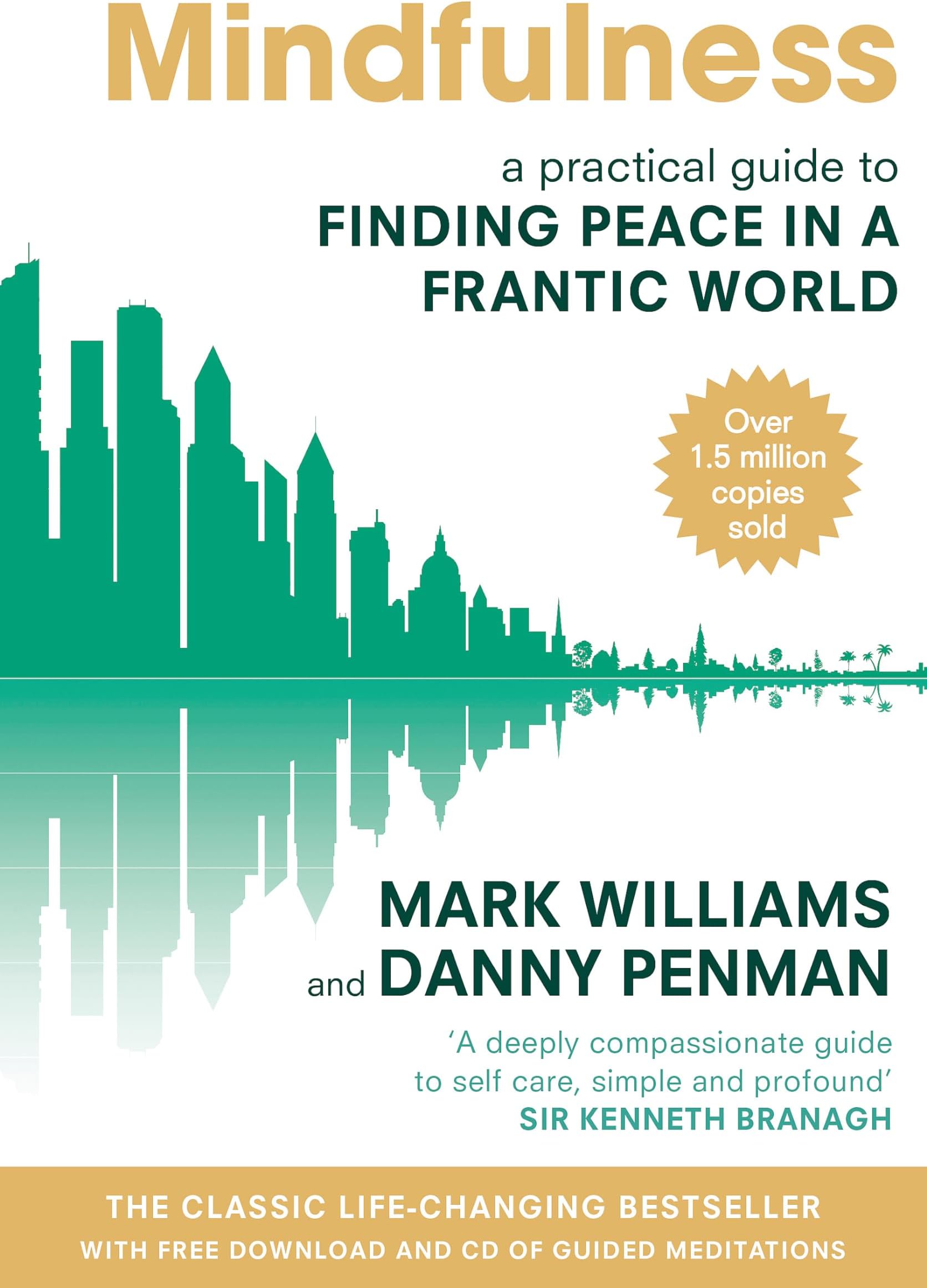
Mindfulness: A Practical Guide to Finding Peace in a Frantic World
Desertcart purchases this item on your behalf and handles shipping, customs, and support to Belgium.
Description
🧠 Unlock calm in chaos — your 8-minute daily mental upgrade!
- HOLISTIC MENTAL RESET - Breaks anxiety & stress cycles with practical, sustainable tools for lasting peace and resilience.
- TIME SMART MINDFULNESS - Daily 8-minute practices fit seamlessly into busy professional lives—no lengthy sessions required.
- PROVEN GLOBAL BESTSELLER - Over 1.5 million copies sold worldwide, transforming lives with a 4.6-star rating from 8,000+ readers.
- ACCESSIBLE COMPASSIONATE - Clear, jargon-free writing that demystifies mindfulness without religious overtones.
- SCIENTIFICALLY BACKED TRUSTED - Co-developed with Oxford prof, endorsed by UK health authorities for depression prevention.
Mindfulness: A Practical Guide to Finding Peace in a Frantic World is a globally acclaimed bestseller with over 1.5 million copies sold. Developed alongside Oxford University experts and recommended by UK health authorities, it offers an 8-week structured mindfulness-based cognitive therapy course. Designed for busy professionals, it features short guided meditations under 10 minutes that effectively reduce anxiety, stress, and depression symptoms. Praised for its accessible, non-religious approach, this book empowers readers to regain control of their mental wellbeing with sustainable daily practices.

Specifications
| Dimensions | 15.8 x 2.1 x 23.3 cm |
| Edition | 1st |
| Isbn 10 | 074995308X |
| Isbn 13 | 978-0749953089 |
| Item Weight | 368 g |
| Language | English |
| Print Length | 288 pages |
| Publication Date | 5 May 2011 |
| Publisher | Piatkus |
Reviews
User
life changing potential
Amazing.. if you are wondering if it is worth the money hesitate no longer, I wish I had discovered it years ago. It's full of sense, written in a way you can read without feeling you are being lectured to,the writing is warm empathic and compassionate which rubs off, I started to feel a bit nicer towards myself just by reading it! The strategies are do-able, there isn't any reason why anyone who wants to couldn't take a 'mindful walk' ...what's three minutes of your life, just to see if it is different...?..and goodness me.. I am noticing things I've not noticed for years, if ever, on regular walks, sparking my interest, and I'm not now trying to do it, I'm just doing it. It adds a new perspective..so walking the dogs becomes something I enjoy rather than something else to tick off the list whilst I'm thinking what else I have to do to tick off the list. This book made me realise I had missed off my list 'enjoy life before I am dead'!, that before I was so busy getting through a list of things to do I wasn't experiencing anything in the moment, I was always a step or two ahead anticipating but then not experiencing something else. Pointless! The meditation cd (I bought the kindle version and the cd was sent in two days..very impressive) is great, I'm not a big fan of the birds singing,waves, green leafy woods type of relaxations because I'm awkward and tend not to want to be where I'm 'supposed' to be, and trying to breath differently to how I am breathing also makes me dig in my heels..so just following my breath works.. and strangely though the intention was not to breath deeply I did find I started to.. so twice a day I find a bit of peace, all of my own..and when life gets hectic I can find it again.. it's fabulous! It's got a small number of practical do-able strategies that seem like nothing much but somehow change your perspective on the world and yourself in it and with it your mood (for the better). I've only followed the programme for a couple of weeks so far but even from the first week began to notice changes I hadn't consciously made but which were enhancing my life and pleasure in it. I feel much better, but..and here's the strange bit I didn't feel 'not better' before (bought it to help someone else!!) so in a way it proved the point that we simply fail to notice what is going on around us and in us and thereby miss out on so much of what could enhance our daily living. I particularly like the ideas of ceasing to judge things but instead to 'notice', thus a mindful walk in the wind isn't filling my mind with 'oh this wind is so cold and awful' chants but I notice that it actually an interesting sensation to be in the wind...it tickles..! And letting go of judging myself has had other benefits, an issue I'd been trying to resolve for years and had given up trying to resolve it seems to have..er...resolved!! I am amazed. And shocked.. because I realise how out of touch with my body I am, trying to 'feel my feet' was a hoot.. I had to look to check they were still on the end of my ankles because I literally could not feel them, if anyone had said to me that I wouldn't be able to feel my feet I'd have laughed ..but now I can. And what do I notice..well mainly that things, sensations come and go, so I don't have to worry about that headache because if I just notice my head is hurting I remind myself it is a coming and going of a busy body and move on.. mostly it goes. I think if you are feeling extremely depressed you are going to find it hard to do even the smallest of strategies..but in fairness the book isn't aimed at someone in that category...yet if you could just manage it, or even some of it you might begin to open up a chink of light in that dark world. In my opinion if you are anxious it would be a godsend. I have bought a few mindfulness books but this one, for me, strikes the right note, and I convey huge thanks to Prof Williams.
User
Simple and effective techniques to fight depression
I've suffered from depression most of my adult life and in that time have been fighting it on numerous fronts: Antidepressants, exercise, dietary changes, CBT and of course enough self help books to start a small shop on the subject. But all of these have only helped with some of the symptoms, none have really cured my depression and none have gone to the heart of it and shown me WHY I am depressed.I had read in numerous places that meditation was considered beneficial and a particular branch of this, "mindfulness", even more so. But my first experiences with this subject were not good. Having bought the Dummies guide initially, it certainly had many "Aha!" moments but no structure and like most self help books soon went back on the shelf and out of memory. Then I tried a guided meditation CD which whilst considered one of the best in the field it was just too long - I can manage to stay awake for maybe 10 minutes at most when relaxing in this manner and I dare say anyone else on medication for depression would be the same. So that became a useful tool to help me sleep but nothing else.This book was different. I'll be blunt, I nearly didn't buy it, having become jaded with the whole self-help philosophy but the good reviews and above all the ridiculously low price made this worth the risk. What this book does is give a formal structure - an 8 week course - to the whole idea of mindfulness, plus it gets you going with some very sensible length guided meditations on the CD. With most of these well under 10 minutes, the chances of nodding off are greatly diminished and the typical objections such as "I don't have time" are overcome. And let's be frank about this, if you're suffering from depression and feeling low, you CAN justify 10 minutes a day to try and fight it.But talk about one huge red herring! Like many, I thought meditation was sitting cross-legged and staring into space. Whilst to an outsider this might appear to be what you are doing for some of this course (well apart from the cross-legged bit, you can sit or lie however you like) what's actually happening inside your head is remarkable. For more information on this you need to be careful to look up psychological mindfulness rather than the religious one, since there is virtually no reference to any religion in this course; this is not a course about Buddhism or any practice designed to enlighten you or take you to God.What this is all about is giving you the tools to gently, carefully, see how your entire thought processes work. To use an analogy, imagine you have been living in a City all your life and this book takes you for a walk up a nearby hill, letting you look back on the scene and giving you a view you never had before. And it's as easy as going for a walk - just practice the mindfulness exercises in the book and on the CD - then things click. Yes, you may feel silly to start with (I did), yes you might think you're rubbish at meditating (I am), yes some of the exercises do elicit a feeling of "What's the point?" but stick with it, slowly but surely you are changing the way you look at life and more importantly, starting to detach yourself from the self-destructive thought processes which contribute to or even, as in my case, actually seed your depression.How can something so gentle work so well? Everyone has their own view on this. Personally, I think the main power of this type of course is that YOU have to do the work. Yes, you really do need to do this every day and that won't suit everyone. But when you do, what you discover is self-discovered, you learn and heal by direct experience of something tangible, rather than blindly believing or accepting something you're told (which is the premise of many self help books, especially ones promising quick fixes).The irony about this book is this: The worse you think you are at meditating the better mindfulness is! Because the other red herring is the whole foundation of mindfulness (coming into the present and freeing yourself from the shackles of the past and the worry of the future) is built on seeing what's going wrong in our heads, where our thought processes get screwed up. And how do we discover this? By failing at meditation and then gently and compassionately thinking "Ah, I can see I've wandered off track" - and repeating this over and over, seeing first and then understanding later how this process works. How the mind and our thoughts work and take us away from the moment we live in - this moment. How our whole life is a train of thoughts that just keep coming but one which we can learn to control. It's about switching off the autopilot.So does it work? For me, yes. This is the first treatment in my whole adult life (I'm 40 now) which unlocked the root causes of my illness. It happened one morning in the shower actually just three days into this course. I was starting to run over some event that happened many years ago, reshaping it into something that might happen in the future, getting very negative about the whole thing, my mind running on and on. I remembered one of the exercises in the first week, to do something mindful as it teaches you to do. Then I saw it - I saw my depressive, negative thoughts from the outside. For the first time, I was no longer IN my thoughts, being that depressive and anxious person, I was seeing the whole process from the outside. From then, over the 8 weeks, this idea and concept was refined and re-enforced.The book actually went further than this, but I am reluctant to waffle on too much about my experiences because it will sound too good to be true! Let's just say I have never been happier and my whole life experience has become the opposite of depression - I have been given new eyes. I should point out that I do this course now on a rolling basis, having first started seven months ago. I wanted to wait this long before reviewing since I still retained some concern it might be a temporary fix, but it does seem to have rewired many faulty parts of my life on a permanent basis.The only thing this book lacks is any help or guidance on interacting with the same people who only knew you as a depressed person. You may experience a growing gulf between yourself and those around you when you become aware of what's underneath and start to unlock the good things there. Trying to explain this all to friends and family - which you'll want to, you'll be excited - is hard work because the tangible results and feelings you get are difficult to explain in lay terms (you have to experience it to understand it). You may also find that other people cannot explain the fact you do actually smile a lot more - you're so happy - they can become defensive and please don't let this burst your bubble. Just remember: This is all about YOU.It has also opened many doors to areas I was previously a skeptic to, notably spirituality and the concept of us (as in the "I", the person or soul inside) being separate from our thoughts which I personally believe is the key to getting a grip on depressive illness.For anyone else interested after you have tried this course there are a couple of recommendations for further reading from Amazon. The first is "Untethered Soul" by Michael Singer. This approaches core concepts of mindfulness from a non-meditation perspective. If meditation is the gentle and flowing guide, then Untethered Soul is the street-fighter which will club you over the head; it pulls no punches and therefore is good as further reading once you have a grounding in the basics. I found a combination of the tools from Mindful Meditation and Untethered Soul quite a potent mix in some challenging life events. "Mindfulness for Dummies" is a useful follow up book (by Shamash Alidina), mostly because of the reworking of the same ideas in different ways and the CD providing more guided meditation, though I cannot recommend it as a starting point to this journey because of its lack of good structure, only as a useful way of continuing your progress.Finally, if you get hooked on the meditation side then by far the best book to explore this that I have found is "Buddhist Meditation" by Kamalashila. Obviously the slant on meditation here is a religious one (but in a nice and non-intrusive way) however this book has some very practical tools and guides to help you meditate without a guided CD, this is the start of yet another journey.
User
Straightforward, clear and useful
I purchased this book as required reading for a Mindfulness course, so will rate the book as a textbook. It's clearly written, and does what it sets out to do, walks the reader through the course. The style is easily readable, understood, and applicable. We read a chapter each week in advance of that teaching/practice session. The meditations are well described.The book comes with a free CD which guides the reader through the meditations. I found that this CD didn't play on all the players in our house (we have 3 and it didn't like the one which comes with the digital radio): but you can solve this one with using your computer and iTunes.I would rate this book highly for anyone who wants to learn about Mindfulness and what it is, how it can help us order our lives and become more relaxed and effective human beings, and I would say that it might well be possible with self-discipline and application to use it without a course. Although working together in a group is what most people would gain from.
User
Fantastic book - genuinely helpful; probably the best self-help book or practice I've experienced!
Fantastic book - genuinely helpful; probably the best self-help book or practice I've experienced!Like other reviewers on here, I've struggled with anxiety and depression and experienced quite a few different talking therapies and read a library full of self-help books with mixed success/ benefit. I was recommended Mindfulness by my doctor; I tried it for a few weeks and didn't really get into it. It wasn't really explained very well to me and I didn't really understand what it was about or how it would help, so I didn't give it the attention it deserves. However, I came across this book online again and after reading the reviews and a couple of extracts from the book, decided to give it a try again. I'm so glad I did!I think the book is really well written - I didn't find it preachy or cheesy, trying to hype itself up like other self-help books I've read. I found it easy to read, credible (it backs it's points up with references to studies) and written with compassion and understand that really came across for me. I had a perception of what meditation was and quickly realised that I was wrong (well, for this type of meditation at least). I'm sure that like many others, I thought meditation was going to be about trying to clear and keeping clear your mind of thoughts and trying to relax; the book explained (and I quickly realised through the practices) that it's not. That was a relief to be honest, because my mind rarely switches off. It took me a while to get my head around the idea of 'the aim of the practice is just to do it' rather some trying to reach a state of relaxation or clear mind or whatever. I was definitely skeptical about this, but the proof is in the pudding and from doing the practices every day, I started feeling the benefits within the first two weeks. And it's worth noting some of the practices were not relaxing at all for me (at least initially). I really struggled with some of them, for example, I was unable to complete the 8mins body and breathing sitting practice for the first 3 out of 7 days. But I stuck at it and now it's one of my favourite practices because I get a lot out of it.I think the 8 week course is excellent - it introduces Mindfulness meditation in small and simple practices that gradually develop as you work your way through the book. Finding 8 mins per day to do a Mindfulness exercise was very easy, and as the course progressed I found myself continuing practices from earlier weeks that it doesn't require or suggest you need to, simply because I felt the benefits of doing them and wanted to keep it up. I look forward each week to what will be introduced the next week, but don't want to stop the week I've just completed.The paperback book comes with a CD included and the recordings are good and the man on the CD has a nice voice, easy to listen to. I like the variety of exercises, practices and the 'habit releasers' it introduces; I found they help introduce Mindfulness into your life in a sustainable and well rounded way. I never found it too much or like I had to change my life significantly to introduce or maintain the practices. I found it easy to introduce them into my schedule. The most important thing with any kind of self-help practice, is that it is sustainable and you can maintain the benefits in the future; although I'm only at week 7 of the course, I'm confident that this is something I will continue for a long time to come.I can't recommend this book enough. It's accessible, easy to read and really works. If you struggle with low mood, anxiety, depression, stress, pain or CFS/ ME symptoms, Mindfulness can really help you. It's been a huge help for me and a hope it will be the same for you too! Enjoy!
User
life changing without myths and nonsense... just simple basic practices
I was referred this book from my therapist after suffering as spout of anxiety and depression. It is not a book that will fix your problems and by no means is a replacement for therapy however this book when used correctly will give you a practical, real and hands on tool to use in life not to destroy your fears and anxieties but to turn towards your fears with openness and kindness and help you stay in the moment and see your fears for what they are, simply thoughts. It poses no mythical and special places to get to with no promise of eternal happiness. Just basic practical tools in a structured format to use daily to build and strengthen the quieter, kinder voice inside that we very often ignore. to begin with finding peace is fleeting but even just one fleeting moment is enough for you to stick out. You dont have to suffer from mental illness which is such a taboo term and subject in our country sadly to benefit from this book, All people can find this book helpful to improve our peace in life, To help us get to grips with our world truly without only fixing on deadlines, meetings, family members,bills etc. If your reading this and feel your suffering please dont suffer in silence, go and seek out help, your life is not ruined, it can be better and you can find joy again but its not something you will "fix", it doesnt work like that. Your not alone and your by no means a failure. With help and only with your hard work to want to get better will you find the peace and happiness you feel you want. Mindfulness is now apart of my life forever but I would never of been able to get to where I am today without therapy and actively seeking not just wanting to get better."constant dripping hollows out a stone" - Lecretius
User
Anxiety is not a weakness!!
Lets be clear, there is and will never be a 'cure' for Anxiety or Depression. One of my favourite saying's has always been that "Depression, Anxiety and panic attacks are not a sign of weakness. They are signs of having tried to remain strong for so long." This is so true.Having suffered with Anxiety for the majority of my life, along with being told from therapy that there is nothing they can do as I can 'see myself from outside the box' too well, that I've been reliant on trying to deal with things myself without medication.I was dubious about the amount of positive reviews of this book but I can now understand why. Mindfulness is still a relatively new therapy based on making you aware of why and how you feel the way you do.I strongly advise anyone who purchases to not just read the book cover to cover and to do the 8 week program in full. One of the main 'lightbulb' moments for me was making me realise that in the frantic world we live in we no longer appreciate the things we used to. For me, the first time I drove my own car I was so happy, appreciated everything, so what made me not appreciate it any longer? Mindfulness highlights how we think and for me at least, when things get too much I can now put things into perspective a lot quicker than I used to.As a new reviewer on Amazon if you felt my review helpful or not, please can you rate accordingly.
User
Meditation book
I can't rate it highly as the contents font sufficiently interest me. However, it was good quality book with extras and for people who can follow using this technique through reading will probably love it to be fair.
User
An incredible resource for depression & anxiety ..
This is the first review I've ever submitted on a book & I had to do it because I've found this to be an invaluable book/CD in helping my depression & accompanying anxiety symptoms & I want others to consider trying it because there's a great chance of it helping them. I've always been skeptical of books which are labelled 'the life changing bestseller', but in this case I believe it's true.I found this book by chance and started the 8 week programme. Within 2 weeks I started to notice subtle improvements, I'm now finishing week 5 and I am full of optimism & far less anxious (the anxiety was totally controlling me before this). The positive changes have crept up in a subtle way & it's incredible how such simple mindfulness techniques can produce such dramatic change & the programme isn't overly demanding at all.One message I have to get across to anyone with depression considering buying the book & CD is this - having experienced the symptoms of hopelessness, lack of motivation, low self esteem etc myself I know that you may be in a place where you may feel no/little interest in embarking on any self -help programme but PLEASE take the step & try it anyway, you won't feel suddenly better (you may not even enjoy it at first) but positive subtle changes, however small, will likely come in a relatively short space of time. This book is ideal if poor concentration is a feature of your depression/anxiety as the authors have written it in a straightforward, easily understood style, the meditations are short. One of the most valuable lessons I've learned so far from this book is that self-critical thoughts fuel the depression/anxiety cycle....the book gives you the tools to deal with this. I also think that this programme has huge potential to help prevent further recurrences if mindfulness exercises continue to be incorporated into daily life long term.Clearly, this review is based on my experience but clinical research & other reviews strongly evidence it's effectiveness. The linked Oxford University mindfulness website & www.franticworld website are also useful.
User
Un buon riferimento per iniziare
Gli esercizi proposti sono utili per iniziare a praticare la Mindfulness. I capitoli introduttivi fanno capire bene il contesto.
User
Very helpful book for avoiding depression relapse
A really excellent book which I found very helpful for finding strategies for avoiding relapse of depression and anxiety. It is very well written with lots of highly relevant and interesting examples. I am convinced that mindfulness is the solution!
User
If you are stressed (and who isn't nowadays), you need to read this book!
Initial Review 12/14/2010:Let me begin by saying that I have always been a huge skeptic about mindfullness, meditation, and anything else along those lines. That is until I began seeing all of the new scientific research on the subject and the new theory of brain plasticity...how people can literally change their brains no matter how old they are. This research was enough to convince me to give mindful meditation a try. Staying with the theme of the science of meditation, I chose The Frantic World book because the program was created by a team of phD scholars from respected universities, such as Oxford, Cambridge, UMass, etc. Interestingly, the main author of this book, Mark Williams, was a skeptic when he started researching the subject as well. Not any more.I am currently on week eight of the plan and I can tell you that I absolutely have noticed a difference. Not only do I feel calmer in situations that used to bother me the past physically, but I am also learning how to treat myself with more compassion, get out of autopilot and break many of my bad habits, and how to face my fears head on rather than avoiding them and actually making things worse. I have gone from a complete skeptic to someone who plans to continue to practice mindfulness for the rest of my life.I'm not going to sugarcoat things and say that it's easy to find the time to meditate. It's not. One has to work hard to make sure that they find the half hour or so per day that they need to dedicate to the practice. That's not easy with work, kids, and life in general. I promise you though that it's definitely worth the time that you put in. I've never written a product review about anything on Amazon or any other site for that matter before. I am writing this review in the hopes that others out there who are struggling with stress, anxiety, etc read it and give mindfulness shot. Incorporating it into my daily life passively as well as actively meditating for short periods of the day has helped me tremendously.Update 1/17/12:Let's see if I can update my review using the comments section. Bear with me because I've never tried to do this before. I completed the entire Frantic World course several weeks ago. I definitely believe that it was beneficial. Do I still get stressed out from time to time? Of course. The idea behind mindfulness is not to make one live in some unrealistic, nirvana-like world...thought that would be nice :). To me it seems as though the goal of mindfulness is to help people deal with life's inevitably stressful situations more easily and quickly than they would have in the past. I think that incidents which would have dragged me down into a huge stressed-out mess for a prolonged period of time a year or so ago no longer seem to have the power to do so.I am still continuing to do the mindfulness practices that were outlined in the book, particularly meditations four and seven. The first being a more general meditation using breathing and sensing the body and the second directed towards self-compassion or as the book calls it "befriending." Those two are my favorite, though from time to time I do practice meditation one and two, which are essentially body scans.I plan to continue meditating. Though I rarely meditate for more than 20 to 30 minutes per day, I have not missed a single day since I started the practice. I believe that every little bit helps. It takes a long time to master any skill. Let's say that one meditated for 20 minutes every day for the entire eight week program. That seems like a long time right? Well, in reality one who has diligently done this meditation has actually only meditated for a total less than twenty hours. When one considers the popular modern-day theory that it takes 10,000 hours to truly be an expert at something, it looks like there is a long way to go. So what's my point in all of this rambling? I guess that my point is that mindfulness' benefits seem to accumulate over time. One will definitely benefit from taking the eight week Frantic World course, but don't just expect to do it for eight weeks and poof be magically stress free from then on. I'm sure that people who do this will experience some benefit, but I think that mindfulness is more of a life-long pursuit. The more one does it, the more benefit they will receive. Am I right? Who knows? I'm certainly not a psychologist or neuro-biologist. I'm just a normal family man who has read a lot on the subject of mindfulness over the past several months.Speaking about reading, here's a list of a couple of other books that I have found helpful in this process. They more emphasize the practice of mindfulness in every day life, rather than purposeful meditation. Hopefully anyone who is reading this will find them helpful as well:Just One Thing: Developing A Buddha Brain One Simple Practice at a Time - Rick HansonHow to Train a Wild Elephant: And Other Adventures in Mindfulness - Jan Chozen BaysWell, that's all for now. Perhaps I'll check back with another update and some more book suggestions some other time.Update 2/7/12:I have found that the new research on Positive Psychology meshes very well with mindfulness practices. I have been practicing and reading about both on a regular basis. Here's a list of the best books that I have found on the subject for anyone who's interested:Authentic Happiness: Using the New Positive Psychology to Realize Your Potential for Lasting Fulfillment by Martin E. P. Seligman - Dr. Seligman is basically the founder of the Positive Psychology movement. He established the school on the subject at U Penn. While older, Authentic Happiness seems better than his newer book on the eubject because it cnotains more practical advice on how to incorporate positive psychology into your life, such as practicing forgiveness, gratitude, flow, etc...Buddha's Brain: The Practical Neuroscience of Happiness, Love, and Wisdom by Rick Hanson - Dr. Hanson is another well known advocate of mindfulness, though his version of the meditations and his books seem to oncorporate many elements of Positive Psychology as well. It's a nice blend of the two. Not just some random person off of the street, Hanson's work delves deep into the science of the mind. He is the founder of the Greater Good Science Center at UC Berkeley and has taught at Oxford, Stanford, and Harvard.3/13/2012:Make sure to check out the new book by Richard Davidson, The Emotional Life of Your Brain: How Its Unique Patterns Affect the Way You Think, Feel, and Live--and How You Can Change Them . It's absolutely amazing.Update 5/31/2012Wow it's been awhile since my last update. I hope that everyone is doing well. I know that I am. I recently has an amazing revelation that I had to share with others who are in a similar situation to the one that I found myself in last year. I used to feel sorry for myself that I went through a period of significant depression and anxiety. Thinking why me? I now have come to realize that those few short months that I felt a little off were one of the best things that has ever happened to me in my life. Hitting bottom actually enabled me to push off and soar to the top. I honestly feel as though I am a better person today than I was before I went through that whole ordeal. I consider myself to be a reasonably smart individual and this enabled me to do the research that was necessary to not only break the cycle of negativity that I was stuck in, but to actually come out the other side a better, stronger, happier, healthier, more spiritual person than I have ever been in my life. I always considered myself to be a relatively happy individual, but I am now realizing just how unhealthy how some of the habits that I had in the past, like holding grudges, believing in jinxes, etc... really were. Not only was I able to become a better person, but even better I can now pass this gift onto everyone in my family...and elsewhere for that matter. I can now build a solid foundation of positivity and confidence for my children that I'm not sure I would have been able to give them in the past. Again, I have always considered myself to be a good father, but kids pick up on it when you're not feeling great, when you hold a grudge, when you say something negative...I think that I can provide them with the gift of positivity at one of the important times for the development of their minds. A gift that they can hopefully pass onto future generations.I never try to force religion upon anyone, but I have been absolutely amazed by the significant links between modern psychology, particularly positive psychology and even mindfulness, and many forms of religion. I'm not sure if psychologists are borrowing from religion, if preachers are borrowing from modern psychology or if they both independently arrived at the same conclusions but the links are definitely there. If you are a religions person and you haven't ever listened to him, I suggest that you check out some of the works by Joel Osteen, especially his book "Every Day is a Friday" and some of his sermons that are available on iTunes such as "Good, Better, Blessed" and "Living in Favor Abundance and Joy." These are some of the most uplifting things that I have ever listened to. Joel Osteen is one of the most dynamic, charismatic speakers of our time. I'm sure that there are people who reject religion in general or Osteen in particular. I know that I certainly never thought that I would listen to a televangelist regularly, but trust me Joel Osteen and his uplifting message are a gift from God that everyone should listen to. I'm not trying to push my views on anyone, again I'm just here to try to help others by suggesting things that have worked for me. I hope that anyone who is reading this who feels that they need a little help because they are anxious, depressed or just thinks that they could be a little more positive or relaxed in life finds it helpful.Update 4/30/2013:Hi everyone. I was on Amazon today looking for books on positive psychology and I noticed all of the wonderful comments that many people have made. Thank you so much for the kind words. My intention in writing this review was to try to help others improve their lives like I have been able to do through making changes, many of which were inspired by Mark William's brilliant work on the subject of Mindfulness.So, how have things been going? To sum them up in one word...Amazing. The changes that I started making in my life two and a half years ago have literally made these the best years that I have ever had. I like to think that one's mindset is sort of like a huge ship. Once the ship of emotions sets off in a negative direction, it's slow-going and it requires effort to turn it around, but it can be done. When you do get it pointed in the right direction the inertia works just as well that way. Positivity, faith, mindfulness all become easier and more natural with practice over time as the structure of the brain changes. It takes just as much energy to be positive and expect something good to happen as it does to be negative ane expect something bad, but the former is a whole lot more fun and healthy than the latter.Here's a few random thoughts on what I have learned throughout this process:1. Don't label yourself as having this or having that, being a positive person or a negative person, or being prone to this phobia or that condition. We're all people and we all have emotions. The people that you see walking down the street have the same feelings that you and I have. There's nothing wrong with you if you feel sad or anxious or whatever from time to time. Everyone does. As much as some people would like you to think that they're immune to feelings such as fear, etc...they're not.2. The key is not to avoid having negative emotions, it's to not let them spiral out of control. Recognize that a thought is just a thought. It can't hurt you. It's nothing more than a cloud passing through the sky of the mind. Trying to avoid anything just makes it worse. While it sounds funny, you have to face your fears in order to master them. Mindfulness has helped me tremendously with this one.3. Always try to have as many positive thoughts as possible and to look at things in the most favorable light. I have tons of digital picture frames in my office and at home that constantly scroll (I had to change it to every 1/2 hour because every minute was becoming very distracting and not very mindful ;) ) pictures of happy times in my life. I also use the notepad in my phone to write down a couple of positive things that happened to me that day or recently when I have the time at work, such as a short break. The more you reinforce the positive, the more a part of your mindset it will become. Scientists have proven that neuroplasticity exists and that what you expose yourself to literally changes the physical structure of your brain.4. I personally have found faith and religion to be very helpful in my life.5. While I don't bury my head in the sand, I have significantly cut back on the news that I watch on television and read on the Internet. Why? The world is filled with millions and millions of people. The news will take the two or three people who have dome something wrong and rub them in your face for hours at a time. The people who commit crimes, etc. represent less than one percent of the population but if you constantly think about the news you'll believe that it's everyone. No thanks. I'm looking for the good in people and you know something, if you walk around with a smile and a positive attitude, looking to help people and thinking the best I've found that you call in the best. I meet more nice people today whan I ever did when I was looking for the worst in everyone.HA, I just read Amazon's review guidelines..."Reviews must contain at least 20 words..." I've got that one covered. Well, that's all the time I have for now, but I wanted to provide an update for anyone who's interested. On a related note to steer things back towards the product, I corresponded with Dr. Williams via e-mail to thank him for all that his work has done for me and he told me that he is almost finished with a new workbook on the subject. I definitely plan on reading it when it's available.Take Care everyone!Jason
User
El libro que todos deberían tener!
Un libro muy bien escrito que ayuda a traer paz a la mente. A mi me resulto perfecto ya que soy una persona muy mentalmente activa.Te enseña técnicas de como controlar tus pensamientos y no dejar que ellos controlen tu vida para el malo.Todo a travez de practicas de meditaciones que se pueden escuchar desde tu movil por internet.Lo que mas me gusta es que no se trata de un libro "espiritual" como casi todos que hablan de meditación, sino abordan la meditacion como una tecnica fiable, basada en estudios psicológicos y te explican como actua en tu mente.
User
Totally recommended
Love this book and the program.I have been doing Body Scan meditation for a long time now and it helped me through very anxious moments, yet program and the book has much more to offer
Common Questions
Trustpilot