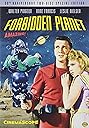
Forbidden Planet: 50th Anniversary Edition (Dbl DVD) (Multi-Title)
Product ID: 4769518
Details
- GenreClassics &
- FormatColor Dolby
- ContributorFred Wilcox
- Initial release date2006-11-14
- LanguageEnglish French
Desertcart purchases this item on your behalf and handles shipping, customs, and support to Belgium.
Forbidden Planet: 50th Anniversary Edition (Dbl DVD) (Multi-Title) A dutiful robot named Robby speaks 188 languages. An underground lair offers evidence of an advanced civilization. But among Altair-4's many wonders, none is greater or more deadly than the human mind. Forbidden Planet is the granddaddy of tomorrow, a pioneering work whose ideas and style would be reverse-engineered into many cinematic space voyages to come. Leslie Nielsen plays the commander who brings his spacecruiser crew to the green-skied world that's home to Dr. Morbius (Walter Pidgeon), his daughter (Anne Francis)...and to a mysterious terror. Featuring sets of extraordinary scale and the first all-electronic musical soundscape in film history, Forbidden Planet is in a movie orbit all its own. Review: Pure entertainment from the very start - The best 4K I have ever seen. I have always loved this film since I first saw it as a weekend matinee on TV in the early 60s. I had to buy the 2.35 widescreen version on DVD. The 2.40 widescreen on Blu-ray. And now the original 2.55 widescreen version on 4K. Completely restored original version. Great picture and sound in complete detail. Doesn't get any better than this. One of the best sci-fis ever made. Extremely rewatchable. Great performances from the entire cast. A movie for all ages. An unforgettable robot named Robby. Review: Probably the best of all the 50's science fiction films. - The 1950's saw an explosion of science fiction movies unlike anything that had occurred before. In fact, in the two preceding decades science fiction had been relegated to Saturday afternoon serials aimed at kids: fare such as Buck Rogers and Flash Gordon. Elements of science fiction otherwise migrated to essentially supernatural horror fare like Frankenstein, Dracula,The Wolf Man and The Invisible Man. But the late forties had seen the advent of the Atomic Bomb in 1945 followed by the twin events of Kenneth Arnold's original sighting of "Flying Saucers" and The Roswell Incident in 1947. When Robert Heinlein's Destination Moon, a relatively big budget feature, proved a big success in 1950, the race was on for the Science Fiction market. The success of The Day the Earth Stood Still in 1951 proved that serious minded films were really possible within the genre. By the time Forbidden Planet came along in 1956, there were easily twenty or more sci-fi releases per year, many of them of the attack by space invaders or giant mutated creatures variety. 1956 also saw The Invasion of the Body Snatchers, Earth vs Flying Saucers, 20 Million Miles to Earth and Godzilla King of Monsters. Forbidden Planet took a different tack: the Earth isn't in the film at all and the "creatures" are not the usual atomic mutation. it has become in retrospect one of the most famous and beloved of science fiction films. The good news is that it still holds up, as fascinating and intense as ever. The film was given quite a big budget and boasts a cast of solid actors, glorious if obviously man-made sets and animated special effects and an innovative electronic score. Oh yes, and Robbie the Robot's premiere, too. the acting mostly focuses on a stentorian-voiced Walter Pigeon as the intense Dr. Morbius who seems to be hiding something and a young, up and coming Leslie Nielsen, in those days a leading man, as Commander Adams, leader of a mission to find out what happened to the crew who were exploring the fourth planet of the star Altair. Anne Francis provides a love interest for the Commander and Earl Holliman, who became a fixture in Westerns, is the mission's cook and provider of comic relief. The film divides itself into three parts. In the first part the crew ignores Dr. Morbius's plea not to land, and their encounters with Dr. Morbius, his daughter Altaira and their faithful robot, Robbie. Viewers with today's heightened sensitivities to various cultural and political issues need to be advised that the first part is full of 50's attitudes that would be considered sexist today. One needs to notice that all of this was intended as a basically humorous setup and that there is no usu in criticizing the mores of past times from a future standpoint. The second section is the heart and soul of the film, where Dr. Morbius takes the Commander and ship's Doctor Ostrow on a tour of the immense underground machine left by the Krell, the previous occupants of the planet who died out eons ago. Morbius explains the entire history of the Krell as they wander through an animated set that retains its awesomeness today. It's an enthralling scene. The third section begins with a series of attacks on the crew and their ship and the resolution of everything. Forbidden Planet was far more than the usual attack by giant bugs or saucers (in fact, the crew's ship is a saucer and not a rocket). It ultimately leads to thoughts about the fragility of life on any planet and the fitness of beings who claim to be its rulers or stewards. it neatly takes on the underlying anxieties of the Fifties, the Atom Bomb and Cold War, and questions whether mankind is ready for power of this destructive capacity. A very fine and worthwhile film.


| Contributor | Various |
| Customer Reviews | 4.8 out of 5 stars 9,425 Reviews |
| Format | NTSC, Subtitled |
| Genre | Action & Adventure, Science Fiction & Fantasy |
| Language | English, French |
| Runtime | 1 hour and 38 minutes |
D**N
Pure entertainment from the very start
The best 4K I have ever seen. I have always loved this film since I first saw it as a weekend matinee on TV in the early 60s. I had to buy the 2.35 widescreen version on DVD. The 2.40 widescreen on Blu-ray. And now the original 2.55 widescreen version on 4K. Completely restored original version. Great picture and sound in complete detail. Doesn't get any better than this. One of the best sci-fis ever made. Extremely rewatchable. Great performances from the entire cast. A movie for all ages. An unforgettable robot named Robby.
J**F
Probably the best of all the 50's science fiction films.
The 1950's saw an explosion of science fiction movies unlike anything that had occurred before. In fact, in the two preceding decades science fiction had been relegated to Saturday afternoon serials aimed at kids: fare such as Buck Rogers and Flash Gordon. Elements of science fiction otherwise migrated to essentially supernatural horror fare like Frankenstein, Dracula,The Wolf Man and The Invisible Man. But the late forties had seen the advent of the Atomic Bomb in 1945 followed by the twin events of Kenneth Arnold's original sighting of "Flying Saucers" and The Roswell Incident in 1947. When Robert Heinlein's Destination Moon, a relatively big budget feature, proved a big success in 1950, the race was on for the Science Fiction market. The success of The Day the Earth Stood Still in 1951 proved that serious minded films were really possible within the genre. By the time Forbidden Planet came along in 1956, there were easily twenty or more sci-fi releases per year, many of them of the attack by space invaders or giant mutated creatures variety. 1956 also saw The Invasion of the Body Snatchers, Earth vs Flying Saucers, 20 Million Miles to Earth and Godzilla King of Monsters. Forbidden Planet took a different tack: the Earth isn't in the film at all and the "creatures" are not the usual atomic mutation. it has become in retrospect one of the most famous and beloved of science fiction films. The good news is that it still holds up, as fascinating and intense as ever. The film was given quite a big budget and boasts a cast of solid actors, glorious if obviously man-made sets and animated special effects and an innovative electronic score. Oh yes, and Robbie the Robot's premiere, too. the acting mostly focuses on a stentorian-voiced Walter Pigeon as the intense Dr. Morbius who seems to be hiding something and a young, up and coming Leslie Nielsen, in those days a leading man, as Commander Adams, leader of a mission to find out what happened to the crew who were exploring the fourth planet of the star Altair. Anne Francis provides a love interest for the Commander and Earl Holliman, who became a fixture in Westerns, is the mission's cook and provider of comic relief. The film divides itself into three parts. In the first part the crew ignores Dr. Morbius's plea not to land, and their encounters with Dr. Morbius, his daughter Altaira and their faithful robot, Robbie. Viewers with today's heightened sensitivities to various cultural and political issues need to be advised that the first part is full of 50's attitudes that would be considered sexist today. One needs to notice that all of this was intended as a basically humorous setup and that there is no usu in criticizing the mores of past times from a future standpoint. The second section is the heart and soul of the film, where Dr. Morbius takes the Commander and ship's Doctor Ostrow on a tour of the immense underground machine left by the Krell, the previous occupants of the planet who died out eons ago. Morbius explains the entire history of the Krell as they wander through an animated set that retains its awesomeness today. It's an enthralling scene. The third section begins with a series of attacks on the crew and their ship and the resolution of everything. Forbidden Planet was far more than the usual attack by giant bugs or saucers (in fact, the crew's ship is a saucer and not a rocket). It ultimately leads to thoughts about the fragility of life on any planet and the fitness of beings who claim to be its rulers or stewards. it neatly takes on the underlying anxieties of the Fifties, the Atom Bomb and Cold War, and questions whether mankind is ready for power of this destructive capacity. A very fine and worthwhile film.
C**8
My evil self is at the door, and I have no power to stop it.
It's funny, me being a fan of science fiction and movies in general, why it is that it took me so long to get around to watching Forbidden Planet (1956). Part of it is I feel as if I've already seen the film, as clips from it are usually always shown whenever someone does a documentary on science fiction in film, as it's just such an influential and amazing piece of work. Now, I've heard that this movie is loosely based on Shakespeare's play, The Tempest, but since I've never read it, I can't comment on comparisons between the play and the film. The film stars Walter Pidgeon, Anne Francis, Leslie Nielsen, and Robby the Robot (Yes, the robot gets a screen credit. If you look on the Internet Movie Database, you'll find it's even listed as an actor). The story is about a spacecraft sent to learn what exactly happened to a previous spacecraft and its' crew, which had been deployed many years prior, and has since not been heard from in some time. This current mission is under the command of Commander John J. Adams (Nielsen), and soon find themselves on approach to the destination planet of the now lost ship. On their arrival, they get an ominous message, from the planet, issued by a member of the original crew, Dr. Edward Morbius (Pidgeon). Despite his warnings, they land and are soon met by a robot named Robby, who escorts them to Morbius' rather posh abode. Here we learn all the members of that fated crew have been killed off, except for Morbius and his daughter (whom Morbius had when he procreated with another member of the original crew), Altaira (Francis), by some unseen, yet completely nasty, force, to which Morbius and his daughter seem immune. Not expecting to find any survivors, Commander Adams now has to change his plans to include trying to contact his superiors and receive further instructions on how to proceed, despite Morbuis' protests that they should leave as soon as possible, leaving him and his daughter behind so that he may continue his research. What is his research? Well, it seems that many hundreds of thousands of years ago, the planet was inhabited by a highly advanced race of being called the Krell, who mysteriously vanished seemingly overnight in comparison to their collective power, intelligence and abilities, and while their cities have long since gone, a great deal of their technology survived underneath the ground, and Morbius has managed to gain some understanding of these beings, even being able to pry bits of information and such in the 20 odd years that he's been here. This amazing discovery is certainly worth writing home about, and so Commander Adams begins having the men disassemble the ship to create a device powerful enough to send a message back to his superiors, and in the meantime, starts making time with Morbius' daughter, who's never seen a man outside of her father, and is uneducated in the ways of woo. Things seem to be progressing until an unseen late night attack on the ship damages some crucial elements needed for communication, so an electrified perimeter is set up to prevent the approach of any more unannounced and unwelcome visitors. We soon find out the fence works, as a huge beastie, normally invisible, now highlighted by the electrical current, tries to attack the ship, killing a few defenders. What exactly is the nature of this beast? Is it somehow connected to the Krell? Does Morbius know more than he's letting on? Will any get off this planet alive? What the heck were these Krell up to anyway? Forbidden Planet is inspirational, in my opinion, because it presents an well developed and thought out story above and beyond the usual `scary alien' fare we saw in the early 50's. Similar to The Day the Earth Stood Still (1951), it brought a level of intelligence to the genre while managing to also entertain. Basically, whatever level you view the film on, it will provide enjoyment. It also hallmarked the first film appearance of Robby the Robot, probably one of the most popular, recognizable, and enduring icons in science fiction film history. Also, it is important to note, this is the first film to utilize an entirely electronically composed musical score. Stereotypical characterizations appear to create the various roles, but since the film was releases a good 14 years before I was even born, I can't help but wonder if the stereotypes started here, given the influence of the film. The production value overall is lavish and indicates little expense was spared in bringing the story to life. The special effects, even by today's standards, look remarkably good, and the realism in the matte painting backgrounds is truly spectacular. The tour of the huge underground Krell facility really stood out in my mind, properly highlighting the enormity and intricacies at the same time. Plot holes? Yeah, I noticed a few of them (like how'd Robby show up at the end despite every circuit being blown? And that self-destruct mechanism at the end...that seemed a bit convenient and lacking proper safeguards one would normally apply as to not accidentally cause it to go off), but these tend to pale in comparison to the overall film. As a whole, I think anyone would be hard pressed not to acknowledge this as one of the more influential films in the genre, and just a lot of fun in general. Warner Brother's gets points from providing an excellent widescreen print (the DVD is double sided, with fullscreen on the flipside), but loses some in their complete lack of special features other than an original theatrical trailer. I find it pretty sad that this film doesn't rate the special features we so often see on new releases. Normally I'd be happy with a good looking print, but surely certain films deserve some preferential treatment, and this, in my opinion, is one of them. Oh well... Cookieman108
T**N
Brilliant and highly influential pioneering classic!
Forbidden Planet (1956), an American science fiction film that is such a classic, so influential, such a pioneer, and still quite watchable, definitely one of the best science fiction films of the 1950s and arguably the best. Set in the 23rd century, the movie is about a United Planets mission to the distant exoplanet Altair IV. A survey expedition on the ship Bellerophon sent there 20 years ago vanished without further contact, and Commander John J. Adams (Leslie Nelson, looking younger and a bit different if you all you know him from is Airplane!) is charged with commanding starship C-57D on a mission to find out what happened to the crew of the Bellerophon. In short order they contact seemingly the only person on the barren desert world, a Dr. Edward Morbius (Walter Pidgeon), who first warns Commander Adams from even landing, insisting everything is fine (despite apparently being the only survivor on a lonely world) but reluctantly giving landing coordinates to Adams’ ship when Adams insists. Upon landing, Adams and his crew find out that indeed Adams is the only official survivor from the crew roster, though there are two others, his daughter Altaira (Anne Francis) and the robot that Morbius built, the now famous Robby the Robot (played by Frankie Darro, voice by Marvin Miller, both uncredited in the film). Oh and whatever unseen force ripped limb from limb all the planet’s human visitors except Morbius and Altaira, who somehow are immune. Things seem fine at first, with Altaira growing to like several of the crewmen, first other humans she remembers except for her father, and Adams and crew eager to know the secrets the planet holds, such as what Dr. Morbius is so intensely studying away from the eyes of others, the vast scientific advances that are embodied in Robby, and what exactly happened to the rest of the crew of the ship Bellerophon. Oh and a couple developing feelings for Altaira. Then things aren’t fine, as the horrible, invisible force is back, ripping crewmen apart limb from limb and Adams and his men determined to stop this creature, thinking the solution is tied to the mysterious work Dr. Morbius does. Good film, good pacing, loved the alien scenery, the otherworldly UFO music, the movie is noteworthy for so many reasons, including being a loose adaptation of Shakespeare’s The Tempest, being a huge influence on Gene Roddenberry’s creation of Star Trek, the introduction of Robby the Robot, the first film to have a robot be an integral character to the film, arguably the first big budget science fiction film ever made, the first science fiction film that depicted humans using faster-than-light technology to visit a planet outside the solar system (up till that time, movies always showed humans visiting the Moon or some planet in our solar system), and the first film to ever have an electronic musical score. Effects and production values definitely aren’t bad, brilliant for the time.
R**T
Excellent storhy material
The visuals are from the 1950's and a bit dated, but if you can forgive that, then this is a most excellent science fiction film. If I had a critique, then it would be that this film, like a lot of scifi films to come after, uses a psychology and psychiatry formula to propel the story and plot forward by examining man's more destructive inner self. The space shots are a little lackluster, and personally I don't like the score even though it fits with the film given the era it was made, but in spite of some very 1950s production values, the film is rather compelling. I used to see stills of this film in a lot of my scifi movie books. In particular I would see the famous matte shot where the two leads and the ship's doctor are walking through some colossal ancient power source, but never did I get a chance to see the film in its entirety until I bought the bluray. Really terrific stuff. And even though the visuals exude 1950's science fiction, MGM, the studio that produced this film, really wanted a marquis (first rate) science fiction film that they could be proud of. And I think they accomplished their mission in that goal, for even if the film visually is somewhat dated, the characters and story hold up. The animated effects are from MGM's animation division (who brought us Tom and Jerry, Droopy, and other classics), so there's a kind of hands on or hand crafted look to the visuals that I think still hold up in spite of having that same kind of hand-crafted quality to them. If I had another real criticism of the film, it's that it wasn't shot on location but on a sound stage. I think this is where the limitations of SFX technology, the kind of technology that could have given us an alien world landscape for the exterior backgrounds, could have really made this film a bit more visually palatable than the very artificial "interior" studio feel that is so prominent with other sci-fi films' i.e. Star Trek, Battlestar Galactica, and several others as an example. Even so the actors, in particular a very young Leslie Nielson, carry the film with performances that are reserved and energetic all at once, again showing the comportment of people of the time, often referred to as "the Greatest Generation". The extras on the bluray are very interesting, including some test footage and missing footage, as well as some very insightful commentary as to the development of the film. Not a blu ray to miss. Get a copy and enjoy.
D**2
Forbidden To Miss
"Forbidden Planet" is one of the most influential science fiction movies of all time. Unlike many of its contemporaries, the special effects are at least reasonable even today. While so many science fiction movies relied on stories of alien races and monsters, this movie uses that type of story to complement what is a surprisingly good science fiction story. This filmed debuted on March 15th of 1956 in the U.S., and subsequently became a classic of the genre. It is pretty much impossible to watch a retrospective on science fiction movies without seeing scenes from this movie included. This film introduced the world to Robby the Robot, and featured Walter Pidgeon as Doctor Edward Morbius, Anne Francis as his Altaira, Dr. Morbius' daughter, and Leslie Nielsen as Commander Adams. It is a little odd seeing Leslie Nielsen in a serious role after all the comedies that he has done in the later part of his career, but he does a decent enough job. You will likely recognize some of the other actors in this movie as well, such as Warren Stevens and Richard Anderson. The story involves the ship's personnel learning about the horrible fate of the other colonists, followed by the crew facing the same horrible force. The story combines action with a more thoughtful story, which undoubtedly has more to do with this movie becoming a classic than anything else. While overall it is a good science fiction story, they do make some ridiculous scientific choices along the way. The spaceship design is very questionable, with three staircases for exit or entry and no airlocks. There is also the absurdity of needing to take the ship apart in order to contact their base when things turn out to be different than what they expected. Those things only detract a little from the overall movie though, and when compared with most of its contemporaries they are very small problems. The story also mixes is some humor more so than some of the other films. Earl Holliman as the cook offers some humorous moments in his attempts to get Robbie to produce Bourbon, and then there is my favorite exchange between Altaira and Robbie: Altaira: "Robbie, I must have a new dress, right away." Robbie: "Again?" Those who know Star Trek, particularly the original series will find themselves on familiar ground in this movie, as it clearly had a huge influence on the show. From the premise of a United Planets Cruiser, to some of the design in the ships, to the similarity in storyline with several of the episodes, there can be no doubt that this movie had a big impact on Gene Roddenberry. You will find plot elements of this movie in the pilot episode "The Cage", as well as "What Are Little Girls Made Of", and "Requiem for Methuselah". Other episodes of Star Trek, as well as other series, may well have taken other ideas from this movie as well. The DVD is fairly bare bones, but it does offer standard and widescreen versions of the movie, one on each side. Other than that, the only extras are the theatrical trailer and language choices. Don't let the lack of extras deter you though, this is one worth watching.
K**R
Disney effects and Hollywood-ized story
Forbidden Planet has always been my favorite science fiction movie sicne I first saw it as a child at the theaters and on television. I was captivated by the story, which is what was meant to happen by filmmakers who took some liberties with the original book by Irving Block and Allen Adler, a fact I didn't know until I found the book earlier this week. I am no stranger to the way Hollywood changes books to fit the Hollywood version of happily ever after when there is no happy and sometimes no ever after. Very seldom does Hollywood stick to the script, except in the case of Cecil B. DeMille, and that is mostly because he remade his blockbusters at least three times and used the same script each time. The problem is that even DeMille changed the script to fit his vision of what the book should look like; I know that because I actually read Ben Hur:A Tale of the Christ, for instance, by Lew Wallace, who also wrote several other historical novels. That is a story for another time. Although director, Fred M. Wilcox, stuck pretty closely to the book's dialogue and story, he softened Edward Morbius and left out the dialogue that covers the real reason why Morbius was such a danger to mankind and the universe and chose to die with the planet. Morbius committed the ultimate sin; he wanted to create life. Do you remember the scene at the Gateway -- it was called the Teacher in the movie? Morbius at down at the machine with the probes touching his head and he "sculpted" a figure of Altaira, his daughter. Morbius said the figure was alive because Altaira was alive in his memory from moment to moment. Big lie! And what about Alta's friends? How did they get to Altair IV and remain exactly the same for 2000 centuries (that is 200,000 years in Earth time when math is applied)? Would not animals brought from Earth to Altair IV have adapted to their new world with protective coloring and attributes? Wouldn't they also have been destroyed in the night and day that destroyed the Krell? And yet there are monkeys (one of five different species, all males), two female deer obviously in their first year of life, and a Bengal tiger roaming the planet far from any other herds or visible life, and they just happened into Morbius's compound. Funny how the men from Earth spaceship C-57-D never glimpse any movement or signs of herds or life of any kind on Altaira IV when they arrived. Also missing from the movie is Major Ostrow, the doctor, dissecting a titi monkey Captain J. J. Adams just happened to back over when they were trying to uncover Morbius's secret meetings with the Krell still alive and kicking on the planet. The rest of the monkeys were also absent, but that may be due to having to deal with five monkeys on the set. They weren't really needed since the point of the monkeys in the first place was deleted from the script. Are you beginning to get what is missing? What Hollywood thought too shocking for the American family in 1956 to grasp and see splashed across the scene in Disney's best special effects? The real reason for the Krell's demise in the book is hinted at in several ways on the screen, and the annhilation of an entire species becomes more of a punchisment for usurping the Universe's -- or God's -- power. It is the same power that Dr. Morbius usurps and why he wants to hold onto the planet without Earth involvement. He has gone beyond Earth's power and he wants to keep it that way. Major Ostrow dies in the movie after using the Krell Gateway to expand his mind, but in the book he does not do so rashly. He is detailed, at his own request, to watch over Morbius and Alta, while the captain makes the ship ready to rocket back to Earth with Morbius and Alta in tow -- even if they have to be tied and gagged. Doc takes the opportunity to expand his own mind slowly and safely over the course of the night while Morbius is in the hands of psychotropic medication that keeps him awake -- mostly because Morbius is afraid to sleep -- and blissfully drugged. Short bursts from the Gateway give Doc what Morbius missed when he was first exposed and lay in a coma for a night and a day -- knowledge. What Morbius has spent 20 years trying to achieve Doc gets in his safe short bursts of Gateway use. Doc understands what really destroyed the Krell and what is at the heart of the Force that has torn apart some of the ship's men. At least Hollywood left that part alone and got most of it right. It was Morbius's souped up Id that was sneaking out when he was asleep to tear the ship's men limb from limb and sabotaging their ability to contact Earth. That monster of the unconscious mind no longer ruled by social convention or reason and fueled by the unlimited power of the Krell furnaces is determined to keep Earth from knowing what Morbius has done and wishes to continue doing -- create life. There it is, the reason behind Morbius's furtive actions and his warning to stay away from the planet or be destroyed by the Force. (This is a different Force from the Force that a Jedi uses, although it could be a taste of what perverted Anakin Skywalker into Darth Vader, but that's another story altogether and happened much, much later.) Alta's friends are Morbius's attempt to create life, life that when dissected could not live. The vital organs are missing and what is left between what organs are part of the animal's makeup is a kind of stringy gelatinous mass like bloody stuffing. Remember, Morbius is not a biologist for a philologist, a scientist of words and languages. He has probably the most basic knowledge about how life is put together and thus he fills in the blanks in his knowledge with the bloody stuffing. It is unlikely that the animals even eat and certainly couldn't procreate since that would take a more profound understanding of biology than Morbius possesses. In the book, Alta tells Captain Adams that her friends just appeared one day when she was a child and had been there ever since. Animals that do not age or proecreate or kill for food or grow old and die, but what a life is the absence of true life. Life means growth and change and inevitably death. Morbius hasn't gotten that right yet. The book is a good one and I recommend it for fans of the movie and for fans of science fiction. While I enjoy the movie still, I find myself looking for clues in what Hollywood decided should be on the screen for what was central to the book. Morbius confronts his monster at the end and Doc does die, but Doc dies of exhaustion and not from a single blast of using the Gateway. Doc was much smarter than that. Morbius is alive and still on his feet at the end of the book. He sets the self-destruct sequence and choose to go down with the planet while Captain Adams and what remains of his crew fly away with Robby the robot and Alta, thus destroying the might and power of the Krell and their drive to create life that killed them -- and Morbius -- in the end. While the idea of creating life without a god's sanction might have been anathema to the mind in 1956, it is all too familiar in the 21st century where life can be -- and has been -- created in a test tube and the technique for cloning and growing human cells in Petri dishes and test tubes. Modern scientists regularly create life from retroviruses and lethal strains of bacteria to used as weapons to cloned sheep and very like humans as well as growing skin for burn victims. I wonder how far we are from creating a furnace powered by the heart of this planet that will fuel the dreams and nightmares of our collective Ids and Egos and end our race in a night and a day. Moreover, I wonder if that is what happened to Atlantis. Did Atlantean scientists tap too deep into the Earth's core to fuel their experiments with creating life and awaken the volcano on their island to their destruction? Who knows? Not all such scientific imaginings are the realm of fiction.
B**N
A good movie that despite being over 75 years old, is worth the watch if you like scifi.
Probably one of the best Science Fiction movies of the 1950's and the standard for what is a good movie in the genre. Definitely worth the watch.
C**A
A Science Fiction Classic
This is an absolutely brilliant cult classic movie featuring a very young Leslie Nielsen. It is light-years ahead of its time, well made, highly watchable and definitely one for any sci-fi buff's movie collection. Now, sure, these days we have CGI and all that good bananas, so you have to remember that this was made nearly sixty years ago and, yes, it looks like it. But considering the technical limitations that they had to struggle with, it's a bloody masterpiece! Seriously, I can't believe they were doing effects work like it then and clearly these pioneering boys blazed the trail for Jurassic Park's digital dinos, Gollum, Avatar and so on that we enjoy today. Story-wise, it's a kinda riff on Shakespeare's 'The Tempest' and Walter Pidgeon turns in a very solid performance as the main antagonist (even if subconsciously) notwithstanding the fact that the script—and his character in particular—seems to spend the time over-explaining stuff. But it's nonetheless highly watchable and an enjoyable ride. I should point out that Forbidden Planet is not a restored version like the *superb* recent Jaws or slightly less jaw-dropping Lawrence of Arabia, but the image quality on Blu-Ray is very good nonetheless and the colors are pleasingly vibrant. Also, the disc contains a bunch of special features including deleted and lost footage, documentary material and a couple of additional Robby The Robot flicks, bringing good value to the package. If you love movies, sci-fi, filmaking or man-in-suit robots, this movie is a must have. Highly recommended, add to cart. :-)
L**.
Muy buena película y edición.
La película es muy buena, la calidad de imagen es muy buena para ser un DVD.
S**R
Possibly The Greatest Sci-Fi Film Ever Made!
Forbidden Planet has gone down in history as being perhaps the greatest Sci-Fi movie ever and it probably is, everybody knows that it was the inspiration on Gene Roddenberry's part for the creation of Star Trek and I suspect George Lucas was similarly influenced too. Forbidden Planet was the first film that made Sci-Fi "cool" if that is the right word, it also looked as if some money had been spent on it and the script was given respect by the actors that gave it their all and played the parts for real. The effects detailing the landscape of Altair 4 and the massive Krell machine under the planet are quite simply astounding, on each occasion that I have seen the film I have always been amazed at the sense of scale and depth that is portrayed on screen, which is even more apparent now with the footage being restored and released onto DVD. It has often made me feel as if I could actually be on the surface of the planet and traversing the many miles of the huge machine. The idea of "Monsters from the Id" was not entirely original at the time the film was made, as it does in some ways have a bearing on Jekyll and Hyde, but the idea of having a race so advanced as to build a planet-sized machine capable of creating solid matter through thought was inspired at the time, and the concept of the Krell being destroyed by their own dark side manifested by the machine was thought provoking material and showed the dangers of absolute power. The film has been lovingly restored and is a godsend with the special features making it even more so. The disc has deleted scenes as many DVD's do, however it must be something of a rarity to have quite a substantial amount for a film this old, I expect masses of deleted scenes from modern films but not here and yet here they are, and very welcome they are too. If the presentation of deleted scenes was not suprising enough then the 10 minutes or so of lost footage certainly is. Here is material that comprises alternate takes and scenes without the effects added and different sound effects for the Id Monster etc, this is brilliant stuff that, as a caption says has been hidden in various film vaults for 50 years before being unearthed and I am glad it was, it is pure gold dust. There are three documentaries, detailing the making of the film and one about 50's Sci-Fi films in general and another about Robby the Robot and are all fascinating. The movie trailer is present as are trailers for various other films of this nature. The two remaining special features actually have nothing to do with Forbidden Planet other than the fact that they feature Robby the Robot, they are follow up vehicles using the prop which was very expensive and MGM obviously wanted to get their money's worth out of it. They are the entire film of The Invisible Boy made the year after Forbidden Planet and an episode of the 50's TV series The Thin Man, entitled Robot Client. Both are Black and White but as they are nothing to do with the featured film I won't go into details about them, nice though they are to have. So there we are, a film that influenced in some ways virtually every piece of Sci-Fi entertainment that followed it in both Film and TV, and is an absolutely essential purchase for fans of this type of thing and in movies in general. Buy this now!
S**O
L'origine di tutto
Un film seminale dal quale hanno attinto a piene mani tutti i film di fantascienza successivi, (se potevano disporre di un budget comparabile). Mentre tanti telefilm hanno ricicalto costumi, mezzi e apparecchiature. Tra tutti ricordo un episodio di Colombo con Robbie il robot. Il film non ha sofferto del passare del tempo, l'unico elemento "antiquato" lo si può riscontrare eventualmente nella storia d'amore. L'edizione in blu-ray è nitida e curata quanto ci si aspetta, pur non essendo al livello di altre uscite restaurate fotogramma per fotogramma. In base alla copertina dell’edizione sembrano copie per il mercato americano, ma vengono riprodotte senza problemi da lettori nostrani. I contenuti speciali migliori sono i documentari. Sia quelli sulla realizzazione, girati nel 2006, dove è tra l’altro possibile vedere una Anne Francis ed un Leslie Nilsen ancora in piena forma, sia quelli dove si ripercorre la storia dei film di fantascienza degli anni 50, intervistando i quattro nomi che vengono subito in mente oggigiorno quando si parla di fantascienza: Lucas, Scott, Spielberg e Cameron.
P**C
Ein Meisterwerk der Science-Fiction
FORBIDDEN PLANET dem Jahr 1956 ist meiner Meinung nach einer der wichtigsten Science-Fiction-Filme aller Zeiten. Regisseur Fred M. Wilcox erschuf mit diesem Film ein cineastisches Erlebnis, das in Sachen Optik, Storytelling und technischer Innovation seinerzeit Maßstäbe setzte – und bis heute fasziniert und ausgezeichnet funktioniert. Wer diesen Film aufgrund seiner bunten Optik als "Trash" abtut hat meiner Meinung nach den historischen Kontext nicht bedacht - die Tatsache, dass ein Film nach (vom heutigen Zeitpunkt an gerechnet) sieben Jahrzehnten noch so gut funktioniert zeigt deutlich, dass dies kein billiger Trash ist, sondern wirklich intelligentes und gut inszeniertes Kino. Während zahlreiche SF Filme, die nicht einmal halb so alt sind, heutzutage unheimlich altbacken wirken, hat sich FORBIDDEN PLANET eine zeitlose Aura bewahrt. Das Skript von Cyril Hume, inspiriert von Shakespeares „Der Sturm“, war aufgrund seiner intelligente Handlung und tiefgründige Thematik in der damaligen Zeit für einen SF Film ein komplettes Novum. FORBIDDEN PLANET beschäftigt sich mit Fragen der menschlichen Natur, der Macht des Unterbewusstseins und der Verantwortung des wissenschaftlichen Fortschritts. Für einen Film aus den 1950er Jahren sind die visuellen Effekte geradezu revolutionär. Die Darstellung von Altair IV mit seiner fremdartigen Architektur, den unermesslichen Krell-Ruinen und der ikonischen, weitläufigen Landschaft war eine bahnbrechende Leistung. Selbst heute wirken die handgefertigten Kulissen, Matte Paintings und Spezialeffekte noch erstaunlich gut – manche CGI Effekte von SF Filmen, welche Mitte der 90er (!) veröffentlicht wurden, wirken deutlich schlechter. Auch der Soundtrack muss unbedingt genannt werden, denn auch er gibt dem Film eine absolut unvergessliche Stimmung und war ebenfalls seinerzeit ein komplettes Novum. Neben den technischen und erzählerischen Innovationen überzeugt FORBIDDEN PLANET auch durch sein starkes Ensemble. Leslie „Frank Drebin“ Nielsen, bekannt für seine späteren komödiantischen Rollen, beeindruckt hier (mit noch dunklen Haaren) als charismatischer und entschlossener Kommandant. Walter Pidgeon verleiht Dr. Morbius eine tragische Tiefe, und auch Anne Francis gibt ihre Rolle sehr überzeugend. FORBIDDEN PLANET war nicht nur für sich genommen bahnbrechend, sondern beeinflusste unzählige Werke der Science-Fiction. Die Darstellung einer organisierten Sternenflotte mit standardisierten Protokollen, das Design der Raumschiffe und die wissenschaftlich orientierte Erzählweise dienten als Vorlage für „Star Trek“ und zahlreiche weitere Produktionen, und auch Filme wie „2001: Odyssee im Weltraum“, „Serenity“ und „Star Wars“ tragen Spuren dieses Klassikers in sich. Alles in allem: dieser Film ist ein Meilenstein, ohne den das SF Genre anders aussehen würde. Mit seiner visionären Inszenierung, seinem durchdachten Drehbuch und seiner beeindruckenden Tricktechnik ist FORBIDDEN PLANET einer der wichtigsten Klassiker der Science-Fiction. Er war seiner Zeit weit voraus und beweist auch heute noch seine Bedeutung für ein ganzes Genre. Wer sich für Sci-Fi interessiert, kommt an diesem Meisterwerk nicht vorbei – ein zeitloser Klassiker, der immer wieder aufs Neue begeistert. Klare 5 Sterne.
Trustpilot
1 week ago
1 month ago