How Money Works: The Facts Visually Explained (DK How Stuff Works)
Product ID: 42978199
Desertcart purchases this item on your behalf and handles shipping, customs, and support to Belgium.
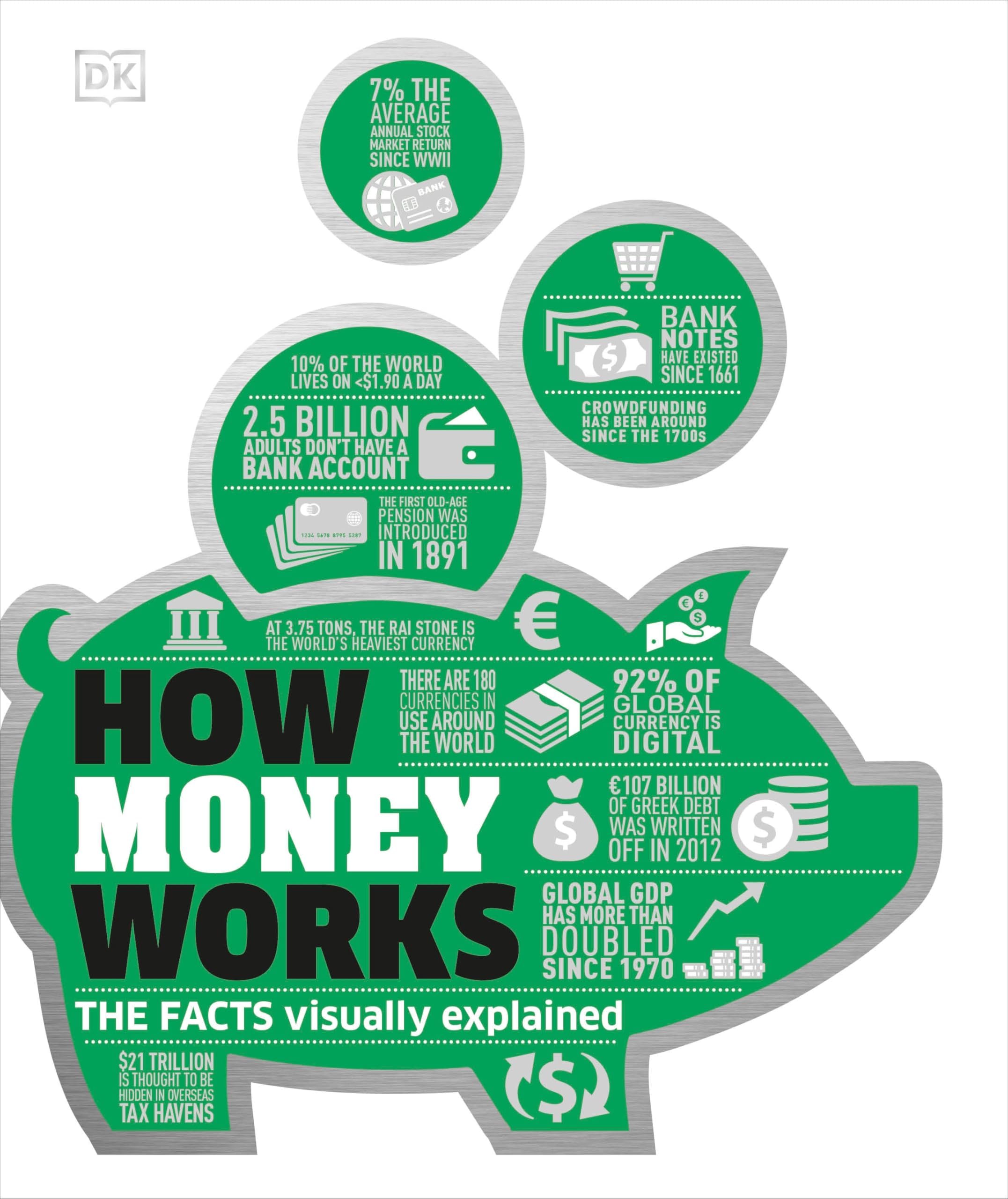
It makes the world go round, but money can truly be an enigma. DK’s visual approach breaks new ground. In graphics, charts, and diagrams, How Money Works demystifies processes and answers the hundreds of financial questions we all have. Money facilitates the billions of transactions that take place every day across the globe. Using ‘need to know’ boxes, step-by-step diagrams, and other eye-catching visuals, How Money Works shows you how this is possible. It explains economic theories, how governments raise and control money, what goes on in the stock exchange, how analysts predict where shares are heading, and many other issues. It busts jargon, explaining terms such as quantitative easing, cash flow, bonds, superannuation, and the open market. This must-have guide to money further features: Key financial concepts in a uniquely visual way, using bold infographics combined with simple, jargon-free language. Genuinely comprehensive, covering every aspect of money – personal, business, and governmental. Defines hundreds of money-related terms, such as cash flow, bonds, superannuation, and the open market. Offers essential basic know-how on everything from managing debt to online fraud. Fully up-to-date, covering topics such as cryptocurrencies (Bitcoin, Litecoin, and others) and quantitative easing. Includes localizable appendix of territory specific reference information. Our forefathers may have used simple bartering to exchange goods and services, but today we depend on complicated financial instruments for pensions, life assurance, mortgages, and more. How Money Works explains how these work, as well as how to avoid on-line fraud and where to invest. With information on the latest forms of funding and currencies such as Bitcoin, this comprehensive book will fast track you to financial literacy and getting the most from your hard-won cash. Review: Great Resource - My son is really enjoying this book! It’s clear and simple and provided a great foundation for understanding how money works. Review: Money For Universal Basic Income? - ANDREW YANG AND UNIVERSAL BASIC INCOME In my desertcart review of Andrew Yang's The War On Normal People, I commented that his book explained why some Americans have much more wealth than others. One of his management strategies was Universal Basic Income (UBI). But where would the UBI money come from? QUANTITATIVE EASING How Money Works describes a strategy called Quantitative Easing (QE): "QE involves the creation of new money – usually in the form of electronic currency – which the central bank then uses to buy government bonds or bonds from investors such as banks or pension funds.” (page 124) These commercial banks then loan this new money to people and businesses at low interest rates. Theoretically, this infusion of cash to those in need stimulates the economy by increasing the supply and liquidity of money (i.e., businesses and people spend rather than save). The book cites possible problems with QE: 1) the economy may not respond as expected, 2) inflation may occur, and 3) banks may hoard the money instead of lending as intended. (page 125) How Money Works notes a case study: “The UK began a QE program in early 2009, after interest rates were cut to almost zero. Most of the new money has been used to purchase government debt. The effects of QE depends on what sellers do with the money they receive from selling assets, and what banks do with the additional liquidity they obtain. The Bank of England believes QE has boosted growth, but at the cost of higher inflation and increasing inequality of wealth, as prices rise." (page 125) THOUGHT EXPERIMENT (i.e., daydream) Experimental evidence suggests that people in need tend to spend their UBIs on necessities such as food, rent and utilities. If so, the main issue may be where the UBI money comes from, not how responsibly the money is spent. Again, I’m more of a biologist than economist. But what would happen if the central bank distributes its new money directly to people in need (or as UBI) instead of having them borrow from commercial banks and pay interest? What would happen if new money begins circulating through the economy from the bottom (trickle up economy) instead of through commercial banks? In my desertcart review of Napoleon Hill’s Law of Success (1925 manuscript version), I wrote, “Ideally, people come before money. Perhaps like self-government, money should be of the people, by the people, and for the people.”















| Best Sellers Rank | #32,297 in Books ( See Top 100 in Books ) #5 in Business Encyclopedias #14 in Money & Monetary Policy (Books) #130 in Finance (Books) |
| Customer Reviews | 4.8 out of 5 stars 1,077 Reviews |
M**N
Great Resource
My son is really enjoying this book! It’s clear and simple and provided a great foundation for understanding how money works.
S**D
Money For Universal Basic Income?
ANDREW YANG AND UNIVERSAL BASIC INCOME In my Amazon review of Andrew Yang's The War On Normal People, I commented that his book explained why some Americans have much more wealth than others. One of his management strategies was Universal Basic Income (UBI). But where would the UBI money come from? QUANTITATIVE EASING How Money Works describes a strategy called Quantitative Easing (QE): "QE involves the creation of new money – usually in the form of electronic currency – which the central bank then uses to buy government bonds or bonds from investors such as banks or pension funds.” (page 124) These commercial banks then loan this new money to people and businesses at low interest rates. Theoretically, this infusion of cash to those in need stimulates the economy by increasing the supply and liquidity of money (i.e., businesses and people spend rather than save). The book cites possible problems with QE: 1) the economy may not respond as expected, 2) inflation may occur, and 3) banks may hoard the money instead of lending as intended. (page 125) How Money Works notes a case study: “The UK began a QE program in early 2009, after interest rates were cut to almost zero. Most of the new money has been used to purchase government debt. The effects of QE depends on what sellers do with the money they receive from selling assets, and what banks do with the additional liquidity they obtain. The Bank of England believes QE has boosted growth, but at the cost of higher inflation and increasing inequality of wealth, as prices rise." (page 125) THOUGHT EXPERIMENT (i.e., daydream) Experimental evidence suggests that people in need tend to spend their UBIs on necessities such as food, rent and utilities. If so, the main issue may be where the UBI money comes from, not how responsibly the money is spent. Again, I’m more of a biologist than economist. But what would happen if the central bank distributes its new money directly to people in need (or as UBI) instead of having them borrow from commercial banks and pay interest? What would happen if new money begins circulating through the economy from the bottom (trickle up economy) instead of through commercial banks? In my Amazon review of Napoleon Hill’s Law of Success (1925 manuscript version), I wrote, “Ideally, people come before money. Perhaps like self-government, money should be of the people, by the people, and for the people.”
P**L
A Must Buy for Financial Literacy
This book is a must read for everyone to learn financial literacy. People complain about it not being taught in schools, well here is the book to buy to learn it on your own. You won’t regret reading it.
E**O
Great info aside from the “Money In The Us”
Great info and great graphics but “the fed” probably wrote the part about money in the US. We already know they want us to be financially illiterate but dang this is in your face.
T**W
Bachelor's Degree in a Book!
As someone who majored in finance and is very passionate about it, I learned nothing from this book. However, I didn't purchase it to learn, but to educate. I love teaching others about finance, and this is the perfect display book to leave on a coffee table. The rich, bold graphics are both visually appealing and quickly digestible. When people have questions about a topic in my field, I can show them in two quick pages much of the gist of what they need to know (versus an hour of me rambling!). I was delighted to see the book didn't shy away from some of the 'meatier' topics like the Time Value of Money (via the formula for compound interest) or the Capital Asset Pricing Model (via the efficient frontier). Every course I took during my undergraduate degree was essentially summed up in every two page section. If you majored in finance, you won't learn anything here, but this book isn't for you! If you majored in anything else, pick up this book. As someone who dedicates his professional career to this subject, I assure you it is full of all the topics you'll need to know about my field. Two small areas for improvement are the Time Value of Money and the physical cover of the book. While the formula for computing the future value (FV) of a sum is given in relation to debt, I felt this didn't go deep enough on the topic. I would have enjoyed seeing this crucial topic of present and future values given its own two page vignette, showing the flip side of how compound interest can work in an investor's favor. The second area of improvement is the physical front cover of the book. The silver outline around the piggy bank and coins scratches off like it was a lottery ticket. This leaves the cover looking easily disheveled. I recommend keeping the book open to a topic you like if you are going to display it (mine is open to the start of the Personal Finance section, personally).
C**E
Good purchase.
Thanks.
J**E
This book is a. Must!
This is an easy to understand and beautifully illustrated book on how the economy works. This book can be easily understood by teens as well as adults and the graphs and charts make it so. I have given this book as gifts to all ages of friends and relatives.
M**E
Great beginners book
Damm good price ... I paid $11 for it .. great introduction book to the history of money and financial & business terms from past to present . Retail , prooerty , banks & stocks etc . Lots of charts and examples ..
M**I
Muy completo y sencillo. Gran libro.
La manera de exponer los temas es simple y efectiva. Es visual, pero no deja de lado entrar a fondo en los temas. Lo recomiendo mucho.
I**Z
Good, easy to read and understand
Good infographics!
C**A
Muito interessante!!
Muito interessante!!
A**R
Great book
My kid loved the book
D**5
So THAT'S how!
How Money Works is clear, understandable, and very informative. Liking it each time I read more in it.
Trustpilot
3 weeks ago
1 week ago