Buy anything from 5,000+ international stores. One checkout price. No surprise fees. Join 2M+ shoppers on Desertcart.
Desertcart purchases this item on your behalf and handles shipping, customs, and support to Belgium.
⚙️ Tune your wheels like a pro, ride like a legend.
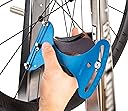
The Park Tool TM-1 Spoke Tension Meter is a precision mechanical gauge designed to measure and convert spoke tension across nearly all bicycle spoke types. With ±2kgf accuracy, it enables cyclists and mechanics to build, true, and maintain wheels with consistent tension, enhancing wheel durability and performance. Made in the USA and fully serviceable, the TM-1 is essential for anyone serious about wheel longevity and ride quality.
| ASIN | B000OZDIGY |
| Best Sellers Rank | #75,725 in Sports & Outdoors ( See Top 100 in Sports & Outdoors ) #22 in Bike Spoke Tools #1,604 in Bike Components & Parts |
| Brand | Park Tool |
| Brand Name | Park Tool |
| Customer Reviews | 4.7 out of 5 stars 903 Reviews |
| Global Trade Identification Number | 00763477007865 |
| Included Components | TM-1 spoke tension meter tool |
| Item Dimensions | 5.75 x 2 x 8.5 inches |
| Item Type Name | Spoke Tension Meter |
| Item Weight | 3.52 ounces |
| Item dimensions L x W x H | 5.75 x 2 x 8.5 inches |
| Manufacturer | Park Tool |
| Material | Multi |
| Material Type | Multi |
| Model | 128972 |
| Number of Items | 1 |
| Part Number | QKTM1 |
| UPC | 763477007865 |
| Unit Count | 1.0 Count |
| Warranty Description | Limited Warranty |
R**R
Great Tool for Tuning Bicycle Wheels, Highly Recommend
I recently went to a downhill mountain bike park. These parks, while fun are quite brutal on your bike. My recent experience left me with busted rear wheel. It was busted in the sense that while riding you could hear all sorts of pinging noises coming from the wheel. I tried to tighten up any loose spokes while I was at the park but ultimately it was time for another solution. I didn't have money for a new wheel and the last time I brought my wheel to a shop I was less than happy with the results. Chances are you may be in the same situation hence the reason you are reading this review. I purchased this item knowing that fixing my wheel would not be easy but I do have a somewhat mechanical background and access to the internet so I figured this was my most affordable solution. The tool arrived in a timely manner and was packaged appropriately (typical Amazon, keep up the good work). The device came with a simple, east to read set of instructions. The device was well built and felt durable, I was initially taken back as the size in person was much larger than what I had expected based off the pictures. I used the device to check the tension on each of my spokes and Park has a web page that will let you input the specs for each spoke and it will tell you where the wheel is weak basically. I think the hardest part for me was trying to figure out the specs for my particular spokes. That was very frustrating (not Parks fault though). After spending about an hour with the device I became quite comfortable using it and even got into a nice rhythm using it. I re-tensioned the wheel while it was on the bike because I did not have a wheel truing stand (I really don't think it is necessary unless you are building a wheel from scratch.). I found that setting the tension is much like tuning a guitar in the sense that when you tighten one spoke you loosen another. My advice is to adjust all of them a little bit at a time and continue going back over them until the tension is set vs. trying to get them all set on the first try. To summarize, I have a fancy new tool which was well worth the money and I have a nice tight and straight rear wheel and ready for the trails. If you are not afraid of a little challenge and some elbow grease I would highly recommend trying this out. I thought it was a bit pricey but it has already saved me a trip to the bike shop not to mention a new rear wheel. It will also help me keep my wheels in tune which will lengthen the lifespan of the wheels.
T**S
Great spoke tension meter for 99.9% of riders, mountain or road
Let's hit the first question off the bat; Do you need this doo-dad to properly build a wheel or keep your wheels in good working order? The answer is it depends upon how close you wish to be to the bleeding edge. Mechanics have been building bike wheels for about 200 hundred years now (dating back to before the early velocipede designs), usually without the benefit of a spoke tension gauge. And for decades, racing wheels used in everything from the Tour de France to serious downhill competitions have been built without spoke tension meters as well. That is because mechanics overbuilt their wheels for the riding style and course, and their fatigue limit was sufficiently far from their elastic limit. (spokes that are tensioned too high are too close to their elastic limit, or that of the rim) Likewise, if you wish to build your own wheels and follow some basic safety factor limits when building a wheel, then a tension gauge is not important. That said, in today's world, there is always that rider out there who is 200 lbs (90.7 kg) and who wants a 24 spoke radially laced front wheel on a 330 gram rim. If bleeding edge riding is your style or you are trying to save 150 grams on your carbon fiber road or mountain bike or you want to push it right to the physical limits, then a spoke tension gauge becomes essential. This Park Tools TM-1 gauge works by using a spoke diameter gauge to measure the middle (or butted part, if your spokes are such) part of a spoke (or you could use precision calipers) and then applying the the tool so that the spoke runs between the two fixed posts and the moveable post. The arrow at the top will point to a number on the graduated scale and you then refer to the separate conversion table to see what kilograms of force (kgf) measurement this corresponds to. For most wheels, you want somewhere between 80 and 130 kgf. Although, this value can vary depending upon the exact riding application. I am not a professional or shop mechanic, but I do build wheels for myself and others that join our off road riding group. I have used this gauge for about twenty wheel builds over the last five years or so. I find it to work fairly well. My older mountain biking wheels (rim brake) are often set up with Mavic 32 hole X517 rims and are typically radially laced in the front and three cross drive/radial lace non-drive in the back. While my newer rims are often 32 hole DT Swiss, Mavic X317 disc or Stans racing rims. I can usually tune by hand and by sound my wheels so that no spoke is 20% above or below the spoke average of the entire wheel (this is a standard reference limit for bike wheels), but the TM-1 really helps me to keep my older wheels at right around 100 kgf and my newer disc rims at about 110 kgf. And these values are right in the happy middle between allowing for a long fatigue life while maintaining ample tension so that if one spoke breaks, the wheel does not taco and I can ride back to the trail head. Those tension levels also prevent fatigue at the rim eyelets and ensure long rim life. Are than any negatives about the TM-1? Not really, but I do find the spoke diameter gauge to be cheaply made. I much prefer to use my Neiko digital caliper when measuring spokes. I also wish that Park Tool would include a standard guide for major manufacturers in their conversion table. The values for a 1.5 mm butted generic spoke from China and one from DT or Sapim are not the same. (Although, you can find these exact values online) And because the gauge is a calibrated spring, I suggest any owner send it back to Park Tool every 25 wheel builds or so, so that exact calibration is maintained. However, those are relatively small quibbles. Thanks to the TM-1, I have never had a wheel taco so far or a spoke break. While this gauge is not essential to wheel building for most riders who are not bleeding edge weight weenies, it does allow the home builder to have some quantitative idea of how their wheels are doing. And for me, that means longer wheel life and no problems on the trail. Five stars in my book.
D**D
It worked great
I really knew very little about wheel building, I have replaced spokes, and tighten a few, but trueing wheels has led to difficulties. I thought if I had a tension meter it would make the job easier. When the Park Tool arrived I metered all my front wheel spokes. This took under 15 minutes. Than I started to spin the wheel. When I noticed a high side I would meter the opposite spokes and see which spokes had a low reading. One of the spokes nearby always had a low reading. Since I knew what the average spoke tension was I would tighten to that spec. Just by doing this method I took care of the low readings. I now have all of the spokes on the front wheel at even tension. What startled me was the rear wheel that was running true had several very low tensioned spokes. I was able to get even tension on the rear wheel also. The drive side being just a bit higher. You can really feel the diffence on my bike. The brakes can now be adjusted very close. Couldn't of done it without this meter. Listening to the sound of a spoke or trying to feel the tightness has never been possible for me. The tool is very easy to use, and like all Park Tools it is well made. The price was great. It was also shipped quickly.
J**L
Inelegant but useful tool
The Park TM-1 is bulky, uncomfortable to hold, a bit clumsy and hard to store. It comes without a case and should not be piled in with other tools. If held vertically, it reads differently on the left compared to the right side of the spoke. You need to be careful to not support it in such a way that you influence the reading. On the other hand, it works quickly and well enough that I didn't find it any slower than comparing the tone of crossed spokes, and a lot less subjective. I used this to build my first set of wheels. After reading the book "the bicycle wheel", Sheldon Brown's excellent on-line articles, and several other resources, I would agree this isn't an essential tool, but it gave me greater confidence in my work and process. Had I tensioned based on the pluck tone on other professionally hand built wheels I own, I would have under tensioned. I am a heavy rider, and wanted to be sure I was getting the spokes to the rim manufacturers maximum recommended tension. I went in expecting to only spot check the tension, but wound up using it all the way around during about half the tensioning process. The process was - find a loose spoke, tighten - find a wobble, tighten the loosest spoke. During the process I probably loosened a spoke a total of twice. So spoke windup never complicated things. I was surprised how little truing was necessary after focusing mostly on evening out the tension. Getting the tension even within 10% was quite easy, and after stress relieving almost no adjustment was necessary. Sure, it took me 4 hours to build 2 wheels, but confidence was more important to me than time.
R**A
Very Good Quality. Very Nice Web Site Instructions and Help.
A Must Have if you want to Build Your Own Wheel Sets..
M**R
Valuable tool and great company
When reliability matters, I choose Park Tools. This tensioner seems to be accurate, and once you get the hang of how to use it (read the instructions) it works well. Spoke tension meters in general are a bit awkward to use, but I'm not sure how I'd improve it. What would make this tool better/easier to use it to make the scale and gradations much easier to read, especially in low light. One way is to make the numbers and scale a contrasting color.
R**E
How else are you going to know? Voodoo?
I've built a few wheels with and without this gauge. I know that I feel a LOT better knowing that my spokes are not too tight or too loose -and that the relative tension is even all the way around the wheel. There seems to be two schools of thought reading the other reviews. One says that this gauge is not necessary and a good wheelbuilder only needs to tell by "feel" if the wheel has correct and/or even tension. The other is that this is just more information that gives you more exact knowledge of where you are with spoke tension. The question is how does one get this "feel" if one has nothing to compare it to? The old canard about striking the spoke and listening for the correct musical note is a bit funny IMHO. Seriously? There are so many variables with regard to thickness and length of spokes that this seems to me to be just more mumbo-jumbo voodoo. A lot of wheel builders seem to be quite proud of their "mad skillz" and look down on this gauge it seems. Some say "take a wheelbuilding class for $100+ each session and "learn" this feel." I tend to go with the "get the right tool for the job" school of thought. With this gauge you will know exactly where the wheel tension is and it is one less variable that one has to guess about. Many of the reasons why some reviewers put down this tool or say that it is doing "more harm than good" in some circumstances seems to read to me as rationalizations why they or other people shouldn't spend the money on a tool such as this. Most bikes shops I visit have this very tool and wouldn't work on wheels without them. And they KNOW what they are doing. Sure, I think that a person may mislead themselves about how important this tool is with relation to other knowledge about building a wheel but if one is careful and does a lot of reading those other things can be figured out as well. Doing everything else right won't help if you have way too much tension on your wheel and start to damage the rim -or have too little and the spokes fatigue and wear quickly. Perhaps some of the VooDoo practitioners don't like the idea that just about anyone has access to the magic of spoke tension with this simple and inexpensive tool. I can't help but feel that they might be a little jealous/upset that just about anyone from the "outside" can jump ahead miles in their abilities without doing their time under the tutelage of a wheel-witch doctor such as themselves and learning the "black arts" like a proper acolyte. Raleighphile doesn't role that way! Knowledge and skills should be free to learn and all should have access if they only know where to look. One more thing: * the first meter I purchased was defective and was showing a much higher reading than what was actually present. This caused my first wheel build to tensioned WAY too loose. I thought at first that all the wheels I've ever built have been WAY too tight but I checked the gauge against one at the LBS and saw that my gauge was in fact defective. Amazon took it back and gave me another one free of charge with free shipping. It's something to be aware of. I don't know how common this is. I keep the gauge safe in the original box whenever I'm not using it an am very careful not to drop or bang it to get the calibration messed up. Having another gauge around or available to check against periodically might be a good idea. If you are friendly with your LBS I'm sure they will let you use one of their gauges to make sure they are reading the same.
D**E
Must have for spoke work.
Must have fore spoke replacement! I have several Park tools and have never been disappointed. The support software works seamlessly with this spoke tension meter.
A**R
Good quality.
Quality product from park tools. Good information supplied too.
R**O
Calidad Park tool
Cumple al 100 % su función, ¿Qué decir? Es ParkTool, en mi opinión la referencia en herramientas para bicicletas
N**N
Bra kvalitet och lätt att använda
Är lätt att använda. Bra kvalitet
L**Y
If you know what your doing this is a must have tool
Even though I'm new to using this tool and the dark art of wheel truing this definitely helped me out a bit. I'm amazed how my wheel hadn't blown up it was that loose
K**N
Would I recommend this tool for new bike mechanics? No, probably not.
Spokes that are evenly tensioned allow wheels to stay truer, longer. The TM-1 measures spoke tension and combined with the app on the Park Tool website, it becomes an incredibly powerful tool for Pro and Amateur bike mechanics alike. Would I recommend this tool for new bike mechanics? No, probably not. I got by for years truing my wheels using my brake pads as reference. But over time you may notice that even though you have trued your wheel, some spokes are low-tensioned and some are high-tensioned. This discrepancy between spokes will mean your wheel becomes untrue faster. As with most Park Tools, the quality is top-notch but you pay the price. And if you are like me and have interest in a tool like this but no idea how to begin using it, the Park Tool site provides an excellent guide and an excellent app.
Trustpilot
1 week ago
1 day ago