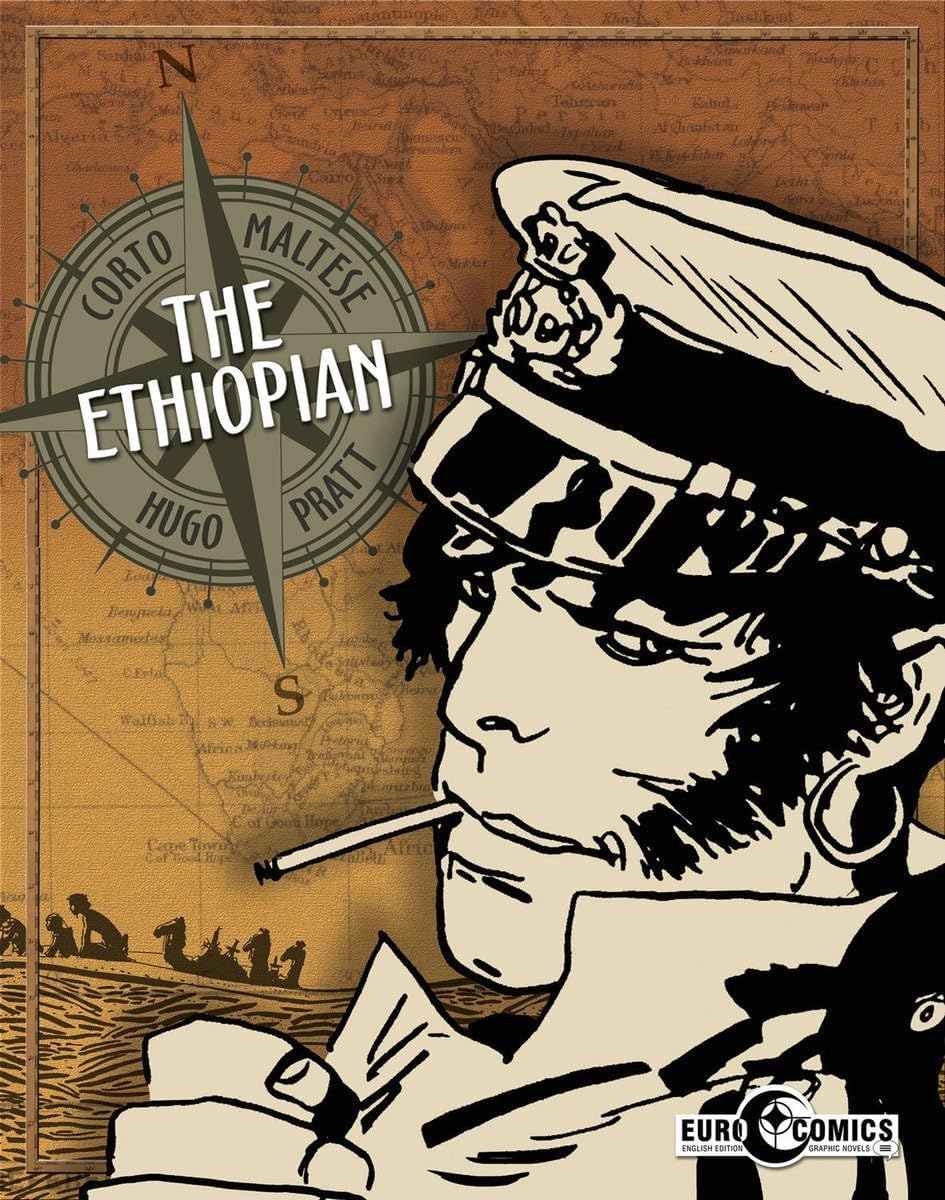
Corto Maltese: The Ethiopian
Product ID: 32676124
Desertcart purchases this item on your behalf and handles shipping, customs, and support to Belgium.
Nominated for both the Eisner and Harvey Awards for Best Foreign Language Publication! When Corto Maltese arrives in the Middle East and Africa in 1918 the shifting sands and loyalties reveal colonial powers still battling for domination over each other and the indigenous people. The desert of Yemen, controlled by the fading Ottoman Empire, is the setting for “In the Name of Allah, the Merciful and Compassionate,” where Corto meets Cush, the Danikil warrior with whom he establishes a close yet conflicted relationship. In “The Coup de Grace” the stubborn racism of an English commander of a small fort in British Somaliland leads to conflict with Cush and the Dervish army of Sayyid Mohamed, whom the British call “The Mad Mullah.” The action moves to Ethiopia amidst inter-tribal conflict in “…and of Other Romeos and Other Juliets,” as Cush introduces Corto to the mysterious and powerful shaman Shamael, who hears the voices of the dead and of devils. German East Africa is the background of “The Leopard-Men of the Rufiji,” where Corto is engulfed in a dreamlike atmosphere that reveals how African justice operates outside the constraints of “white” law. Review: "... you're English and you came here presuming to be our masters..." - Chapter Two of The Ethiopian, "The Coup de Grace," opens with lines from a poem, "The Drunken Boat," superimposed over scenes of the desert. Rows of cacti and a pair of camels give way to images with an undercurrent of danger: a scorpion, a large machine gun, and a soldier and flag of the King's African Rifles. The following page shifts the scene to the interior of a fort displaying the banner of the K.A.R., where the speaker is revealed to be a tidy white man in military garb. "Ah, yes... I love Rimbaud," Captain Bradt wonders aloud. Then, from behind a wicker chair, Corto Maltese's head pokes out, cigarette in mouth: "You surprise me! I don't know why, but I thought that career officers of the British Army only liked Kipling." This clever exchange underscores an important theme of The Ethiopian: an examination of colonialism and the desire for control that forms part of the basis of it--Hugo Pratt frames much of the conflict in this book in machinations by the British in the pursuit of empire. Corto, being half-British himself, can never fully belong to the Danakil or the British or any of the other groups of people featured in The Ethiopian, but he is able to occupy those spheres by virtue of his knowledge of Islam and Great Britain, and even navigate those spheres to some extent by virtue of his deeds. Save for the first story, Corto's only stake in the book's adventures seems to be the preservation of his own life: the stories see him stumbling into gun battles, an execution and an inter-tribe war, and exiting with barely his own jacket intact. But it's because he is so far removed from everything that Corto is able to act in a manner that does not forward the British agenda nor the agenda of the people they seek to control. He acts according to a personal code of honor that values friendship and sympathy for whoever's the weakest at any given moment, be it oppressed or oppressor. "I'm not a hero..." Corto remarks to himself during a quiet moment between life-threatening situations. It's a line couched in some introspection that really encapsulates the heart of the character. There's nothing that could be said about the quality of this book's printing that hasn't been said already: the reproduction of Pratt's art is excellent and the translation reads well. The inside cover flaps feature a picture from the Danakil desert and of Pratt in Ethiopia in 1982, and pull out into identical maps of Ethiopia. There is one obvious typo in the second page of Chapter One, but otherwise it's a fine printing. There are only four stories featured here: "In the Name of Allah, the Merciful and Compassionate," "The Coup de Grace," "... And of Other Romeos and Other Juliets" and "The Leopard-Men of the Rufiji." The first three feature Corto's travels with the Danakil Cush in Ethiopia, while the last seems to stand apart from the others--"The Leopard-Men of the Rufiji" takes place in Tanzania, has a more hurried pace than its predecessors, and only barely hearkens back to the adventures preceding it. In fact, more time is spent dwelling on an adventure that hasn't yet been reprinted by IDW publishing. They're all generally good stories, though. One major complaint is the lack of any strong woman presence in any of these stories--in fact, only one of the stories depicts a woman at all, and her role is merely a pawn in a larger power struggle. There's very little to her beyond that. This is disappointing, especially considering the women Pratt's featured in previous books. The second complaint is related to the last story, "The Leopard-Men of the Rufiji," which exhibits a group of Africans who operate outside of colonial and tribal boundaries to administer justice across the continent. This story appears to rehabilitate the image of the real-world "Leopard Society" written about in the early 20th century; portrayed as cannibals in historical accounts, Pratt ennobles them in this last story. Despite this, it almost seems like Pratt is homogenizing an entire continent when he writes that there is "one true law" of Africa that Leopard Men serve. This does serve the larger end of repudiating colonial rule, but the apparent oversimplification in depicting Africa as monolith almost comes across as a misstep. A closer reading might dispel this interpretation. Ultimately, it's best to keep in mind that these stories were originally intended as adventure comics for young men. That Pratt is able to infuse them with such profound subtext is a testament to his skill as an artist. Many of the lessons conveyed here about imperialism will certainly be salient to readers in light of what’s happening in the world today. Review: Adventures in Africa with Corto and Cush - I quickly perused the previous thirteen reviews and everyone, save one, gave it five stars. Who am I to argue? This episode takes Corto to Africa where he has adventures with the unforgettable character Cush. After reading "Celtic Tales" I was afraid that the series was to be headed into a decline, but sometimes it's good to be wrong. This is the sixth book of twelve, the fifth one that I've read and I have to say that this is my favorite so far. I'm thrilled that I still have some unread Corto Maltese books! The format that IDW has published these books is a real treat to hold in your hands. It's officially a paperback, but it feels like holding a hardback edition. Highly recommended.
| Best Sellers Rank | #4,607,327 in Books ( See Top 100 in Books ) #2,402 in Literary Graphic Novels (Books) #5,213 in Mystery Graphic Novels #13,833 in Crime Action & Adventure |
| Customer Reviews | 4.8 out of 5 stars 89 Reviews |
V**L
"... you're English and you came here presuming to be our masters..."
Chapter Two of The Ethiopian, "The Coup de Grace," opens with lines from a poem, "The Drunken Boat," superimposed over scenes of the desert. Rows of cacti and a pair of camels give way to images with an undercurrent of danger: a scorpion, a large machine gun, and a soldier and flag of the King's African Rifles. The following page shifts the scene to the interior of a fort displaying the banner of the K.A.R., where the speaker is revealed to be a tidy white man in military garb. "Ah, yes... I love Rimbaud," Captain Bradt wonders aloud. Then, from behind a wicker chair, Corto Maltese's head pokes out, cigarette in mouth: "You surprise me! I don't know why, but I thought that career officers of the British Army only liked Kipling." This clever exchange underscores an important theme of The Ethiopian: an examination of colonialism and the desire for control that forms part of the basis of it--Hugo Pratt frames much of the conflict in this book in machinations by the British in the pursuit of empire. Corto, being half-British himself, can never fully belong to the Danakil or the British or any of the other groups of people featured in The Ethiopian, but he is able to occupy those spheres by virtue of his knowledge of Islam and Great Britain, and even navigate those spheres to some extent by virtue of his deeds. Save for the first story, Corto's only stake in the book's adventures seems to be the preservation of his own life: the stories see him stumbling into gun battles, an execution and an inter-tribe war, and exiting with barely his own jacket intact. But it's because he is so far removed from everything that Corto is able to act in a manner that does not forward the British agenda nor the agenda of the people they seek to control. He acts according to a personal code of honor that values friendship and sympathy for whoever's the weakest at any given moment, be it oppressed or oppressor. "I'm not a hero..." Corto remarks to himself during a quiet moment between life-threatening situations. It's a line couched in some introspection that really encapsulates the heart of the character. There's nothing that could be said about the quality of this book's printing that hasn't been said already: the reproduction of Pratt's art is excellent and the translation reads well. The inside cover flaps feature a picture from the Danakil desert and of Pratt in Ethiopia in 1982, and pull out into identical maps of Ethiopia. There is one obvious typo in the second page of Chapter One, but otherwise it's a fine printing. There are only four stories featured here: "In the Name of Allah, the Merciful and Compassionate," "The Coup de Grace," "... And of Other Romeos and Other Juliets" and "The Leopard-Men of the Rufiji." The first three feature Corto's travels with the Danakil Cush in Ethiopia, while the last seems to stand apart from the others--"The Leopard-Men of the Rufiji" takes place in Tanzania, has a more hurried pace than its predecessors, and only barely hearkens back to the adventures preceding it. In fact, more time is spent dwelling on an adventure that hasn't yet been reprinted by IDW publishing. They're all generally good stories, though. One major complaint is the lack of any strong woman presence in any of these stories--in fact, only one of the stories depicts a woman at all, and her role is merely a pawn in a larger power struggle. There's very little to her beyond that. This is disappointing, especially considering the women Pratt's featured in previous books. The second complaint is related to the last story, "The Leopard-Men of the Rufiji," which exhibits a group of Africans who operate outside of colonial and tribal boundaries to administer justice across the continent. This story appears to rehabilitate the image of the real-world "Leopard Society" written about in the early 20th century; portrayed as cannibals in historical accounts, Pratt ennobles them in this last story. Despite this, it almost seems like Pratt is homogenizing an entire continent when he writes that there is "one true law" of Africa that Leopard Men serve. This does serve the larger end of repudiating colonial rule, but the apparent oversimplification in depicting Africa as monolith almost comes across as a misstep. A closer reading might dispel this interpretation. Ultimately, it's best to keep in mind that these stories were originally intended as adventure comics for young men. That Pratt is able to infuse them with such profound subtext is a testament to his skill as an artist. Many of the lessons conveyed here about imperialism will certainly be salient to readers in light of what’s happening in the world today.
K**N
Adventures in Africa with Corto and Cush
I quickly perused the previous thirteen reviews and everyone, save one, gave it five stars. Who am I to argue? This episode takes Corto to Africa where he has adventures with the unforgettable character Cush. After reading "Celtic Tales" I was afraid that the series was to be headed into a decline, but sometimes it's good to be wrong. This is the sixth book of twelve, the fifth one that I've read and I have to say that this is my favorite so far. I'm thrilled that I still have some unread Corto Maltese books! The format that IDW has published these books is a real treat to hold in your hands. It's officially a paperback, but it feels like holding a hardback edition. Highly recommended.
D**W
The Best of Pratt, in My Opinion
All of Pratt's work is amazing, but to have this volume -- my very favorite -- in the original format size, is truly wonderful. The animated movie is also quite good, with English subtitles. From North Korea, of all places.
V**I
Nicely made
I really enjoy these books by Hugo Pratt, and was happy to find them in English. They make a nice gift or collectors item.
A**D
Incredible fantastic book
Super fantastic copy
D**C
Great Read!
The book is awesome, it’s a little dented up though. But highly recommended book!!
B**R
Not the best Corto but still beautiful
I’ve read 6 Corto Maltese books. The Golden House of Samarak (the book I am reviewing) is okay but near the bottom of the list. The pacing is weird and there’s a lot of dream sequences from multiple character and sometimes they turn out not to be a dream. It’s disorienting. The other issue is sometimes things are glazed over. Hugo Pratt doesn’t always have his finger on the pulse of tempo. What he lacks there he makes up for in ingenuity, creativity, knowledge of history and illustration skills. Despite the drawbacks, this book is still extremely enjoyable although I wouldn’t suggest you begin your Corto journey with this book.
B**D
Master Storyteller
Hugo Pratt is a master and this is an incredible book! Milton Caniff reincarnated.
G**H
Yet another great release from IDW/Eurocomics
Yet another great release from IDW/Eurocomics. This is one of my favourite of the Corto books, with complex tales involving a wide variety of characters and action like they just don't seem to do that much of any more. The mix of Arthurian legend, Shakespeare, Stonehenge, Cornwall, U-boat and the threat to fair Albion in 'A Mid-winter's Morning Dream' is just wonderful and enchanting story telling by Pratt and the English translation is near perfect, as it is for all the other stories. This edition looks great, but it is also great to hold with thick paper and waxed covers. All this and Hugo Pratt's masterful drawing makes this another must by, just like the previous two editions. Can't wait for the next one!
E**N
Four Stars
Great art combined with complex storytelling!
B**L
Magic storytelling!!
Hugo Pratt has the magic of the old storytellers and can transport you to other times and other continents!! Highly recommended for those who enjoy adventures in times that have gone by!!
L**A
Corto Maltese em álbum excelente !
Essa coleção sobre a obra de Hugo Pratt, o marujo Corto Maltese é uma obra prima dos comics. Muito bem editada.
A**Y
A must buy
Third part of the Euro comics release. Brilliant story line and quality of print. Corto Maltese is an outstanding comic! Now just waiting for the remaining series...
Trustpilot
1 month ago
2 months ago