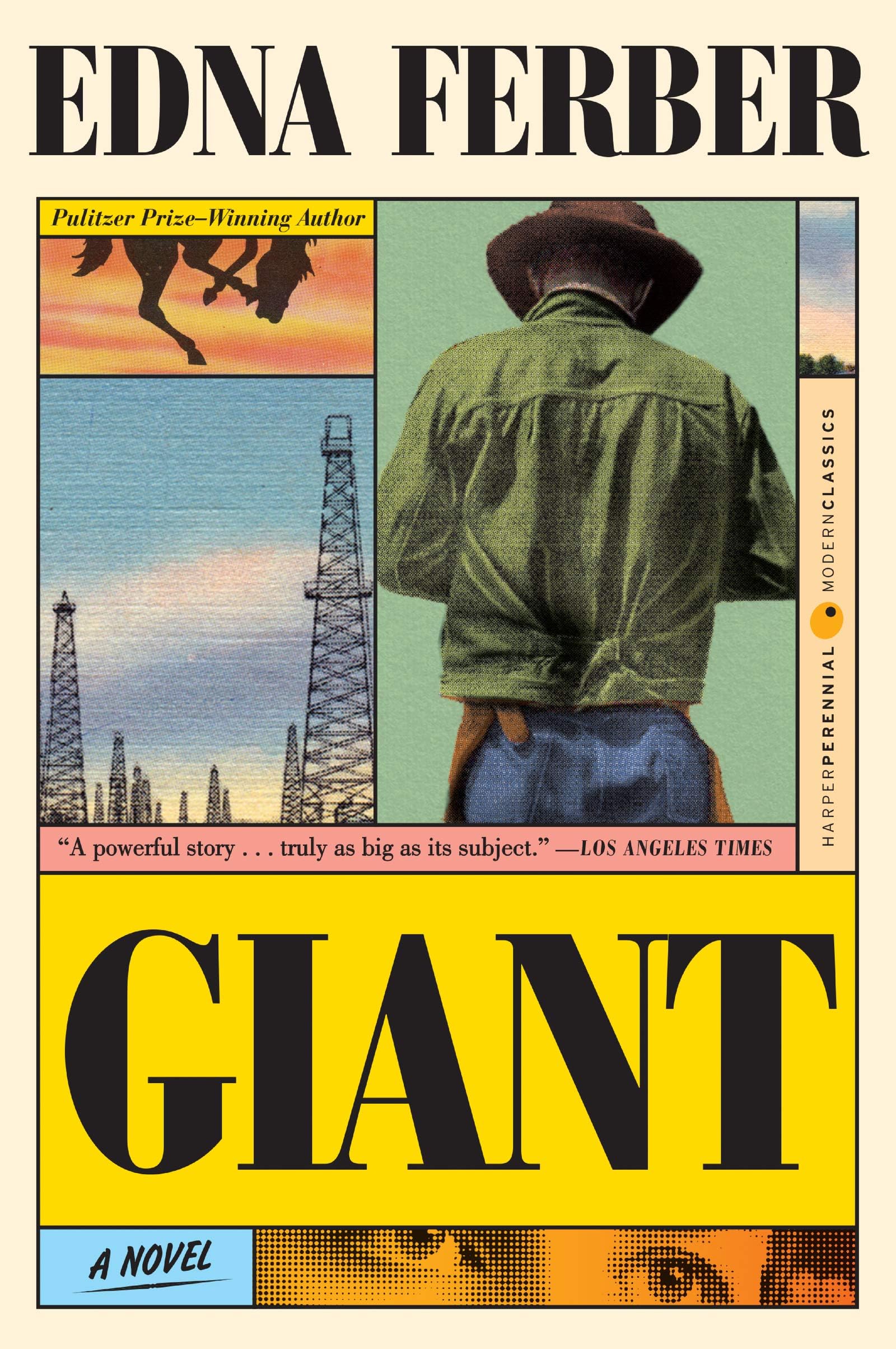
Giant: A Novel (Perennial Classics)
Product ID: 2812583
Desertcart purchases this item on your behalf and handles shipping, customs, and support to Belgium.
“A powerful story...truly as big as its subject.” — Los Angeles Times The basis for the classic film starring James Dean, Elizabeth Taylor, and Rock Hudson, Giant is Pulitzer Prize-winning author Edna Ferber's sweeping generational tale of power, love, cattle barons, and oil tycoons, set in Texas during the first half of the twentieth century. When larger-than-life cattle rancher Jordan "Bick" Benedict arrives at the family home of sharp-witted but genteel Virginia socialite Leslie Lynnton to purchase a racehorse, the two are instantly drawn to each other. But for Leslie, falling in love with a Texan was a lot simpler than falling in love with Texas. Upon their arrival at Bick's ranch, Leslie is confronted not only with the oppressive heat and vastness of Texas but also by the disturbing inequity between runaway riches and the poverty and racism suffered by the Mexican workers on the ranch. Leslie and Bick's loving union endures against all odds, but a reckoning is coming and a price will have to be paid. A sensational and enthralling saga, Ferber masterfully captures the essence of Texas with all its wealth and excess, cruelty and prejudice, pride and violence. Review: Remarkable novel - It’s difficult to review Edna Ferber’s Giant because the book and the movie are so intertwined in my mind. Having seen Rock Hudson, Elizabeth Taylor, and James Dean in the key roles numerous times, those faces were the only ones I could attach to the characters as I read the book. I also had a difficult time, being a lifelong Texan, with the geographic setting. In the film, the ranch is obviously far West Texas; the book doesn’t specify but leads one to believe that the ranch is somewhere near the Gulf of Mexico, placing it near Houston—yet Houston seems to be hours away. Ferber’s town names often are invented, particularly the town of Holgado, which seems to be a large metropolis of mid-twentieth century Texas. This sort of thing is typical of authors, but the film is so firmly rooted in Texas geography that I felt a bit uncomfortable, trying to fit the place names into the Texas I know. That being said, the novel and Ferber were far ahead of their time regarding race relations and women’s place in society. Ferber had proven in her novel Show Boat back in the 1920s that she was a progressive woman as far as race relations go. She carries this theme much farther in Giant. Again, I had though the race theme and even the women’s theme was an invention or embellishment of the film makers. But they are straight out of Ferber’s book. She is adamant that her female protagonist Leslie Benedict have a say in how she chooses to live her life, and Ferber also is quite clear that Texans of the time in which the book is set—the 1920s, 30s, 40s, and early 50s—have a wrong-sighted attitude about their citizens of Mexican descent. It has been said that Texan readers at the time were incensed by Ferber’s depiction of them, for she paints my fellow Texans as vain, arrogant, sometimes ignorant, and above all, racist. But, knowing now what we know, her portrayal is fairly accurate, albeit a bit satirical. And finally, the prize-winning author’s writing style: previously, I had only read Show Boat, her novel written in the 1920s. With Giant, fifty years later, Ferber’s writing style is quite unconventional. She uses run-on sentences liberally and is continually stringing together lists of words with no commas. This, at first, unsettled me, and I wondered why she was allowed by her editor to get away with this. But soon I realized, at least in my eyes, she was trying to convey the idea that Texans of that era did not live by rules. That their lives were totally unconstrained and their attitudes matched those rules of life. Giant is a remarkable book and quite a good tale. Review: Great in its day - Stereotypical portrayal of the land, the people, even the animals. It is true that the reality of Texas in the twenties and thirties was a bit bizarre (read “The Big Rich”), but Giant starts with a part of the story that is never finished and ends with what might be a romantic cliff hanger. In between are two dimensional characters and events that might shape a character’s growth. Like Bick’s over bred cattle, lots of meat but no flavor. Sort of a fun read.


| Best Sellers Rank | #71,562 in Books ( See Top 100 in Books ) #1,276 in Westerns (Books) #1,713 in Classic Literature & Fiction #5,038 in Literary Fiction (Books) |
| Customer Reviews | 4.3 out of 5 stars 1,086 Reviews |
R**S
Remarkable novel
It’s difficult to review Edna Ferber’s Giant because the book and the movie are so intertwined in my mind. Having seen Rock Hudson, Elizabeth Taylor, and James Dean in the key roles numerous times, those faces were the only ones I could attach to the characters as I read the book. I also had a difficult time, being a lifelong Texan, with the geographic setting. In the film, the ranch is obviously far West Texas; the book doesn’t specify but leads one to believe that the ranch is somewhere near the Gulf of Mexico, placing it near Houston—yet Houston seems to be hours away. Ferber’s town names often are invented, particularly the town of Holgado, which seems to be a large metropolis of mid-twentieth century Texas. This sort of thing is typical of authors, but the film is so firmly rooted in Texas geography that I felt a bit uncomfortable, trying to fit the place names into the Texas I know. That being said, the novel and Ferber were far ahead of their time regarding race relations and women’s place in society. Ferber had proven in her novel Show Boat back in the 1920s that she was a progressive woman as far as race relations go. She carries this theme much farther in Giant. Again, I had though the race theme and even the women’s theme was an invention or embellishment of the film makers. But they are straight out of Ferber’s book. She is adamant that her female protagonist Leslie Benedict have a say in how she chooses to live her life, and Ferber also is quite clear that Texans of the time in which the book is set—the 1920s, 30s, 40s, and early 50s—have a wrong-sighted attitude about their citizens of Mexican descent. It has been said that Texan readers at the time were incensed by Ferber’s depiction of them, for she paints my fellow Texans as vain, arrogant, sometimes ignorant, and above all, racist. But, knowing now what we know, her portrayal is fairly accurate, albeit a bit satirical. And finally, the prize-winning author’s writing style: previously, I had only read Show Boat, her novel written in the 1920s. With Giant, fifty years later, Ferber’s writing style is quite unconventional. She uses run-on sentences liberally and is continually stringing together lists of words with no commas. This, at first, unsettled me, and I wondered why she was allowed by her editor to get away with this. But soon I realized, at least in my eyes, she was trying to convey the idea that Texans of that era did not live by rules. That their lives were totally unconstrained and their attitudes matched those rules of life. Giant is a remarkable book and quite a good tale.
E**N
Great in its day
Stereotypical portrayal of the land, the people, even the animals. It is true that the reality of Texas in the twenties and thirties was a bit bizarre (read “The Big Rich”), but Giant starts with a part of the story that is never finished and ends with what might be a romantic cliff hanger. In between are two dimensional characters and events that might shape a character’s growth. Like Bick’s over bred cattle, lots of meat but no flavor. Sort of a fun read.
J**T
Shocking for its time
A must read, better than the movie. And keep in mind that this was written in the 1950's when subjects like how Mexicans were treated in Texas and racial discrimination were taboo topics--- and they are still sore spots to Texans. But "Giant" takes them on. You would have to say that it was a stepping stone to the Civil Rights Movement in this country. I remember when the book came out and it was announced that a movie was to be made from it. Some Texans said they would shoot the movie screens out. That never happened. But it shows how embarrassed they were to have their dirty little secret exposed to the world.
R**A
Fantastic!
This is an excellent book set primarily in Texas. It follows generations of the Benedict family and their friends. Now I will have to see the movie. (I have seen bits and pieces of the movie in the distant past; I don't remember if I watched the whole thing.)
F**6
See the movie. You can pass up the book
Actually, this is one of the rare times when the movie is better than the book. Rather rambling, at times -- the writing is clearly reflective of its times and does not hold up well. This can be said about quite a few of Ms. Ferber's novels, as well.
E**S
Beware of Kindle version lack of editing
Great story, great characters. But reading the Kindle version is hard due to lack of editing. Sentences that make no sense. Lack of punctuation. Misspellings. Characters talking, but what they are saying just ends mid sentence. Made it very distracting. At the cost of this Kindle book, it needs to be re-edited.
P**T
Excellent Author...doesn't disappoint
Difficult to get into...but stick with it. Excellent writing and a worthy read.
A**R
All these years later it still holds up.
I can’t help but think that Yellowstone borrowed a lot from this book. It is a really fun and still relevant read
S**E
A LITERARY CLASSIC THAT BECAME A FILM CLASSIC FOR THE AGES!
A wonderful story covering three generations of life in the vast expanse of Texas, one of Edna Ferber's finest literary achievements. May I also add that as great as the book truly is, GIANT on the big screen, a George Stevens extravaganza starring James Dean, Elizabeth Taylor and Rock Hudson, was a rare instance when the movie was as good as the book--and perhaps even better!
T**I
Lebendiges Texas
Ferber gibt in ihrem Buch ein lebendiges Bild von Texas in den 1920-50er Jahren. Die Lebensgewohnheiten der Menschen vor dem Hintergrund eines rauen Landes und eines beständigen ethnischen Konflikts lassen auch das Thema des Schmelztigels der Kulturen plastisch vor Augen treten. In eine flüssigen Geschichte werden Kontraste und Wesensmerkmale texanischer und amerikanischer Kultur im Gegenlicht der an England angelehnten Lebensverhältnisse der Ostküste dargestellt. Zwar ist die Geschichte nicht sonderlich tiefgehend, aber eben wegen ihrer Lebendigkeit und Gegenständlichkeit sehr lesenswert. Der Leser erfährt viel über die Lebensgewohnheiten und das Alltagsleben auf einer großen texanischen Ranch. Im Gegensatz zur berühmten Verfilmung mit James Dean, steht in Ferbers Buch Texas als Land der Rinderbarone im Vordergrund.
Trustpilot
2 days ago
3 weeks ago