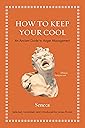
How to Keep Your Cool: An Ancient Guide to Anger Management
Product ID: 256908623
📚Bilingual Latin-English text
🔥Timeless Stoic wisdom on anger
⚖️Ethical & practical anger management
Desertcart purchases this item on your behalf and handles shipping, customs, and support to Belgium.
📖 Master your emotions with ancient power — don’t miss out on Seneca’s secret to staying cool!
How to Keep Your Cool is a bilingual edition presenting Seneca’s classic essay 'On Anger,' offering a profound Stoic perspective on why anger is destructive and how to control it. This 0.65-pound book combines historical insight, ethical guidance, and practical advice, making it a must-read for professionals seeking emotional mastery and social harmony in a turbulent age.
| Best Sellers Rank | #35,243 in Books ( See Top 100 in Books ) #112 in Ethics & Morality #127 in Western Philosophy #160 in Emotional Self Help |
| Customer Reviews | 4.6 out of 5 stars 111 Reviews |
B**N
Wisdom for All, Anger for None
Seneca was a first-century Stoic philosopher exiled under Caligula and murdered by Nero. How to Keep Your Cool consists of lengthy selections from his essay De Ira (On Anger). Like other volumes in this series, the book is bilingual, in this case consisting of Latin (on the left) and English (on the right). It is a powerful and thought-provoking read. According to Seneca, anger is a desire to punish wrong, whether real or perceived (p. 15; 1.6). Perhaps this seems familiar, and even praiseworthy (for anger sounds righteous), but his approach to the matter will likely strike many as odd. Unlike the contemporary belief that anger can be rightly channeled, Seneca believes that anger is simply dangerous. It is 'the ugliest and most savage of all emotions', 'hardly human', and 'a brief madness' (p. 5; 1.1). When angry, we are 'transported beyond mortal thinking by an insane mind' (pp. 25-27; 1.20). His remedy is to first avoid situations where we are likely to become angry, and second to make sure that if we are angry, we do no harm. He doubts that anger can be useful, because 'it's easier to shut out harmful things than to govern them, easier to deny them entry than to moderate them once they have entered' (p. 17; 1.7). As I look around (and at myself), I think he is right. All of this indicates that the danger is not just true of the individual but of society as a whole, and Seneca applies his views on anger to larger social contexts as well. When angry, we should not trust the belief that we have, in fact, been wronged (p. 47; 2.22); 'we grow angry before we use our judgment' and are thus quick to believe the worst about another's motives (p. 49; 2.23). Groups are the same, and 'often a whole crowd has lined up to march into anger' (p. 115; 3.2), such that 'a monstrous frenzy carries away the citizens' and social norms are abrogated (pp. 117-19; 3.2). Anger affects not just individuals, but societies. Seneca has given me much to ponder. There is much here worthy of reflection - and, above all, application to our own lives.
C**T
Really helpful. Great quality book. Just…
I’m really enjoying this book and learning a lot. I like the color and feel of the dust jacket. The pages are pure white with nice sized black text. Every opposite page has, I assume, the Ancient Greek. It’s fun to try and work out the words and sentences that match the English. So far (I’m about 60% in) the subjects are great, how to raise a child without anger, why anger is bad, how to deal with it as an adult. Really great info that every person should read. My own gripe… it seems the author has translated some words to fit American Christians vocabulary. “Sin” and “knights” are two examples. I feel is does a disservice to Seneca and the ancients and messes with the understanding of the mindset of the people from that time. They don’t deserve to have parts that made them great and unique white washed away for the sake of El worshipers today.
A**R
Timeless Wisdom
This is a critical & timeless philosophy that provides insight & guidance into eradicating negative thoughts that drain us of life's Joy & purpose . Life is short , let's not waste our precious time & energy on unhealthy thoughts & attitudes .
C**E
I love books
The cover is like a cool suede material
J**.
Seneca was one of the greatest writers on the stoic philosophy.
What's not to like about a writer who lived 2000 years ago whose thoughts and advice are just as relevant today as they've ever been. Like Marcus Aurelius his works will never go out of print.
Trustpilot
1 month ago
2 weeks ago