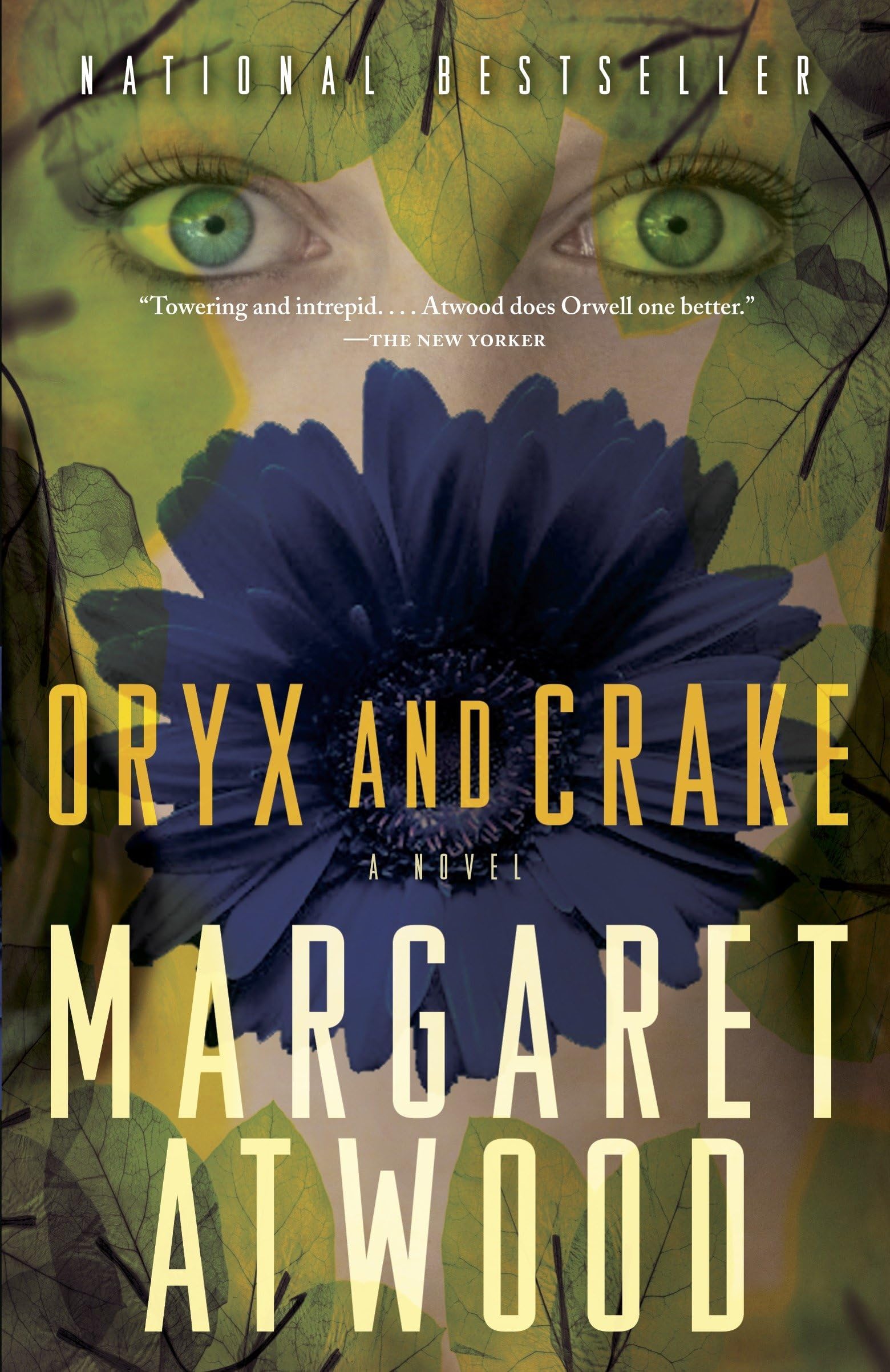
Oryx and Crake (The MaddAddam Trilogy)
Product ID: 1357510
Desertcart purchases this item on your behalf and handles shipping, customs, and support to Belgium.
NATIONAL BESTSELLER • The first volume in the internationally acclaimed MaddAddam trilogy is at once an unforgettable love story and a compelling vision of the future — f rom the bestselling author of The Handmaid's Tale and The Testaments A Kirkus Reviews Best Fiction Book of the Century Snowman, known as Jimmy before mankind was overwhelmed by a plague, is struggling to survive in a world where he may be the last human, and mourning the loss of his best friend, Crake, and the beautiful and elusive Oryx whom they both loved. In search of answers, Snowman embarks on a journey — with the help of the green-eyed Children of Crake — through the lush wilderness that was so recently a great city, until powerful corporations took mankind on an uncontrolled genetic engineering ride. Margaret Atwood projects us into a near future that is both all too familiar and beyond our imagining. Review: Gripping read - I had avoided this book for years. I loved Atwood's Blind Assassin so much, that I dreaded this switch of genre. After all, dystopian lit isn't really my thing. To me, they are either too bleak or are packed with too much scientific nonsense. But given the impending release of the final book in the trilogy, I thought I'd give it a go. There is something about fantasy trilogies (albeit a dystopian one) that tickles my reading fancy. I was glad to find that I could not have been more wrong about this book. This book grabbed me from the very first page. It cleverly played on existing fears of technology, in this case of biotechnology. What if the very thing we create to advance our lives becomes the very sword that ends it? And to Atwood, this what-if pondering isn't limited to the creation of the single terminator specimen, that ultimate weapon of mass destruction, but includes the failure übercapitalist system that is constructed to keep humans safe (and, well, sustain the biotech corporate machine). What if Mother Nature, who this society has strived to conquer and control, lashes back, revolts, avenges? What Atwood has brilliantly done here is to present us the night,ate of a technocratic society. Atwood created a world where humans are no longer in the picture as they were all but one killed by a super virus and surviving species are humanoids, genetically engineered to withstand everything from mosquitoes to diseases and are stripped are human flaws such as greed over property and sexual frustration, traits that have lead humans to wage wars. Domesticated genetically engineered animals have escaped and are now found in the "wild": pigoons (pigs used to breed human organs), wolvogs, fluorescent rabbits and more. The earth's climate has degraded to the extent that it is inhabitable to the common man. Before the outbreak, mankind had organised themselves into colonies; now void and dilapidated. The only person, who has survived the terrible tragedy that had befallen mankind is Snowman. Or previously known as Jimmy. Throughout the book, as we learn more about the bleak and dreadful post apocalyptic world, we also learn about Jimmy's past, his relationship to Crake, a person or being, who seems to be behind all this, including the humanoids (they are called the Children of Crake) and his relationship to a mysterious woman, Oryx (all the animals are referred to as Children of Oryx). Are they deities? Supernormal beings? As we follow Snowman's attempt to trace back his steps, the books comes to an unexpected conclusion, which proved once again that this is not you run-of-the-mill dystopian novel. It was shattering but intriguing at the same time, you can't help but asking: WHY? Unlike many, I didn't feel unsatisfied at all with what many called an 'abrupt' ending. Then, a discovery that Snowman may, after all, not the only one to have survived, provided a nice Segway into the second book. Really glad I waited till now to read all three because this means I can dive straight into the second book! Granted, some parts lacked the necessary scientific explanation and hence may come across rather unconvincing. How did the genetically modified species survive given their dependency on humans? Why didn't Snowman succumb to other forms of environmental stresses? How did humans managed to stay so segregated and yet when the outbreak happened, why did it travel so rapidly? But none of that really matters, because Atwood never intended this to be a forecast. Instead this is an exercise of the mind, a parable of the worst case scenario to engage our minds into exploring the protean of human nature, the things worth preserving, holding on to, whether it is physically and mentally, when all is lost. Highly recommended to students and adherents of alternative thinking and the philosophy of counterfactuals. And of course to any dystopian lit enthusiast! Review: Fascinating, Prescient Character-Based Dystopia - One day, something is going to be the end of the world as we know it. Superbacteria and/or a global plague. Nuclear war. Heck, maybe the zombie apocalypse. But why not climate change? In Margaret Atwood's Oryx and Crake, it's climate that creates the void into which increasingly powerful corporations pour themselves. Soon, the divide between the haves and the have-nots becomes even more literal, with the highly-educated few retreating into city-esque complexes created and owned by business interests, while the masses are walled off into their own zones. Jimmy is born into privilege, to a mother and father who are good worker bees, and it is in the compound school that he meets Glenn, who becomes his best friend...and who ends up changing the world beyond what anyone could have imagined. As an adult, Jimmy has renamed himself Snowman (after The Abominable), and as far as he knows, he's the last "real" human left alive. There's a group of genetically engineered people, the Children of Crake, but they're not the same. He's left alone, in a devastated world, with only his memories and his guilt over the role he played in it all. These memories make up the bulk of the book, with very little actually happening in an actual plot sense. Jimmy does venture back to the last place he lived in search of food and sunscreen and medicine, which forces him to confront what happened with Glenn, who became Crake, and the beautiful, reserved Oryx, who was involved with them both. How they died, and how the virus that wreaked havoc on the rest of the world was released. It's a character study as much as a work of speculative fiction, and that's really Atwood's strength anyways. She loves to dig into the ways our little flaws can set in motion events that spiral out of control, to take the tensions underlying society and drag them up into the open. I find it really interesting that this book was written in 2003, the year I graduated high school, because so much of it seems to apply to the kinds of debates that continue to be relevant even now: just because we have the technology or knowledge to do something, does that mean we should? How do we weigh morality? Whose morality gets weighed? The writing date of the book does mean there are some things that come off anachronistic (she posits a world focused on disc-based storage, in which email is a primary communication method), a lot of it is startlingly prescient. Clearly I liked it, but it was not without failings. The biggest, for me, was its lack of developed female characters. Jimmy's mother is intriguing, but we see relatively little of her and through mostly his eyes, reflecting on the way her choices impacted him. Oryx remains to the reader just as mystifying as she largely is to Jimmy, and while I could see Atwood intending this as a statement of how men tend to project their own stories only the women they claim to love (Jimmy is convinced he knows parts of Oryx's past, which she herself denies), I wish we'd gotten more of her perspective. And as much as I enjoy character-driven novels, I wish it had been structured differently, so that it was taking place in the present rather than largely in the past. These are relatively minor issues, though. On the whole, this book is fascinating and thought-provoking and one I'd recommend widely (though maybe not younger/less sophisticated teenagers).


| Best Sellers Rank | #20,943 in Books ( See Top 100 in Books ) #119 in Dystopian Fiction (Books) #144 in Post-Apocalyptic Science Fiction (Books) #725 in Literary Fiction (Books) |
| Customer Reviews | 4.3 out of 5 stars 14,083 Reviews |
D**I
Gripping read
I had avoided this book for years. I loved Atwood's Blind Assassin so much, that I dreaded this switch of genre. After all, dystopian lit isn't really my thing. To me, they are either too bleak or are packed with too much scientific nonsense. But given the impending release of the final book in the trilogy, I thought I'd give it a go. There is something about fantasy trilogies (albeit a dystopian one) that tickles my reading fancy. I was glad to find that I could not have been more wrong about this book. This book grabbed me from the very first page. It cleverly played on existing fears of technology, in this case of biotechnology. What if the very thing we create to advance our lives becomes the very sword that ends it? And to Atwood, this what-if pondering isn't limited to the creation of the single terminator specimen, that ultimate weapon of mass destruction, but includes the failure übercapitalist system that is constructed to keep humans safe (and, well, sustain the biotech corporate machine). What if Mother Nature, who this society has strived to conquer and control, lashes back, revolts, avenges? What Atwood has brilliantly done here is to present us the night,ate of a technocratic society. Atwood created a world where humans are no longer in the picture as they were all but one killed by a super virus and surviving species are humanoids, genetically engineered to withstand everything from mosquitoes to diseases and are stripped are human flaws such as greed over property and sexual frustration, traits that have lead humans to wage wars. Domesticated genetically engineered animals have escaped and are now found in the "wild": pigoons (pigs used to breed human organs), wolvogs, fluorescent rabbits and more. The earth's climate has degraded to the extent that it is inhabitable to the common man. Before the outbreak, mankind had organised themselves into colonies; now void and dilapidated. The only person, who has survived the terrible tragedy that had befallen mankind is Snowman. Or previously known as Jimmy. Throughout the book, as we learn more about the bleak and dreadful post apocalyptic world, we also learn about Jimmy's past, his relationship to Crake, a person or being, who seems to be behind all this, including the humanoids (they are called the Children of Crake) and his relationship to a mysterious woman, Oryx (all the animals are referred to as Children of Oryx). Are they deities? Supernormal beings? As we follow Snowman's attempt to trace back his steps, the books comes to an unexpected conclusion, which proved once again that this is not you run-of-the-mill dystopian novel. It was shattering but intriguing at the same time, you can't help but asking: WHY? Unlike many, I didn't feel unsatisfied at all with what many called an 'abrupt' ending. Then, a discovery that Snowman may, after all, not the only one to have survived, provided a nice Segway into the second book. Really glad I waited till now to read all three because this means I can dive straight into the second book! Granted, some parts lacked the necessary scientific explanation and hence may come across rather unconvincing. How did the genetically modified species survive given their dependency on humans? Why didn't Snowman succumb to other forms of environmental stresses? How did humans managed to stay so segregated and yet when the outbreak happened, why did it travel so rapidly? But none of that really matters, because Atwood never intended this to be a forecast. Instead this is an exercise of the mind, a parable of the worst case scenario to engage our minds into exploring the protean of human nature, the things worth preserving, holding on to, whether it is physically and mentally, when all is lost. Highly recommended to students and adherents of alternative thinking and the philosophy of counterfactuals. And of course to any dystopian lit enthusiast!
G**M
Fascinating, Prescient Character-Based Dystopia
One day, something is going to be the end of the world as we know it. Superbacteria and/or a global plague. Nuclear war. Heck, maybe the zombie apocalypse. But why not climate change? In Margaret Atwood's Oryx and Crake, it's climate that creates the void into which increasingly powerful corporations pour themselves. Soon, the divide between the haves and the have-nots becomes even more literal, with the highly-educated few retreating into city-esque complexes created and owned by business interests, while the masses are walled off into their own zones. Jimmy is born into privilege, to a mother and father who are good worker bees, and it is in the compound school that he meets Glenn, who becomes his best friend...and who ends up changing the world beyond what anyone could have imagined. As an adult, Jimmy has renamed himself Snowman (after The Abominable), and as far as he knows, he's the last "real" human left alive. There's a group of genetically engineered people, the Children of Crake, but they're not the same. He's left alone, in a devastated world, with only his memories and his guilt over the role he played in it all. These memories make up the bulk of the book, with very little actually happening in an actual plot sense. Jimmy does venture back to the last place he lived in search of food and sunscreen and medicine, which forces him to confront what happened with Glenn, who became Crake, and the beautiful, reserved Oryx, who was involved with them both. How they died, and how the virus that wreaked havoc on the rest of the world was released. It's a character study as much as a work of speculative fiction, and that's really Atwood's strength anyways. She loves to dig into the ways our little flaws can set in motion events that spiral out of control, to take the tensions underlying society and drag them up into the open. I find it really interesting that this book was written in 2003, the year I graduated high school, because so much of it seems to apply to the kinds of debates that continue to be relevant even now: just because we have the technology or knowledge to do something, does that mean we should? How do we weigh morality? Whose morality gets weighed? The writing date of the book does mean there are some things that come off anachronistic (she posits a world focused on disc-based storage, in which email is a primary communication method), a lot of it is startlingly prescient. Clearly I liked it, but it was not without failings. The biggest, for me, was its lack of developed female characters. Jimmy's mother is intriguing, but we see relatively little of her and through mostly his eyes, reflecting on the way her choices impacted him. Oryx remains to the reader just as mystifying as she largely is to Jimmy, and while I could see Atwood intending this as a statement of how men tend to project their own stories only the women they claim to love (Jimmy is convinced he knows parts of Oryx's past, which she herself denies), I wish we'd gotten more of her perspective. And as much as I enjoy character-driven novels, I wish it had been structured differently, so that it was taking place in the present rather than largely in the past. These are relatively minor issues, though. On the whole, this book is fascinating and thought-provoking and one I'd recommend widely (though maybe not younger/less sophisticated teenagers).
J**E
A darkly funny update of Brave New World for a consumer-driven society
Dystopias are all the rage these days, and even setting aside some grim feelings about our current age, it’s not hard to understand why. Dystopias make for rich world building, sure, but more than that, they allow writers to play with heady concepts – the power of language (1984), genetic engineering (Brave New World), unfiltered modern communication (Chaos Walking), media circuses (The Hunger Games), and so forth. What’s rarer, though, is finding a dystopian novel with a sly, dark sense of humor about itself, laughing all the way through the apocalypse and beyond. And yet, that’s what you get with Margaret Atwood’s wonderful Oryx and Crake, a post-apocalyptic tale that gradually starts revealing its roots in a dystopian society of sorts, filled with designer medications, profit-seeking corporations, medical research, and genetic engineering. You know, fiction. In strict plot terms, Oryx and Crake is simple – it tells the story of Snowman, a human living in some sort of post-apocalyptic Earth. Mind you, this isn’t a radioactive blight, or some ashen McCarthy hellscape. No, the Earth of Oryx and Crake simply qualifies as post-apocalyptic by virtue of the fact that we rapidly realize that Snowman might be the last human being alive. Now, that doesn’t mean he’s the last humanoid – not with that tribe of creatures so like us, but so different, living nearby. And as we watch Snowman’s awkward interactions with a set of creatures that don’t quite understand him, he thinks back to the world that was – and how he and his friend Crake, along with a woman named Oryx, just might have ended it all. This dual-threaded story structure lets Atwood play around in a number of ways, exploring not only a landscape changed thanks to the tampering of man with genetics, but also with our own modern world, showing how our own habits could end up being our doom. In Atwood’s hands, Oryx and Crake becomes a Brave New World for the modern age, where it’s not ourselves we need to genetically engineer – it’s the world around us, from animals to diseases, and most especially, to our medications. In the wrong hands, Oryx and Crake could turn didactic and preachy, a jeremiad against modern conveniences and our desire to be happy above all else. But Atwood lets the subtext carry its own weight, instead investing us in Snowman, his awkward place in a tiered society that doesn’t have much need of him, and his friendship with the brilliant, strange Crake. Without giving too much away, Atwood’s story becomes far more human and emotionally driven than you might expect from its epic world-building, and its depiction of the way the world ends is almost bitterly funny. That, of course, goes for much of the book, whose absurd brand names, bad drug side effects, internet sites, and school settings all feel dead-on, pushed just one step beyond our current reality and into deadpan parody. There’s a dark winking to help the trenchant points go down, finding the absurdity in so much of our modern world and trying to help us laugh at it along with Atwood. For all of that, I’m not sure Oryx and Crake quite sticks the landing; even knowing that there are two more books to follow doesn’t make the slightly open-ended ending here less frustrating or less arbitrary feeling, as though Atwood just picked a bit of a random point at which to end the book. It’s not a dealbreaker – not in a book whose characters are this rich, whose world is this intriguing, whose commentary is so well handled – but it is the one sour note in Oryx and Crake, a book that otherwise I absolutely loved, beginning to end, and the one that confirmed for me what I thought after I finished The Handmaid’s Tale years back: that I really need to make reading more Atwood a priority.
A**R
Need Jumper Cables, But Runs Fine.
I'll start off with a qualifying statement; I really enjoyed this book. It's well written, I find the characters interesting, and the book doesn't intellectualize to the points that you become disinterested. Atwood essentially paints a stark picture of a society not far advanced from our own where medical and genetic research represent the strongest economical and political forces at play. It's written from the point of view of a emotionally stunted man who survives the catastrophic events that occur. One of the primary critiques of this book is that the characters are kind of flat. While this holds true for most of the characters, Crake is actually a fairly complex individual. I feel that the one-dimensional feel of the other characters is actually a conscious decision on the part of the author to underline the basic nature of the society she's describing. It's difficult to feel a sense of horror at the destruction of this society because it's already depicted as something not particularly worth saving. This is probably intentional. Even Oryx, ostensibly the most sympathetic character in the book, doesn't particularly engage the reader. The story of her life, one of sexualized exploitation, is both repulsive and alluring. Nonetheless, you don't feel a particularly strong connection to the character, and her role as a key player doesn't really fit very well with the overall story. The science is neat, if pretty derivative. The irony that pigoons, genetically engineered cattle and organ growers, come to view people as a food source is a pretty common theme in science fiction, and the idea that drug companies are developing diseases and cures as part of their business cycle is hardly original. What I found more interesting was the role of industrial sabotage in innovation. Intellectual elitism, political disenfranchisement, and the decline of literacy are all present as indicators of a fallen society. The book begins weakly. The introduction confuses the reader because of the alien nature Crake's creation and the protagnist, 'Snowman', are presented in a confusing, disjointed context. I know this is an attempt to establish a basic premise of immense change, but the execution really distracts the reader more than adds to the story. The heir apparents to humanity are a little too odd. It's difficult to decipher whether the animal habits and characterists genetically engineered into the Childern of Oryx and Crake are meant possess meaning or establish the genre. Once you get over the intial bump in the beginning, the story takes off. The most interesting character, and really the biggest reason to read the book, is Crake. He's really the key figure in the book, and I don't really want to talk about him because doing so kind of negates the greatest strength of this book. Suffice it to say, he goes a long way in offsetting many of the weaker aspects of this book. He's more complex than you think. This isn't Atwoods best work, but it's a good, entertaining read. I recommend it.
R**S
Comin through the Wry
Many readers will probably be familiar with another of Atwood's dystopian novel, The Handmaiden's Tale, which was another amazing engaging book of a dark future. But where the Handmaiden's Tale is of a Orwellian totalitarian state, Oryx and Crake is more apocalyptic. I don't think it would be a spoiler to tell you all version 1 humans die; you'll probably find that in the backcover blurb of most editions. What the blurbs don't tell you is the depth at which she plums Jimmy's, the narrator and slacker friend of Crake. Jimmy is sort of a futuristic Holden Caulfield, whose alienation and rebellion from an early age is documented by Atwood in frequent flashbacks from the novel's present. I write flashbacks, though that's not quite the right term, as the flashbacks are often told in present tense, and one gets a sense of the interchangeability of present in past, though not in a disorienting sense as in To the Lighthouse, from which Atwood quotes from in the novel's preface. ("leaping form the pinnacle of a tower into the air") Unlike Holden, Jimmy is not an unreliable narrator. His memories of the past are all too real; too stark. His humor along the way ranges from wry to gruesome, but those are the memories life has served up. It's not too much of a stretch to say that Jimmy is often on the verge of making that suicidal leap, not so much for lost love or diminished expectations or even misery, though all that plays a role, but from the ennui of being the last or nearly the last version 1 human left alive. It all sounds like a mediocre sci-fi novel as I write this, but I've all come to expect so much more from a writer of Atwood's ilk and I wasn't disappointed. As with Caulfield, Jimmy's isolation has its seeds in the elite class into which he was born as well emotional neglect by his genius parents. I'll spare you a full synopsis of the novel; you can find that in other Amazon reviews. Instead, here for example is an excerpt of Atwood's dissection of the pre-apocalyptic Jimmy: "He no longer thought of these women as girlfriends: now they were lovers. They were all married or the equivalent, looking for a chance to sneak around on their husbands or partners, to prove they were still young or to get even. Or else they were wounded and wanted consolation. Or they simply felt ignored... At first he enjoyed the rushed impromptu visits, the secrecy, the sound of Velcro ripped open in haste, the slow tumbling to the floor; though he figured out pretty soon that he was an extra for these lovers - not to be taken seriously." Whether you read sci-fi or mainstream fiction, you'll find this book is truly a Good Read. Robert Burns The Unselfish Gene
D**L
A beautifully written but bleak post-apocalyptic novel
This story takes place in a bleak but believable future and keeps you reading. But I found it hard to relate to its characters. The protagonist, called Snowman, may be the last surviving human. The plot consists mostly of showing Snowman's dire situation, interspersed with flashbacks of his pre-apocalypse self (called Jimmy). Why is Snowman the only person left on the planet? What happened to Oryx and Crake? How did the world come to such a sorry state? Learning the answers is what kept me reading. After a long series of flashbacks, the mystery is revealed. But by that time, I didn't care as much as I could have. I wasn't invested enough in the characters. I felt for Jimmy, who'd had a rough life. But since his primary trait was alienation, he never seemed to care much. Neither did I. The plot in the present consisted mostly of Snowman trying to stay alive, half-heartedly mentoringthe Crakers (people genetically created by Crake) and avoiding gene-spliced animals. Snowman's actions served mostly as an excuse for flashbacks. But when the flashbacks caught up to the present and something was about to happen, the book ends. There's no question Margaret Atwood knows how to write. Her style is magnificent. She weaves a beautiful word picture but never in a way that's obtrusive. And her world building in this story is fleshed out and believable. She can be a bit preachy. In The Handmaid's Tale, that preachiness bothered me, but at least I felt for the protagonist. In Oryx and Crake, the author challenges us to take a look at our world today and argue that her bleak vision of the future is impossible. Could genetic engineering get out of control? Is western civilization shallow and materialistic? Are big corporations dangerously amoral? Sure. But this story ignores all positives. Whether her cynicism is justified or not, the mix of good and bad in humanity is what lets us attach our emotions to fictional characters. Dystopian novels have the saving grace of a protagonist that struggles against a world gone awry. In a post-apocalyptic novel, hope has been lost, but we follow the protagonist as they trudge along bravely. Even a book as bleak as Cormac McCarthy's The Road is redeemed by the love of the man for the boy. Oryx and Crake is a fine novel written with Atwood's admirable writing style. Her world building is solid. The mystery keeps you reading. But I was left wanting. If her main theme is that human beings suck, and we deserve to become extinct, it's disappointing. The second book in this trilogy, The Year of the Flood,is supposed to be more hopeful. The blurb for the finale, MaddAddam, says: "this thrilling conclusion to Margaret Atwood's speculative fiction trilogy confirms the ultimate endurance of humanity, community, and love." I hope that's true. There was no sign of it in Oryx and Crake
D**N
An engaging story...but not our future
The only other book I read by the author was "Handmaid's Tale" and it was a great story. The fact that I agreed with the message of the book made it better. This novel, the latest by the author, is also a great story, and remains so even though I completely disagree with the author's message. The author's view of biotechnology is extreme and outlandish, and deeply cynical, but the story is captivating and one can find oneself totally engaged in it from the very first page. The story revolves around someone called "Snowman", an apparent loner in a world completely disrupted by biotechnology via the techniques of genetic engineering. It is a world containing many new transgenic creatures: the pigoons, rakunks, wolvogs, cane toads, snats, and flourescent rabbits. It is a world brought about by biotech industries going by the name of OrganInc Farms, HelthWyzer, and Nanotech Biochem. These industries used to exist on "Compounds", which were distinct from the "pleeblands", and "Compound" people did not go the pleeblands, the later being inhabited by addicts, muggers, identity-stealers, paupers, and crazies. The "human soul" has been discarded in this world, with this leading to a deeply apathetic populace desensitized to killing and torture. Transgenic animal creation was brought about by "biolab hotshots" who liked to fool around with the creation of animals: it made them "feel like God." And religion and God have been exposed as resulting from a "cluster of neurons", a "G-spot" in the brain, the elimination of which by genetic engineering was tricky but accomplished, giving people who were neither zombies nor psychopaths. Ironically, the author has more confidence in the efficacy of genetic engineering than those who even now are practicing it. Biotech managers and investors would wish that things were as easy as they are in the story. But they are not, and patience and millions of dollars in investment are needed to bring about a successful product. The biotech industry is very volatile at the time of publication of this book, definitely not the powerful behemoth able to bring about products and techniques as efficiently as they do in the story. The many transgenic animals that populate the planet in this future world are actually intriguing if viewed from another vantage point. The rapidity in which they come about as distinct species should not dissuade us from caring for them as we would any other lifeform. If biotechnology is efficacious enough to increase the diversity of life on this planet, this is indeed a virtue, not a vice. Will the story frighten many into an anti-biotech stance? It might, but this should not cause those who support biotechnology any concern. To attempt to refute a fantasy is a missappropriation of time; to attempt to create products that enrich life on Earth is time definitely worth spent, and a goal definitely worth striving for. The future holds much promise, and will be unlike anything the author envisages: yes, a world populated by thousands of new species of plants and animals, but also a world populated by billions of thinking machines, both human and non-human. If human history is the guide, it having been one of brilliant technological and scientific innovation, and, as statistics shows, an overwhelming repugnance to violence and war, then there is indeed much to look forward to. The author is a great story-teller, and this book (and others of hers) is ample proof of this, but she is a bad statistician. For humans are not the anxious, maladjusted, violent creatures of her books. Quite the contrary, as a mere counting will indicate, they have proved able to distinguish between good and bad, between what is worthy and what is not, and how to bring about change working for them, not against. In the words of the (jealous) deity in the most popular book in Western literature, humans definitely know good from evil, and with this ability, along with their wisdom and remarkable intelligence, have become as gods...
Y**E
a very good scientific book!
Oryx and Crake is a novel surrounding the idea of a perfect gene pool. It follows Snowman, one of the only humans left in existence, as he recounts the chaos that left him with the experiment his best friend left behind. The book doesn't really have any suspense to it until the end. If you can't get into books without suspense, it's not for you. The ideas in the book are a little out there, but not totally impossible, in my opinion. Some genetic engineering is already possible. I would love to be a member of a team working to create the impossible. Snowman is the poster child for "last man on the earth." He is isolated, scruffy, and scrounges for food on a daily basis. He lives in a tree and wears a sheet! When he talks to the Crakers, he has to watch his words so he doesn't get stuck explaining something that can't really be explained. Crake is a genius scientist who has created the "perfect race." He wants them to populate the Earth rather than humans, even though he is human. I think he's kind of a bad guy in the story, because he is the whole reason for the destruction of the human race! At the same time, he is a good guy for creating the impossible. Oryx is a child that Snowman and Crake saw in child pornography online, and Snowman was determined to find her. When Crake hires her to work on his team, Snowman was angry at first, because Crake stole her from him. However, Oryx ended up liking Snowman instead. I think of her curly pigtails like anime. This story takes place in a post-chaotic world where it seems all humans are dead - except Snowman. All supplies are gone and he struggles for survival. Some parts of this book were boring, but if you are a math and science nerd like me, you will like this book. All of the topics are very interesting and well-thought out. The reason I'm giving it 4 stars is because it feels like it drags on. There's no suspense. It gets more suspenseful near the end of the book, but the beginning, I'll admit, is boring. I would definitely recommend this book to late high-school students and above, because there is a wide vocabulary and in-depth analysis of science. The way the story is told, it's a little confusing to understand for younger people. I had to re-read parts to get a full understanding of what was happening. All in all, an excellent read.
D**S
Chef d'oeuvre
que dire de Oryx And Crake sans dévoiler l'intrigue? Les mots manquent tant le roman est plein de subtilité, de tendresse et de réalisme. Parfois insoutenable car l'histoire est d'une noirceur terrifique, parfois à vous tirer les larmes des yeux... Finalement, un roman apocalyptique qui, on le redoute tous, risque bel et bien d'arriver...
M**T
Good quality and fast delivery
Good quality and fast delivery
D**N
Gripping and intelligent!
After I read about this series of Margaret Atwood I ordered the first book to have a look without having too high expectations. I was really surprised how gripping this utopia is and how intelligent Atwood manages to create this supposedly fictional world that shows some concerning similarities with today. Even though the book is sometimes slow it never bores the reader and succeeds in explaining the reason for the devastating present via flashbacks. Jimmy is a character who falls more and more apart due to the fact that he has no other human beings to talk to. The Crakers, creatures of at least some human resemblance, help to give some comic relief and . After reading the first book I was really hooked and looked forward to the second book, The Year of the Flood, which unfortunately was not as good as Oryx and Crake.
L**A
Finalmente una storia di Fanta scienza apocalittica ( ma davvero fantascienza? O molto possibile futuro?) ben scritta e coinvolgente
Finalmente una storia di Fanta scienza apocalittica ( ma davvero fantascienza? O molto possibile futuro?) ben scritta e coinvolgente. Leggerò anche il seguito
S**S
great!
This was a favourite book of mine back in school. I typically prefer paperbacks but the first ed. paperbacks were so damn ugly that I had to compromise the price point and buy a "used" hardcover. To my surprise it came in basically brand new as there was a sealed plastic covering over it, so I was very happy about that. note: Im fairly certain I bought a "very good" condition as opposed to a "like new" condition, but there's nowhere really to for me to confirm that...
Trustpilot
1 week ago
2 weeks ago