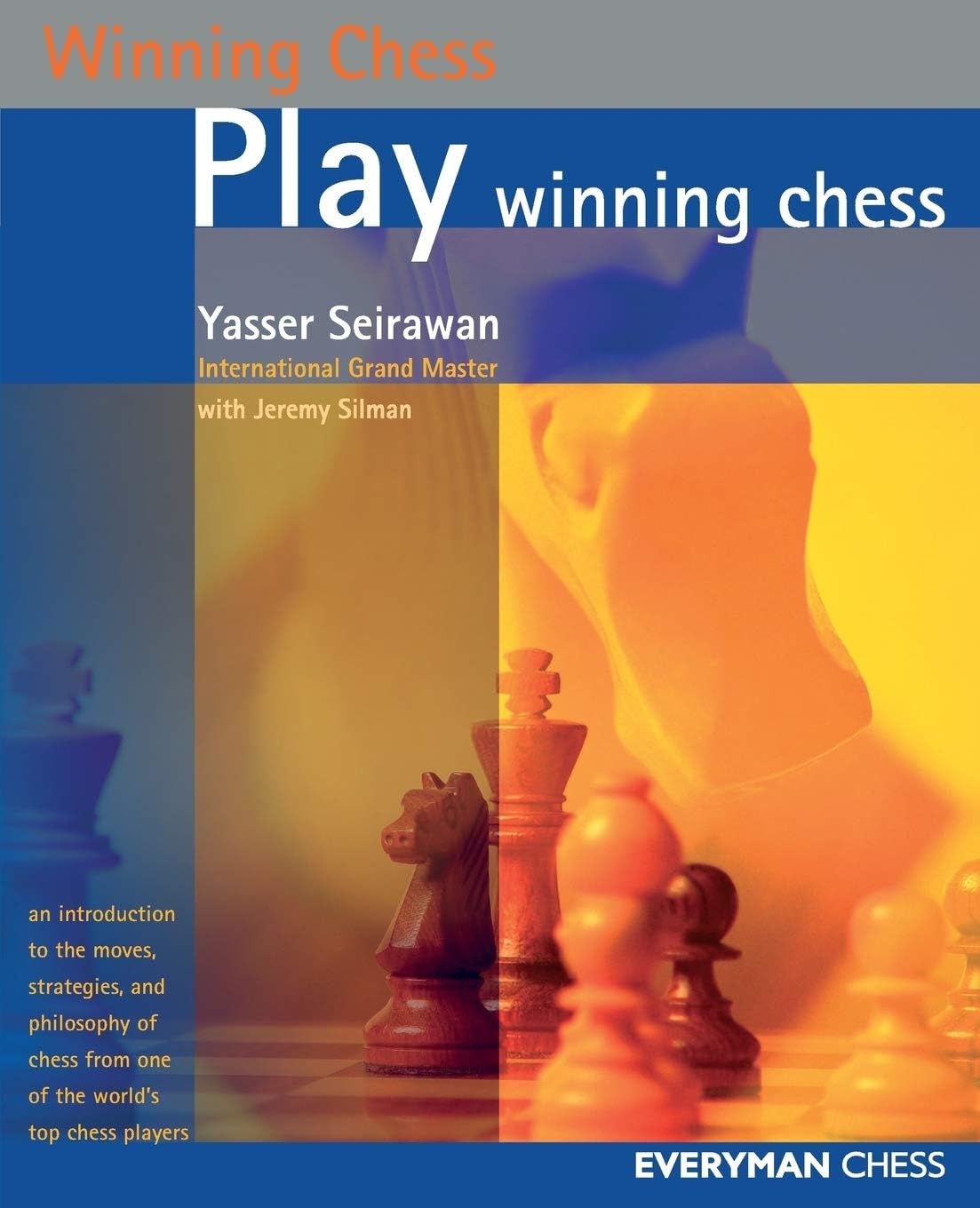
Play Winning Chess (Everyman Chess)
Product ID: 12419886
Play Winning Chess is an introduction to the moves, strategies and philosophy of chess, with clear explanations of the games, fundamental and instructive examples, question-and-answer sections, sample games and psychological hints. Review: Far and away my *favorite* chess book! - I've had a copy of this book since shortly after getting into chess in high school a few years ago, and it's still my favorite by a landslide. This is a book that'll have you walking away with a very strong foundation in chess. The book starts off with the basics: the movement of the pieces, algebraic notation (i.e. how chess moves are written in text), and some of the history of the game. You'll learn the basics of various tactics and strategies as the book jumps right into explaining force (how strong pieces are, eg their value - seasoned players know this as 'material'), time (covering the pace of play, 'tempo', etc.), space (breaking down the chess board, control of positions, etc.), and pawn structure (fairly self explanatory). There are also several quiz questions along the way to practice what you're reading, and each chapter has a number of test questions to re-emphasize and practice what you've learned. The most astounding thing about this book is that, after reading and studying it, not only will you have a solid foundation in chess, you'll be able to actually analyze a chess board. When I first got *really* into chess in high school, I played well, but a lot of it was based on gut feelings. I could usually get a feeling that I was in a better/worse position than my opponent, but I couldn't ever explain *why*. After this book, you'll know enough principles to actually outright analyze a chess board, even if it's only at a basic/beginner's level, e.g.: "Well, white is down two points of material, but his opponent is pinned against the wall and running out of room as white's pieces are better developed." For an experienced player, this sounds very basic, but (in my experience) it's something a lot of beginner books tend to gloss over. Also, Seirawan has an absolutely wonderful way of writing, with a smattering of (admittedly somewhat cheesy) humor that makes the book an absolute pleasure to read, rather than the dry writing of many other chess books! Here's an example, from pages 6-7: "...If you don't own a clock but want to time your games, you can use a tape recorder to sound a beep every 10 seconds. When you hear the beep, you must make your move or suffer some dire consequence--forfeiture of the game is the usual penalty, but you can be creative: loss of all your worldly possessions, exile to a remote island where nobody plays chess, and so forth." All in all, it's a *fantastic* book that I simply cannot recommend enough! Though this book alone won't magically take you right to mastery (nor can any single book), it absolutely provides an excellent foundation to begin learning to play chess well. I had a lot of success with it, and a friend of mine I purchased it for as a gift last year had a similar experience. Definitely recommended for the aspiring chess player. P.S. There is a glaring typo in one of the first few pages. 'rank' = row and 'file' = column, which is explained correctly in the glossary, but they're listed backwards early on in the book. The book is pretty much error-free, but there is that (not insignificant) one a few pages in. D'oh! Review: “Play Winning Chess:” perhaps the best novice player’s chess book I’ve ever read. - “Play Winning Chess” is the first in a series of “Winning Chess” books co-authored by American International Grandmaster Yasser Seirawan and American International Master Jeremy Silman. It is an altogether excellent book that does a wonderful job of instructing beginners on how to play chess. I usually don’t purchase books intended for beginning chess players, but since “Play Winning Chess” is the first in a progressive series of books (the others being “Winning Chess Tactics,” “Winning Chess Strategies,” “Winning Chess Combinations,” “Winning Chess Openings,” and “Winning Chess Endings”), I decided to begin with the basics. I’m glad I did. What most impresses me about this book is how very well written it is. Seirawan and Silman are both exceptionally knowledgeable writers who convey their ideas with clarity, precision, and humor. Seirawan and Silman's prose reminds me a little of the late, great chess author Fred Reinfeld’s writing, and I consider that to be high praise indeed. “Play Winning Chess” is a very well-organized book. After covering the history and basic rules of chess, the authors explain their concepts with simplicity, according to four time-tested basic principles that will lead aspiring chess players to play winning chess. The four principles are: Force, Time, Space, and Pawn Structure. Using examples from games they played, Seirawan and Silman illustrate these principles in a clear and easily understandable manner. The book contains a bounty of diagrams to help illustrate the author’s points. However, the diagrams in the Kindle versions tend to be a bit on the small side. “Play Winning Chess” is perhaps the best novice player’s chess book I’ve ever read. It belongs in every serious beginner’s library. Highly recommended.
| Best Sellers Rank | #537,228 in Books ( See Top 100 in Books ) #127 in Chess (Books) #199 in Board Games (Books) |
| Customer Reviews | 4.6 out of 5 stars 617 Reviews |
S**R
Far and away my *favorite* chess book!
I've had a copy of this book since shortly after getting into chess in high school a few years ago, and it's still my favorite by a landslide. This is a book that'll have you walking away with a very strong foundation in chess. The book starts off with the basics: the movement of the pieces, algebraic notation (i.e. how chess moves are written in text), and some of the history of the game. You'll learn the basics of various tactics and strategies as the book jumps right into explaining force (how strong pieces are, eg their value - seasoned players know this as 'material'), time (covering the pace of play, 'tempo', etc.), space (breaking down the chess board, control of positions, etc.), and pawn structure (fairly self explanatory). There are also several quiz questions along the way to practice what you're reading, and each chapter has a number of test questions to re-emphasize and practice what you've learned. The most astounding thing about this book is that, after reading and studying it, not only will you have a solid foundation in chess, you'll be able to actually analyze a chess board. When I first got *really* into chess in high school, I played well, but a lot of it was based on gut feelings. I could usually get a feeling that I was in a better/worse position than my opponent, but I couldn't ever explain *why*. After this book, you'll know enough principles to actually outright analyze a chess board, even if it's only at a basic/beginner's level, e.g.: "Well, white is down two points of material, but his opponent is pinned against the wall and running out of room as white's pieces are better developed." For an experienced player, this sounds very basic, but (in my experience) it's something a lot of beginner books tend to gloss over. Also, Seirawan has an absolutely wonderful way of writing, with a smattering of (admittedly somewhat cheesy) humor that makes the book an absolute pleasure to read, rather than the dry writing of many other chess books! Here's an example, from pages 6-7: "...If you don't own a clock but want to time your games, you can use a tape recorder to sound a beep every 10 seconds. When you hear the beep, you must make your move or suffer some dire consequence--forfeiture of the game is the usual penalty, but you can be creative: loss of all your worldly possessions, exile to a remote island where nobody plays chess, and so forth." All in all, it's a *fantastic* book that I simply cannot recommend enough! Though this book alone won't magically take you right to mastery (nor can any single book), it absolutely provides an excellent foundation to begin learning to play chess well. I had a lot of success with it, and a friend of mine I purchased it for as a gift last year had a similar experience. Definitely recommended for the aspiring chess player. P.S. There is a glaring typo in one of the first few pages. 'rank' = row and 'file' = column, which is explained correctly in the glossary, but they're listed backwards early on in the book. The book is pretty much error-free, but there is that (not insignificant) one a few pages in. D'oh!
M**S
“Play Winning Chess:” perhaps the best novice player’s chess book I’ve ever read.
“Play Winning Chess” is the first in a series of “Winning Chess” books co-authored by American International Grandmaster Yasser Seirawan and American International Master Jeremy Silman. It is an altogether excellent book that does a wonderful job of instructing beginners on how to play chess. I usually don’t purchase books intended for beginning chess players, but since “Play Winning Chess” is the first in a progressive series of books (the others being “Winning Chess Tactics,” “Winning Chess Strategies,” “Winning Chess Combinations,” “Winning Chess Openings,” and “Winning Chess Endings”), I decided to begin with the basics. I’m glad I did. What most impresses me about this book is how very well written it is. Seirawan and Silman are both exceptionally knowledgeable writers who convey their ideas with clarity, precision, and humor. Seirawan and Silman's prose reminds me a little of the late, great chess author Fred Reinfeld’s writing, and I consider that to be high praise indeed. “Play Winning Chess” is a very well-organized book. After covering the history and basic rules of chess, the authors explain their concepts with simplicity, according to four time-tested basic principles that will lead aspiring chess players to play winning chess. The four principles are: Force, Time, Space, and Pawn Structure. Using examples from games they played, Seirawan and Silman illustrate these principles in a clear and easily understandable manner. The book contains a bounty of diagrams to help illustrate the author’s points. However, the diagrams in the Kindle versions tend to be a bit on the small side. “Play Winning Chess” is perhaps the best novice player’s chess book I’ve ever read. It belongs in every serious beginner’s library. Highly recommended.
E**E
Fast Paced and More Than it Seems
Internation Grand Master Yasser Seirawan and International Master Jeremy Silman team up in this collaborative effort to teach the basic fundamentals of Chess. When I originally opened up this book, I thought it was a little below my level and probably written for children. I muscled through it, though, before moving on to the next book in the series, and I'm very glad I did. While at first the writing style and information makes the book seem less valuable than it is, in reality the book is deceptive in its simplicity. Seirawan and Silman present the fundamental concepts of chess at a break-neck speed and move on to the next important piece of information without stopping. The history section and rules information section were boring to me because I already knew the material, but they'd probably be invaluable to someone who was just learning how to play. What follows, though, is a primer on the four principles of chess that most amateurs don't understand. How to properly utilize material advantage, tempo, initiative, position and pawn structure is a very difficult thing to learn, and the authors don't try to teach it all in one book. This is a primer. It lays the foundation for tactical, strategic and positional learning to be made later. An earlier reviewer said that this book has a "steep learning curve", and it does. If you walk into this book with no knowledge of how to play chess, you will probably have to read it 2 or 3 times. Even if you have a solid grasp of chess fundamentals, I still recommend reading this book just for the possibility of new insights. Reading it as a 1400 rated player, it still opened my eyes to some new ideas I hadn't thought about before. I heartily recommend this book to chess amateurs of my level and lower.
A**R
Perfect book for my level
I am really glad I found this book. I feel this book and more specifically this author fit my current level and my learning preference perfectly. I fully intend to continue through Mr. Seirawan's entire series. I was initially hesitant to purchase this book because I thought it would be too basic. The first chapter of the book is very basic, but the subsequent chapters were very helpful. If you don't have a good understanding of space, force and pawn structure. I think this book will be very helpful for you. I play a lot of blitz chess at chess.com. I am currently rated at about 1000. Before I read this book, I had a hard time winning games against players that were ranked similarly to me. After reading this book, I am routinely beating these same players, and expect my rating to improve over the near term. Not only has my own playing improved, but I can see that my opponents make a ton of errors at this level that this book addresses. Before reading this book, I wasn't taking advantage of my opponents subtle errors because I wasn't aware of them. Swapping good pieces for bad pieces comes to mind. I would routinely swap a good knight or bishop for my opponents bad knight or bishop not really understanding that it was a mistake to do so. I didn't really understand why my knight was good and there bishop was bad, I just saw the numerical value was similar so I would routinely exchange them for no reason. I will say that all of the information in this book is freely available online. Moreover, I have a diamond level membership at chess.com and routinely use all of there educational tools that come with that membership, which are very beneficial. That being said, I think I will benefit more from this series then the vast amount of information available online.
I**E
Excellent introduction for the amateur/hobbyist
This book is simply an excellent introduction to the principles of good playing. Seirawan's grandiose style might be a little unflattering for many, but I find it humorous. Clearly he's earned the right to speak about crushing opponents, and I believe it's done sort of tongue-in-cheek as inspiration for the perhaps sordid newbie (myself). I now perform much more admirably against 1300-1900 rated friends of mine, usually taking them to an interesting endgame, thought my position is typically much weaker. All in due time! Once Seirawan introduces algebraic notation, he jumps right in and expects you to have it memorized, so be ready to have a mini chess set on hand, or a phone app where you can play both sides. It is simply too much for a beginner to keep visualizing the positions as they change from the printed board. I prefer the tactile experience of actual pieces to a phone or ipad app. If you're the same way, I recommend the Checkbook Magnetic Travel Chess Set, especially if you wish to use this book while commuting or traveling. I travel often and this is a great tool. In summary, if you are thinking about getting into chess, and don't really know which book to buy, get this one and start playing!
G**T
An excellent Beginner's guide to improving your understanding of competitive chess
This author is an entertaining writer for subject matter that can be quite dry and clinical. He breaks down solid tactical elements into understandable chunks for easy digestion and implementation. He even adds a bit of history here and there to keep it interesting. This is the first book out of several I have read that is helping me hack through the tangled mental jungle of the middle game. This book is probably too basic for an any solidly ranked player, but for someone who has been wanting to take his game to a more polished plateau, I think this series of four books will help you a great deal. I've already purchased two of them, and I will be reading all four.
B**S
Great for beginners and those who want to improve their game
The Yasser Seirawan "Winning Chess" series of chess books have some of the very few chess books that I actually enjoyed reading. Their style is engaging and easy to read and comprehend, and I found my game improving. I'm no chess master, I just love the game, and when my father-in-law showed interest in learning how to play, this was the book that immediately sprang to mind. This book starts out assuming that you know absolutely nothing about chess. It starts you out with how the pieces move, and teaches algebraic chess notation in a non-threatening manner (essential for any chess book! ;) But then it also goes into essential strategy, such as pawn structure and tempo. If I had to choose only one chess book to take with me for an extended trip, this would be the one.
R**L
A must-read for every chess beginner!
This in an introductory, first chess book targeted to the beginner-novice player. It focuses on explaining what GM Seirawan posits to be the four primary principles of chess – Force, Time, Space and Pawn Structure. Understanding how to properly evaluate and use these principles will enable the player to formulate plans and strategies to significantly improve his/her chances for a successful result in their games. The importance of the concepts introduced in this instructive book cannot be overstated. In fact, I consider this book to be a MUST-READ for every beginner whose goal is to play better chess! If you're serious about wanting to learn to play good chess - START HERE!!
R**L
Rhe chess theory fundamentals
Its what i needed.
L**.
Perfeito
Muito bom
G**N
Great book for beginners
This book approaches all you need to know, from the rules to the mindset you have to have to play winning chess
ト**ノ
凡百の類書に勝る、本物の一冊。
本書の価値を語るなら、この作中文がベストだろう。 「ミハエル・タリは、あらゆる指し手を超高速で計算できる天才である。 ボトヴィニクは、多少の計算と、本書で習う四大原則で戦略を立て、彼に対抗した。 1960年の世界チャンピオン戦において、 異なるアプローチの二人が盤上で出した結論は・・・同じであった!」 多くの入門書ライターが述べるチェスの原則「あらゆる駒取りを調べよ!」とは、まったく対照的である。 この文章は、計算が不要だと言いたいのではない。 天才的頭脳だけが、強くなる道具ではない、と言いたいのだと思う。 本書で述べられる四大原則「セイラワン・メソッド」は、既存の考えと原則を、洗練収束したものと考えられる。 まず一つ一つが、わかりやすい。読書と英語に慣れていれば、ひとつ2~3日で読んで理解できるほどである。 そして、これらから得られるものは、チェスへの「洞察力と方針想像力」であり、 付け焼刃の「このときはこうする」「あのときはああする」「これの答えはこれ」ではない。 おかげでチェスをプレイして沸いてくる「どうしよう」「わからない」が激減した。 ベースは既存の基本原理なので、別のさまざまなチェス書籍にも応用でき、理解を促進してくれる。 序文から最後まで、著者のチェスへの情熱、ユーモア、読者への配慮にあふれている。 いちど読めば、著者とチェスの虜になることだろう。 おまけに文章も平易だ。辞書機能の乏しいKIndle for PCで読んでも、何とかなるレベルであった。しかも安い。 読めば本当にチェスが強くなるし、もっと楽しくなる。
C**E
Riktigt bra!
Bättre än jag trodde.
Trustpilot
5 days ago
3 weeks ago