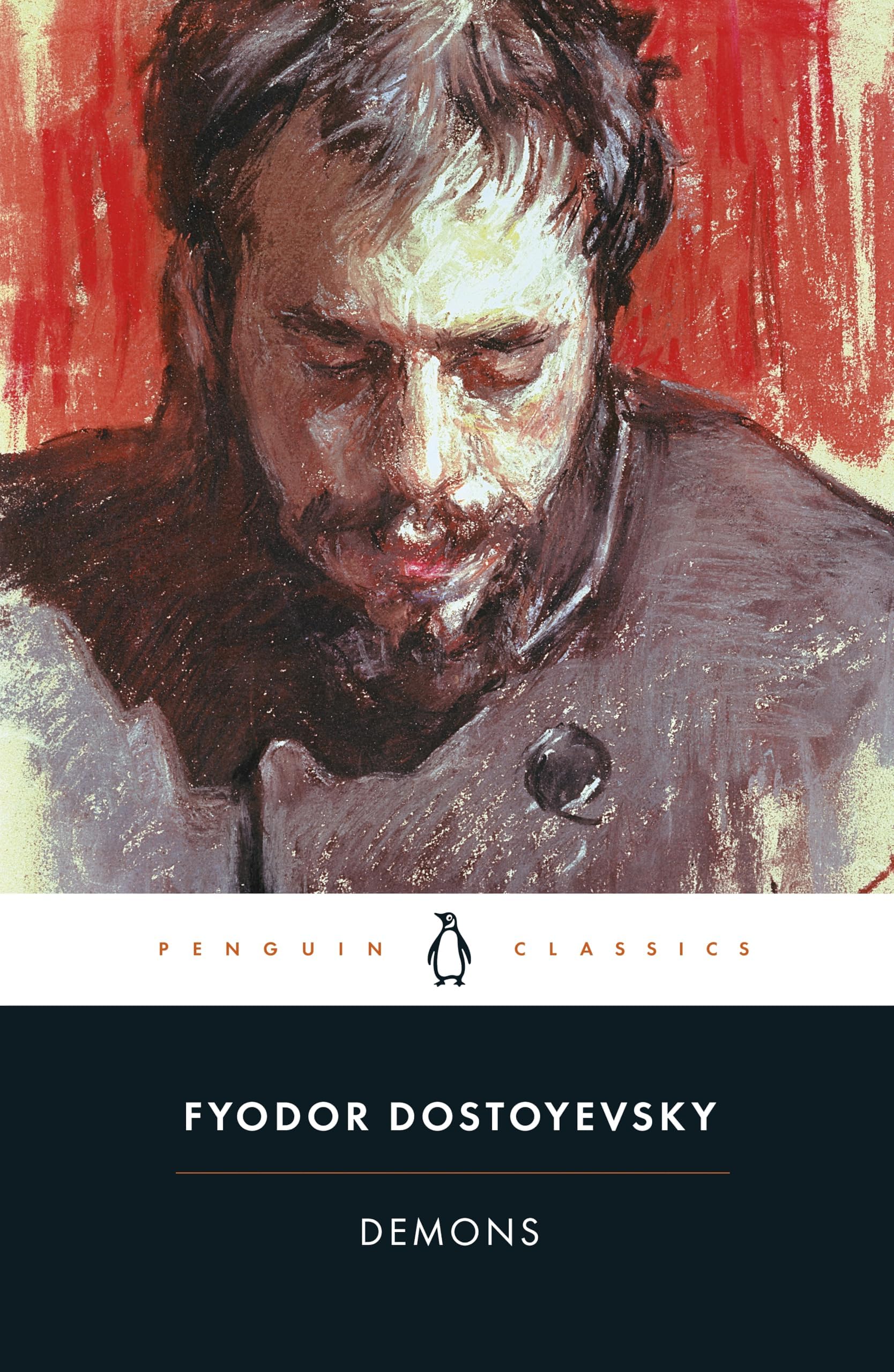
Demons (Penguin Classics)
Product ID: 11042011
Desertcart purchases this item on your behalf and handles shipping, customs, and support to Belgium.
A superb new translation of Dostoyevsky's chilling and prophetic novel of revolutionary fanaticism Pyotr and Stavrogin are the leaders of a Russian revolutionary cell. Their aim is to overthrow the Tsar, destroy society, and seize power for themselves. Together they train terrorists who are willing to lay down their lives to accomplish their goals. But when the group is threatened with exposure, will their recruits be willing to kill one of their own to cover their tracks? Savage and powerful yet lively and often comic, Demons was inspired by a real-life political murder and is a scathing and eerily prescient indictment of those who use violence to serve their beliefs. Review: An exemplary translation - Demons or Devils or The Possessed, depending on which translation you pick up, is a complex book. Dostoyevsky himself admitted in a letter that he would sacrifice straightforward readability for the tendentiousness of the message(s) he transmits in this novel. As an example the narrator Gogonov shifts from being part of the narrative and observing events to being completely detached from the tale being told. At times the reader wonders how he knows so much of what he tells. He goes from describing the plot without judgment, to judging very acutely certain occurrences and characters being described. Demons takes on a smörgåsbord of very dense political, philosophical and religious issues. This is one of the high points of the novel, its 'inner stuffing,' standard Dostoyevsky fare. You may be forced to stop at times and re-read passages or discussions amongst the characters, to try to take them in, chew them and consider them seriously. Dostoyevsky intended for his audience to ponder the case in point. Many have hailed him prophetic in his prediction - through Shigalyov's political utopia - of the amount of people that would be slaughtered in the 20th century due to political ideologies that did for the most part tend to tilt to the side of 'ego trips', as Robert Belknap correctly observes in the introduction - Stalin, Hitler, Mao, and so on - the number being around 100 million. Most importantly, Dostoyevsky was worried about the influence of materialist, nihilistic and atheistic ideas, aggressively transmitted, which could 'infect' or spread through the inadvertent youth of the day - and did eventually lead to the disasters Russia underwent following its 1917 revolution - when he wrote Demons. Of no less importance is the religious side, with Kirillov and the monk Tikhon as the main proponents, as well as the holy fool Semyon Yakovlevich. There is much that is discussed regarding God, Christ, the church, etc. providing food for philosophical as well as religious thought. The story is divided into three parts, the first concerning itself chiefly with high society in a rural town in 1860's Russia - the 'Society Tale' -, followed by a second part - the Anti-Nihilist 'political tract', if you will - which details closely the workings of the main characters of the work as they plant the seeds of the havoc that will ensue in the third part of the novel, Belknap considering it to be the 'Psychological Novel' part, the invention of which is accredited to Dostoyevsky himself. Demons is profoundly moving. It is inevitable that you sympathize with the main 'villain' - clearly a troubled character - Stavrogin. This man, and his continuous bouts of clear consciousness and what one sees as kindness and magnanimity, make the analysis of his behavior on the other side of the spectrum harder. It is an unfortunate debacle, the state of affairs he ends up creating for himself. Dostoyevsky was clearly pointing the finger at the 'softer' radicals of the 1840's as being the root of the calamity. Their jabberings in support of what were considered 'new' ideas, all the nihilistic and atheistic propositions that were en vogue at the time, would lead to a more active radical next generation that would take it upon itself to 'shake the very foundations of society' and it's moral mores. In the end I gave the book 5 stars because this version is absolutely fantastic. The endnotes are comprehensive and give a much-needed overall guide to Russian cultural and other references throughout the work, as well as a splendid introduction which I read after completing the novel, a chronology, a dictionary of the terms and a list of the characters. A very fine edition from Penguin. If you want to read Dostoyevsky, maybe you could treat yourself to start with The Idiot or something softer, more accessible. But if you want to rush straight into one of his more problematic and intense works, look no further. Just the character Kirillov makes such a dramatic appearance. He is at once a rational, delusional, sympathetic and extreme person, who will keep you hooked to his speeches and actions. Highly recommended. Review: great lit - character driven but very rewarding in the long run. Also, one of the most relevant sagas to today even though written in 1870 approx. Stephan Morrow Artistic Director The Great American Play Series









| Best Sellers Rank | #18,287 in Books ( See Top 100 in Books ) #14 in Russian & Soviet Literature (Books) #157 in Classic American Literature #308 in Fiction Satire |
| Customer Reviews | 4.6 out of 5 stars 988 Reviews |
F**A
An exemplary translation
Demons or Devils or The Possessed, depending on which translation you pick up, is a complex book. Dostoyevsky himself admitted in a letter that he would sacrifice straightforward readability for the tendentiousness of the message(s) he transmits in this novel. As an example the narrator Gogonov shifts from being part of the narrative and observing events to being completely detached from the tale being told. At times the reader wonders how he knows so much of what he tells. He goes from describing the plot without judgment, to judging very acutely certain occurrences and characters being described. Demons takes on a smörgåsbord of very dense political, philosophical and religious issues. This is one of the high points of the novel, its 'inner stuffing,' standard Dostoyevsky fare. You may be forced to stop at times and re-read passages or discussions amongst the characters, to try to take them in, chew them and consider them seriously. Dostoyevsky intended for his audience to ponder the case in point. Many have hailed him prophetic in his prediction - through Shigalyov's political utopia - of the amount of people that would be slaughtered in the 20th century due to political ideologies that did for the most part tend to tilt to the side of 'ego trips', as Robert Belknap correctly observes in the introduction - Stalin, Hitler, Mao, and so on - the number being around 100 million. Most importantly, Dostoyevsky was worried about the influence of materialist, nihilistic and atheistic ideas, aggressively transmitted, which could 'infect' or spread through the inadvertent youth of the day - and did eventually lead to the disasters Russia underwent following its 1917 revolution - when he wrote Demons. Of no less importance is the religious side, with Kirillov and the monk Tikhon as the main proponents, as well as the holy fool Semyon Yakovlevich. There is much that is discussed regarding God, Christ, the church, etc. providing food for philosophical as well as religious thought. The story is divided into three parts, the first concerning itself chiefly with high society in a rural town in 1860's Russia - the 'Society Tale' -, followed by a second part - the Anti-Nihilist 'political tract', if you will - which details closely the workings of the main characters of the work as they plant the seeds of the havoc that will ensue in the third part of the novel, Belknap considering it to be the 'Psychological Novel' part, the invention of which is accredited to Dostoyevsky himself. Demons is profoundly moving. It is inevitable that you sympathize with the main 'villain' - clearly a troubled character - Stavrogin. This man, and his continuous bouts of clear consciousness and what one sees as kindness and magnanimity, make the analysis of his behavior on the other side of the spectrum harder. It is an unfortunate debacle, the state of affairs he ends up creating for himself. Dostoyevsky was clearly pointing the finger at the 'softer' radicals of the 1840's as being the root of the calamity. Their jabberings in support of what were considered 'new' ideas, all the nihilistic and atheistic propositions that were en vogue at the time, would lead to a more active radical next generation that would take it upon itself to 'shake the very foundations of society' and it's moral mores. In the end I gave the book 5 stars because this version is absolutely fantastic. The endnotes are comprehensive and give a much-needed overall guide to Russian cultural and other references throughout the work, as well as a splendid introduction which I read after completing the novel, a chronology, a dictionary of the terms and a list of the characters. A very fine edition from Penguin. If you want to read Dostoyevsky, maybe you could treat yourself to start with The Idiot or something softer, more accessible. But if you want to rush straight into one of his more problematic and intense works, look no further. Just the character Kirillov makes such a dramatic appearance. He is at once a rational, delusional, sympathetic and extreme person, who will keep you hooked to his speeches and actions. Highly recommended.
S**W
great lit
character driven but very rewarding in the long run. Also, one of the most relevant sagas to today even though written in 1870 approx. Stephan Morrow Artistic Director The Great American Play Series
A**R
Great
The Penguin Classic edition of Demons delivers Dostoevsky’s intense exploration of ideological extremism and moral chaos in a clear, sturdy translation with helpful notes that ground the novel’s 19th-century Russian context; the narrative is dark, psychologically sharp, and unflinching in its portrayal of characters driven by cynicism, fanaticism, and spiritual emptiness, and this edition’s supplementary material (introduction, annotations, glossary) makes the complex philosophical and historical references accessible without diluting the power of the original text, so it stands out as a reliable, thought-provoking presentation of one of Dostoevsky’s most challenging masterpieces.
J**Y
Dostoevsky’s anti-nihilist novel
THE DEMONS AND THE SWINE Fyodor Dostoevsky’s novel DEMONS, first published in three parts in a Russian journal in 1871 and 1872, is the story of human beings who are psychologically, spiritually and morally lost in a world of rapid cultural and political change. The book has often been called THE POSSESSED, but translators in recent years have identified DEMONS as the novel’s proper title; according to their view, the story is not about those who are possessed by demons but about the demons themselves. As I have identified it, the theme which governs Dostoevsky’s dark novel and which is demonstrated in the events of the story is: “The impossibility of human life without morality.” The book is about the attempt by a small group of intellectuals to bring down the structure of society, starting with a small Russian town. I reject the idea that a supernatural exists, and therefore I reject the idea that literal demons exist and possession of one’s soul by them is possible. And in my view, literal demonic possession can only provide people with an excuse for evil-doing: “The Devil made me do it." But there is a form of possession that does exist, is very real, and is a frightening fact of some people’s psychology: possession by IDEAS. This is the kind of possession Dostoevsky is talking about in DEMONS; the demons are the ideas that his villains want to spread throughout the culture, so much so that the people will welcome a dictator or a gang of thugs to run the country. When a shadowy but central character of the book, Nikolai Vsevolodovich Stavrogin, suddenly acts in ways that seem to be uncharacteristic of him, attacking people in little bursts of violence, the narrator of DEMONS writes “And the beast showed its claws." Dostoevsky was a deeply religious, Christian man; nevertheless, he does not attribute Nikolai’s beastly character to evil spirits, but rather to evil ideas. In Nikolai’s case, his behavior as a person is a logical consequence of his nihilistic philosophy. Stepan Trofimovich Verkhovensky is a Russian intellectual “liberal” of the 1840’s. He is in his early fifties, living with—and living off of—his friend of many years, Varvara Petrovna Stavrogina. He is the tutor of Varvara’s son Nikolai, whom she entrusted Stepan with raising. Stepan’s son Pyotr Stepanovich and Nikolai are friends. None of the ideas that were taught in the universities of the time and were gaining popularity are ever fully presented in detail in DEMONS. However, Pyotr and Nikolai seem to have accepted and embraced them and have gathered around them other men who lean in the same philosophical and political direction as they do, and have formed a cell of a clandestine revolutionary movement which has by then created a number of cells throughout Russia. Their ultimate goal is to destroy society and society’s moral norms. What they plan to replace society with is really anyone’s guess; simply the destruction of it is their focused aim. Stepan has lived with Varvara for years, and she has had a frustrated wish for him to marry her. He secretly considered it for only one time and briefly, but quickly dismissed the idea: “‘Her fortune is immense,’” he thinks, “‘true enough, but…’ In fact, Varvara Petrovna did not altogether resemble a beauty: she was a tall, yellow, bony woman, with an excessively long face reminiscent of a horse.” He doesn’t seem to want to probe deeper into his feelings about Varvara, nor really about anyone else. This lack of trying to understand oneself and others is something Stepan has in common with almost every other character in the book—one exception being a character, whom I will discuss later, who is only included in a chapter of the book which was eliminated from it by its first publisher, completely against Dostoevsky’s wishes. How people appear to each other in the story is what determines how many of them relate to each other, and people often judge each other by non-essentials, as Stepan does with Varvara. As the revolutionary cell develops, with its goals being the tearing down of Russia, the tearing down of “the Russian God” and the infusion of atheism into Russian society, the destruction or abolition of the family, the Marxist-style organizing and unifying of the work force and the deconstructing of other of their societal targets, a factory in the area becomes a focal point of an attempt to plant the seed of revolution. Propaganda leaflets are distributed there, and inevitably, with the help of a paid ex-convict, a well-to-do part of the town is set ablaze and three people are murdered. The police are unable to accurately identify those involved. One member of the cell, Ivan Pavlovich Shatov, has by then begun having strong doubts about the goals of the cell, he fears that they will destroy the Russia that is secretly dear to him, and is having strong reservations about the actual morality of what the cell wants to achieve, despite how benevolent any of its members’ professed ideals sound. The other members are concerned that he will go to the police, and meet to make a decision on whether to kill him. Throughout the story, with the exception of Pyotr and Nikolai, who both have some relatively clear idea of the social implications of the ideas they embrace, the members of the cell have no clear idea, each with his own level of ignorance. This fact becomes almost concretely obvious in the scene after Shatov has been shot: “Although Virginsky rushed at Shatov when all the others did, he didn’t grab Shatov and didn’t help hold him down. As for Lyamshin, he joined the group only after the shot had been fired. Then during the entire course of this fussing with the corpse, which lasted perhaps ten minutes, they all seemed to be only partially conscious. They grouped themselves around and rather than any uneasiness or alarm, seemed to feel nothing but surprise. Liputin was standing in front, right by the corpse. Virginsky was behind him, peering over his shoulder with peculiar and seemingly detached curiosity, even standing on tiptoe to have a better look. And Lyamshin had hidden behind Virginsky and would peer out from behind him occasionally and apprehensively, and then immediately hide himself again.” The only participant in the planned murder of Shatov who understood from the beginning the grave nature of the act is Pyotr (Nikolai was not there). He knew not only what the cell’s decisions could lead to, but most importantly, what its ideas—or its philosophy, if you could call it that—would ultimately lead to, there or elsewhere in Russia and the world. The other members, with their occasional or oblique glances at the activity around Shatov’s body, show us that they had only a more or less vague idea of the destructive nature of the cell’s ideas—as casual adherents of its nihilistic philosophy, they had no idea of what nihilism is really all about. They had no idea that it meant what they had just witnessed and were still witnessing. There are many characters in this novel, too many for some readers—including myself—to keep track of; it’s a pretty crowded story. But what one can see is that practically all of them are not quite rational in their dealings with each other. There always seem to be unwritten rules people have regarding how they treat one another. It is their interactions—or non-interactions—with each other that Dostoevsky is interested in; people assume they know what someone is talking about even if they don’t, most of the time they simply react to what they hear someone say without really listening to what they are saying (as demonstrated by one character’s reaction to hearing the name “Filibusterov”; he is one of the relatively high-strung townspeople worried about a revolution in Russia starting locally, and reacts to the sound of the name and assumes the speaker means “filibusters”, thinking that some people have arrived in town to incite revolution. He happens to be right, even though it is merely coincidence), people say one thing and mean something else and, of course, people often lie. It is through social interactions and relationships that ideas are spread throughout a culture as well as through education and the writings of philosophers and theologians. This is what Dostoevsky is particularly fascinated with, and in DEMONS the ideas he was warning Russia to be on guard against the spreading of are the ideas that belong with anarchy, mob rule, atheism, the destruction of the family and, most of all, nihilism—the principle of destruction for the sake of destruction. It is through the social interactions of people like his characters, Dostoevsky is saying, that “demons” infect and possess the souls of others. It is in the actions of his characters, even everyday actions, that he shows the moral nature of the ideas they hold. In THE ROMANTIC MANIFESTO, philosopher and novelist Ayn Rand’s book on aesthetics, she writes: “Dostoevsky…was a passionate moralist whose blind quest for values was expressed only in the fiercely merciless condemnation with which he presented evil characters; no one has equaled him in the psychological depth of his images of human evil.” The essence of that evil in the psychology of Dostoevsky’s villains is the constant dodging of reality, the evasion of uncomfortable issues and questions. This is made visibly apparent in the scene described above in which a few of the participants in Shatov’s killing only make occasional glances at the preparations for disposing of and hiding the body, afraid and unwilling to look at it straight on. In a chapter of the novel that Dostoevsky’s publisher insisted be removed, Nikolai confesses an evil act to a retired bishop, Bishop Tikhon. He tells him in his written confession that a few years prior he molested a fourteen-year-old girl, whom later in the confession is said to be ten-years-old; Nikolai is clearly not sure. He also writes that after this act, the girl, who was somewhat of a willing participant but who also felt a terrible shame about it, hanged herself and Nikolai did nothing to stop it though he could have. Bishop Tikhon, concerned about the salvation of Nikolai’s soul, advises him to spend a number of years in a certain monastery, his penance and salvation being doing the work of the Lord. Nikolai rejects the bishop’s recommendation, and storms out of the bishop’s room. For its first publication (serialized), this chapter was removed by the publisher, apparently on the basis that it was too shocking. Despite Dostoevsky’s protests, the publisher insisted it not be included in the book. Personally, I wish Dostoevsky had then refused to let the publisher have it; in its appropriate place at about two thirds of the way into the story and not being alluded to after that, it would leave something festering in the back of the reader’s mind that would make the novel’s last few paragraphs much more powerful. But from what I understand of Dostoevsky’s financial health, he was always desperate for money, which he poorly managed, and often had gambling debts. As I described it earlier, DEMONS is a dark book. In discussing the sense-of-life—a general feeling about existence—that various writers of fiction have, Rand wrote: “Dostoevsky gives me the feeling of entering a chamber of horrors, but with a powerful guide.” Whatever he thought about Dostoevsky’s sense-of-life, Russian novelist and dissident Alexander Solzhenitsyn once said about him that “HE was granted to see much, a man of fantastic illumination.” This keen psychological and spiritual insight of Dostoevsky’s is the true value of his best fiction. At the beginning of the book, Dostoevsky places an epigraph. It is from Luke 8:32-36: “Now a large herd of swine was feeding there on the hillside; and they begged him to let them enter these. So he gave them leave. Then the demons came out of the man and entered the swine, and the herd rushed down the steep bank into the lake and were drowned. When the herdsmen saw what had happened, they fled, and told it in the city and in the country. Then people went out to see what had happened, and they came to Jesus, and found the man from whom the demons had gone, sitting at the feet of Jesus, clothed and in his right mind; and they were afraid. And those who had seen it told them how he who had been possessed with demons was healed.” Also in Solzhenitsyn’s speech for his acceptance of the 1970 Nobel Prize for Literature, he says this: “Dostoevsky’s DEMONS—apparently a provincial nightmare fantasy of the last century—are crawling across the whole world in front of our very eyes, infesting countries where they could not have been dreamed of; and by means of the hijackings, kidnappings, explosions and fires of recent years they are announcing their determination to shake and destroy civilization! And they may well succeed.” Running to “the feet of Jesus” may be Dostoevsky’s answer to the problem of moral and psychological redemption, but what the story says to me is that the nature of the answer is to return to one’s forgotten moral roots—or to find moral roots for the first time—which are found in philosophy and a sound intellect. One’s carefully chosen philosophy is like a security guard in one’s soul, there to protect one’s mind from evil and deadly ideas. The novel’s “purpose” may be to demonstrate what can happen to people when they have no moral guiding light, but Dostoevsky’s personal purpose in writing DEMONS was to expose the personalities and psychology of nihilistic revolutionaries. Some literary scholars have said that DEMONS prophesied the Russian Revolution. I would say that it prophesied the tearing down of other nations, too; maybe even my own country, the United States of America. If that is to be, the warning signs of it will be visible early on, in the behavior of those individuals who will stop at nothing in order to bring it about. —Jim Ashley (January, 2022)
D**N
Dark, Intense, and Really Makes You Think
This is definitely a heavier read, but in a good way. It’s intense, thought provoking, and really dives into human nature, beliefs, and inner conflict. It’s not something you rush through , it makes you slow down and actually sit with the ideas. At times it feels dark and complex, but that’s part of what makes it so impactful. It’s the kind of book that stays with you and gives you a lot to think about long after you finish.
N**N
nice gift
my son love this and the price was great
N**E
Great Translation - (but avoid the back cover - and the Amazon description)
This concerns the Penguin Classics Robert Maguire translation: The book is as gripping as anything FD ever wrote. It ranks just behind Crime and Punishment and Brothers Karamazov. It is also VERY funny, which is a relief, because (of course) it is very dark. And yes, it's a soap-opera. Most of his books are. But he crams them full of political, secular and spiritual ideas, and has them do battle. His best books almost feel like living things, if that doesn't sound completely ridiculous. (Ok, it probably does.) But two problems with this Penguin edition: One: it never occurred to me to read the back-cover until I was finished, and I'm happy I didn't. The silly, unnecessary synopsis is a bit of a spoiler, like most flap-copy and back-copy in the publishing world. There was nobody at Penguin who thought this was a bad idea? And, of course, Amazon puts that same description on this page! Problem Two: the end-notes are fantastic, hats-off to editor Ronald Meyer. However: those end-notes are NOT keyed to the page numbers in the text. Penguin seems to do this a lot. And there are a TON of notes in this book. So if you read twenty-five pages without stopping, and you tell yourself you'll catch up on the notes later, good luck finding the origin-page for those notes. Outside these two not-so-small issues, it's a must-read.
A**R
Poor shipping and handling.
The book showed up looking pretty beat up. I get that it’s a paperback but it wasn’t wrapped or had any cushioning in the box with it. The book itself isn’t bad. Just don’t buy it from Amazon if you care how it looks.
L**A
Must read
Loved it! Must read. Very interesting plot twist.
E**O
Ok
Grande casa editrice. Pagine perfette, , caratteri chiari. Non vedo l’ora di farei altri acquisti di libri, sicuro che saranno i migliori.
P**E
In insight into the human psyche
A classic book that most people are oblivious to,let alone prepared to read. I am not sure if this is the best translation. The book is a good price with free delivery. The packaging was to flimsy to transport a book.
E**S
Excelente portada
Excelente edición. Nota importante, es en inglés, pero está maravillosa
F**N
Très bonne édition
Très bonne édition avec notes précieuses lecture confortable comme tous les livres penguin classicisme et prix intéressant Livraison rapide et ponctuelle.
Trustpilot
3 days ago
1 month ago