Buy anything from 5,000+ international stores. One checkout price. No surprise fees. Join 2M+ shoppers on Desertcart.
Desertcart purchases this item on your behalf and handles shipping, customs, and support to Belgium.
โ๏ธ๐ฅ Stay cool, stay warm, stay aheadโclimate control that works as hard as you do!
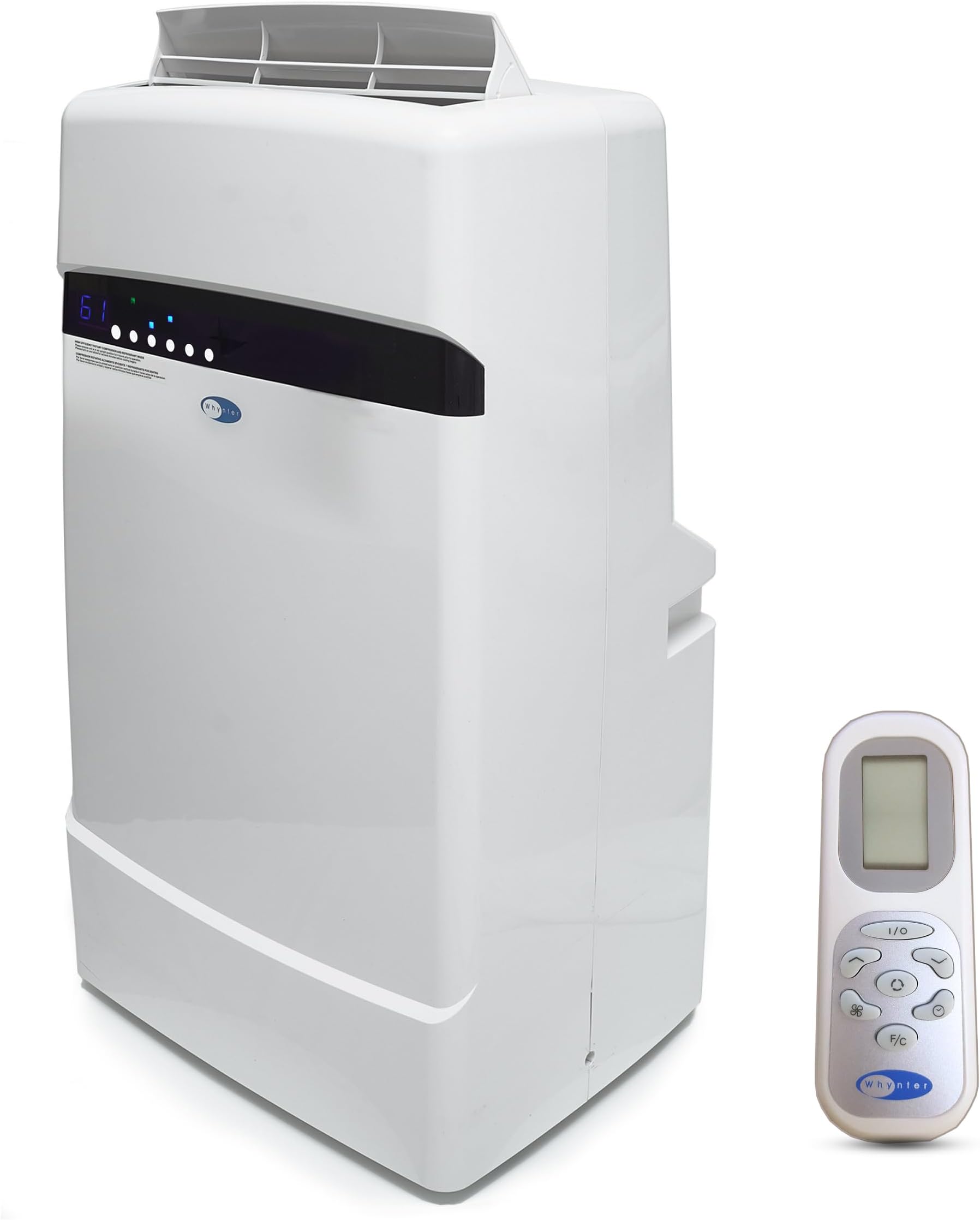
The Whynter ARC-12SDH is a powerful, award-winning portable air conditioner and heater combo delivering 12,000 BTU cooling and heating for rooms up to 400 sq ft. Featuring a patented dual hose system, it efficiently cools while operating quietly at 51.5 dBA. With 4 modesโcool, heat, dehumidify (96 pints/day), and fanโplus an activated carbon filter and washable pre-filter, it ensures superior air quality and year-round comfort. The unit includes a full window installation kit and storage bag, making it a versatile, professional-grade climate solution for modern living spaces.


| ASIN | B003MQDGIW |
| Additional Features | Portable |
| Air Conditioner Application | Indoor |
| Air Flow Efficiency | 165.45 Cubic Feet Per Minute Per Watt |
| Annual Energy Consumption | 1100 Watts |
| BEE Star Rating | No Energy Star |
| Best Sellers Rank | #966,008 in Home & Kitchen ( See Top 100 in Home & Kitchen ) #893 in Portable Air Conditioners |
| Brand | Whynter |
| Brand Name | Whynter |
| Capacity | 96 Pints |
| Color | White |
| Compressor Type | rotary_scroll |
| Control Method | Remote |
| Controller Type | Digital Control, Remote Control |
| Customer Reviews | 3.7 out of 5 stars 193 Reviews |
| Filter Type | Activated Carbon Air Filter and Washable Pre-filter |
| Floor Area | 400 Square Feet |
| Form Factor | Portable |
| Global Trade Identification Number | 00891207001972 |
| Included Components | Window installation accessories, remote, and storage cover bag with pocket |
| Installation Type | Window Vent Installation |
| Inverter Type | No Inverter |
| Is Outdoor Unit Required | No |
| Is Product Cordless | No |
| Item Dimensions D x W x H | 16.5"D x 20"W x 34"H |
| Item Type Name | Whynter ARC-12SDH 12,000 BTU (6,884 BTU SACC) Dual Hose Cooling Portable Air Conditioner, Heater, Dehumidifier, and Fan with Storage bag, up to 400 sq ft in White |
| Item Weight | 78 Pounds |
| Manufacturer | Whynter |
| Model Name | ARC-12SDH |
| Model Number | ARC-12SDH |
| Noise | 51.5 Decibels |
| Number of Heating Elements | 1 |
| Number of Power Levels | 3 |
| Power Source | Corded Electric |
| Product Dimensions | 16.5"D x 20"W x 34"H |
| Refrigerant | R-410A |
| Room Type | Bedroom |
| Seasonal Energy Efficiency Ratio (SEER) | 6.97 |
| Special Feature | Portable |
| Start Year | 2010 |
| Start year | 2010 |
| UPC | 891207001972 |
| Unit Count | 1.0 Count |
| Voltage | 115 Volts |
| Warranty Description | 1-year limited manufacturer's warranty and 3-year compressor warranty. |
| Warranty Type | Limited |
| Wattage | 1100 watts |
| Window Opening Maximum Height | 46 Inches |
| Window Opening Maximum Width | 46 Inches |
| Window Opening Minimum Height | 20 Inches |
| Window Opening Minimum Width | 6.5 Inches |
T**S
You really want a dual hose air conditioner.
I live in a southern California where 10 months a year, it's pretty nice. But I also live a bit inland, so about two months a year it gets unbearably hot. I was toying with doing a whole house air conditioner (3-ton, aka 36000 btu/hr), but the bit for doing it up to code was well past ten g's. So I started to research alternatives. Since I have sliding windows, I really couldn't use a window air conditioner. There are casement air conditioners sized to fit sliding windows, but the selection isn't as good. I wasn't really considering a portable air conditioner because I only knew about single hose units and there were too many drawbacks. The idea of a single vent portable air conditioner is pretty attractive until you consider the thermodynamics of it: all of the heat producing parts are in your house -- which means that you have to cool them too. And even though the gets vented to the outside, that air has to come from somewhere... like that precious cool air that you just made. And all that air being blown out the window has to be replaced, which means hot air is being sucked into your cool room under the doors and through various air leaks. In short, while you're trying to cool the room you're fighting against the heat from the compressor, the cold air you're throwing away, and the hot air that's being sucked in. A single hose air conditioner is the worst way to cool a room short of leaving your refrigerator door open. *** That's why you *want* a dual hose air conditioner. It solves two of the three big limitations of single hose portable air conditioners: it uses outside air for the condenser (hot side) core airflow, so it doesn't waste your just cooled air, and it isn't replacing that cooled air with hot air. The hot side stays hot and the cool side stays cool. Sure that pesky compressor is still getting hot, but the only way you're going to solve that is to buy a window air conditioner. So, needless to say I'm quite happy with my purchase. It gives me 1/3 of the cooling of a whole house AC, for less than 1/10 the cost. Granted I can only cool one room at a time, but this means being able to get a good night's sleep rather than being miserable two months a year. One other technical things I'd like to talk about: drainage. The act of cooling will draw moisture from the air. This unit gives you two options to get rid of it. For low humidity climates, it is designed to drip to a pan at the bottom of the unit. As the hot-side air is drawn over it, the water will evaporate again, pass over the condenser (hot side) coils and be vented to the outside. You *want* this to happen: moisture laden air holds more heat than dry air, and will pull more heat out of the hot side coils. Thus letting the moisture fall to the drip pan at the bottom and evaporate again will cool more efficiently than if you drained it off and let dry air pass over the hot side coils. However, if too much condensed water accumulates in the drip pan, a float switch shuts off the compressor. Which happens in humid weather. For mid/high humidity areas, there is a drain port halfway up the unit with a garden hose fitting. There is already plenty of water vapor in the air for heat transfer: no more is needed in the drip pan. Thus you should just drain it: I took a hose fitting and a meter of clear plastic tubing and ran the drain output into a glass jug (see attached photo). In two evening's use, I got about 1.5 gallons out of it. (See other attached photo) That's almost 6 liters of water that was in the air making things muggy. I was amazed over how much water came out of the unit. The remote is pretty nice. I can leave it on the nightstand and turn on/off the unit without getting out of bed. One more thing, this particular model is also a heater (actually a heat pump). It can warm your room in winter, providing the outside air is above 45 deg F. It won't work as a heater in Minnesota, but can be used on southern California winter days to take the chill out of a room and where the whole house furnace would be overkill. Now to deal with some of the objections I've seen in other reviews: 1. Size. It's 12000 BTU/hr, that's bigger than many/most air conditioners, but it is not enough to cool your entire house. It does make 200 sqft into a meat locker though. Most would agree that it should adequately cool 400-550 sqft. 2. Noise. Now that we're all used to whole house AC and climate controlled offices and cars -- where all the moving parts are tucked out of the way -- we forget that all that equipment makes noise. It's not quiet/silent, but it's not too loud either. I usually run mine about 3 hours before bedtime and turn it off. There is a timer so you can run it for an hour or two after you turn in. Even if I had to run it all night, I'd rather sleep with the fan and compressor noise rather than tossing and turning and not sleeping from the heat. 3. Water/dampness. There were a lot of complaints about the unit stopped working in humid weather. That's because the condensate could accumulate in the drip pan and the limit switch would shut off the compressor. The solution would be to drain the moisture from the upper drain port. The second water complaint was that the unit would leave a puddle on the floor. Again the same thing. The drip pan is just that: a pan. If you tip the unit, water will spill. (Don't ask how I found that out.) If you're not on a level surface, you may be spilling before the limit switch shuts off. If you have that much water production, maybe you should be using the upper drain instead. 4. Lights. This would be *MY* biggest complaint. They're pretty bright. In fact they keep me up at night more than the noise. Worse yet, there are no labels explaining what they mean. Which means RTFM if you're wondering what the purple LED means vs the blue one or green one. And you have no idea what the fan speed is or other indicator lights because they're all blue, just different positions for different settings. Not quite enough to drop my rating from 5 stars to 4, but close.
J**M
Not perfect but very good
I am reasonably happy with the unit. It was easy to setup and cools one room quite nicely. So the negative comments I have are more like the 5% I do not like. Keeping that in perspective, the items I would like changed are as follows: - The unit is a bit noisy. 54dB vs the Sharp 43dB. The Whynter is always running with the sound increasing when the cooling unit is on. I understand the Sharp turns on and off. - The 6" plastic pipes that connect the unit to the window adapter are very robust. They are a bit tricky to hook up and quite long. I replaced them with ordinary 6" stove pipe - 2 adjustable elbows and 8" of straight pipe. This allowed me to get the unit as close to the wall as possible and minimize the resistance of the pipe itself. I haven't seen any evidence of condensation. - The unit front panel is not labelled and the remote is poorly labelled. I had to keep the handbook around to see what the LEDs and remote buttons meant. After a while simple things like changing the fan speed are easy to remember. But anything else requires having the manual handy. This was very poorly done. - This has nothing to do with the unit itself, but it does not cool multiple rooms well at all. I have a bedroom and office across the hall from on another on the second floor. Getting the cool air over to other room requires a number of fans and that does not seem work very well. The temperature differential can be 5 or 8 degrees. Still trying to figure out how to fix that. So buying a portable for multiple rooms requires some additional technology. This is the first portable air conditioner I have owned so I have nothing really to compare with. So not sure my expectations were realistic. All in all I am as happy with the Whynter as I could expect to be. The only problem I believe I have a right to be annoyed with is the remote and unit display. Cryptic.
K**E
Horrible Design and waste of money - Get Something Else
This unit was purchased for an 18x12 room with basement size/type windows on an upper floor that also has no heat. The unit cools the room. The unit doesn't seem any louder than any other air conditioner I've encountered. The window kit was easily cut down to fit, and installation was easy. That said, this unit is a pain in the you-know-what and if I had any other options I'd be pursuing them. There's a five degree variation before the unit turns on. So if you have it set to 72, the room can be 77 before it turns on. So if you're a cold-blooded ice monster like me, to keep the room cool enough, the unit has to be set colder than you actually want it. The lights on the display are not only ridiculously bright, they are also bright blue. Blue lights are the most disruptive to sleep, and when I say the lights are bright, I mean if I sat close enough to the unit I could read a book. I used a piece of the window kit and some duct tape to cover the display, and the light still comes through. The book says the unit "might" collect some water while cooling. Almost makes it sound like this is not a common occurrence. Without exaggerating, the unit only runs 3 to 4 hours without needing to be emptied. I am in Maine and the last couple days it's been in the upper 80's with humidity in the low 30's and dew point in the mid-to-low 50's. The unit ran from 2130 to 0030 last night, and then from about 0830 this morning and shut off just before 1 because it was full of water. Not only does it need to be emptied practically constantly, the drain is not even a full inch off the floor. The instructions say to put a "flat pan" under the unit to catch the water. A paint tray is too tall, the only thing going under that unit is a cookie sheet (probably best if one with sides is used). I have mine up on a set of 4x4s right now so I can drain it, but in the interest of not having to babysit the stupid thing constantly, I will most likely find something to lift it onto so the water can drain into a bucket. This will, of course, render the casters useless. In addition to the above, whatever the water collects in inside the unit is not closed. So if the unit has shut off because it's full of water, and you're trying to get a reasonably sized container underneath the unit to drain it, the water will spill. Everywhere. Ah ha! You're thinking. I'll just get a hose and drain it that way! Unfortunately, grasshopper, only gravity is emptying that tank. And finally, the best bit of ridiculousness, when the unit is sitting level, all the water won't drain out. To get all the water out the unit has to be tipped backward to completely drain. I don't know if all portable air conditioners are this "difficult," but this one certainly is. I do not recommend, especially for the price. Update 07/02/2016: Put the unit up on a series of blocks to make draining it easier because it was shutting off so frequently. In the 24 hours after it was raised I got about a quart of water out of it, and haven't gotten a drop of water out of it since. Was it possibly because the unit was new? The world may never know. If it stays dry I will probably come back and update my review and give it a higher rating. Update 08/06/16 - I officially hate this unit. I have a 5 qt pot that needs to be emptied every 4 to 6 hours (7 to 8 if I'm lucky) because this thing produces So. Much. Water. On the plus side, my cats enjoy drinking the collected water and I have one very clean spot on the floor when the pot overflows. On the minus side is everything else. I am going to need a 5 gallon bucket under this thing if I want to only empty it once a day instead of 2 to 3 times a day. The room is cool, but I don't know if the work to keep it running is worth it. Under current conditions with the drain plug in it shuts off after two hours because it's full of water, with a loud and annoying beep before it does (to make sure you wake up to know it needs to be emptied). Update 12/16/16: This was purchased specifically because it has the heating option. Unfortunately the thing has stopped working less than a year after I purchased it. At the tail end of summer when I managed to build a frame to support the unit so it would then gravity drain into a bucket, the A/C went wonky on it and would only run at specific fan speeds. There was a period in between when I needed A/C and when I decided it was cold enough to need the heat (during which time it sat, plugged in, and off in an upright position) and the heat will kick on for approximately a minute (if it kicks on at all) and then shuts off. Huge, HUGE waste of money. I will be contacting the manufacturer and wasting my time there to see if it's under some sort of warranty that they'll find a way to not honor, but I am not holding my breath.
F**L
Whynter 12,000BTU Dual Hose Portable Air Conditioner, Frost White (ARC-12SDH)
After extensive research, reading customer reviews, professional reviews and pricing at my local appliance stores, I broke down and bought two of these units, 2 weeks apart. My son and I moved in with the elderly 'rents to look after them. They keep the central AC at 80 and watch TV with wool caps, slippers and lap blankets... yes, in the middle of the Florida summer! To say the least my son and I were sweatin' it out at night. I got only one portable AC (PAC) at first because of some of the negative reviews, large investment on something I wasn't too sure was going to work well for us, problems with the drainage, etc... I didn't want to invest in two, if one didn't work. The room I am cooling is approx. 12x 12. I probably got too much in the BTU department, but I wanted to be sure that it would do the job. It ABSOLUTELY DOES THE JOB AND THEN SOME! I did get the second one. The PAC came in a large box, packaged well. Easy to disassemble, box was taken away by recycling. All good. My brother-in-law set the PAC in my bedroom. I only have a sliding glass door to work with, so he needed to do some modifications and adjustments. All of the parts were in the box and easily assembled. Follow the directions (and pictures) and all should match up well. I went to Home Depot, purchased a 4' x 8' piece of AC insulation board (foam in the middle and covered with silver foil on the outside...cuts easily with a utility knife), a roll of AC duct tape (not duct tape, but the kind that is foil and used for AC duct work), 2 packages of 1" x 1" foam weather stripping, and 3 feet of 1/2" diameter tubing. ($30-$40 all together). The tools that my brother in law used were a drill to make a 1/2 inch hole in the insulation board, a utility knife, and a measuring tape. I'll tell you how he put it together and the reasons for doing it the way he did... after all, he is a clever guy and he saw a design flaw here or there... First, he measured how wide he would need the insulation board to be. Remember, it went into a sliding glass door, which would render the slider useless, once the PAC was installed. (I didn't care, I NEEDED the AC). He cut the insulation board 4" wider than the width of the plastic window kit (comes with the unit, has 2 holes to attach the duct hoses). Of course, the height of this piece has to fit into the door. Next, he decided where he wanted to put the plastic window kit in the insulation board. He centered the plastic window kit vertically and pressed it into the insulation board to leave an imprint in the board. He used the utility knife, followed the straight lines of the impression, to cut out the shape of the plastic window kit. He used the AC duct tape to tape the window kit into the insulation board, front and back. He next taped this, (the piece of insulation board with the plastic window kit taped into it) into place in the door jamb/frame of the slider. All taped in. It doesn't look pretty, or it looks as good as it can for being what it is, but it certainly is functional. He then attached the exhaust hose to one of the round circles (4" hole on the plastic window kit) and put one of the caps (provided) on the other. ***HERE IS WHERE HE THINKS THERE IS A DESIGN FLAW, AND WHY HE DID NOT ATTACH THE SECOND HOSE TO THE SECOND HOLE. The directions and the whole idea of the DUAL HOSE SYSTEM is to blow out the hot exhaust through one of the hoses and then to draw in cool air, from outside, through the other hose. This is the problem with this idea (according to my brother in law): "THE TWO HOSES, WHEN CONNECTED TO THE WINDOW KIT, ARE ONLY 1 1/2"-2 " APART. HE DOESN'T BELIEVE IT'S POSSIBLE TO DRAW IN "COOL" AIR FROM THE OUTSIDE FOR TWO REASONS: IT'S HOT OUTSIDE, HENCE THE NEED OF THE AC AND BECAUSE THE INTAKE IS GOING TO 'SUCK' THE HOT AIR IN FROM THE EXHAUST BECAUSE IT'S TOO CLOSE TO THE INTAKE." So, the intake hose is attached to the unit, but not to the vent hole. It's simply leaning up against the door, out of the way, sucking in the cooled air from inside the room. When I explained what I was doing to the Home Depot guy, he reminded me that once that sliding glass door was opened a few inches, there would be a gap between the two doors... in the middle, if you will. Simple solution was to stuff the foam weather stripping in there! Done. I was concerned about the drainage issues... Florida is HUMID! I read on some reviews that the unit would shut down in the middle of the night because the drip pan was full... Again, my brother in law to the rescue!!! He removed the plug, drilled a hole in the insulation board at the same level or height of the drain. He attached the tubing to the drain on the unit, and threaded it out through the insulation board to the outside. Problem solved! After he installed the unit, I noticed that there were tiny little gaps in the plastic window kit, around the circles... I could see light shining through. I ran a bead of caulk around it. No more light, no air escaping and no ants getting in. I turn the PAC off when I'm not home. Remember, the central AC is set at 80 degrees and the outside temperature, at this time of year, during the day is between 90 and 95. When I return, I turn the PAC on and set it at 74. Within 15 minutes, the room is cooled down to 74. (I have a separate thermometer and wanted to make sure that it was cooling to what I had it set at.) As I type right now, my fingers and toes are cold! I'm comfortable... I might even have to turn it a little warmer! Some reviews mentioned that it is a loud unit.... I don't agree... it is no louder than a window shaker! I would definitely recommend this unit. So far, so good! It's only been three weeks, but I am optimistic that it will continue to work well. (I waited 10 days or so to order one for my son and he, too, is now comfortable in his room. It's about the same size as mine.)
M**O
1 Year Review: MECHANICALS work well, everything ELSE, though.......
I STILL spoke too soon... In August 2014, one month after the warranty expired, one of the LED's for the fan-speed died... Geeshhhhh! Ideally I'd give this 2.5 out of 5 stars - it's really been a 50/50 experience. I've saved all my notes to bring you a full 4-season review. I bought this heat pump a year ago in early July of 2013, The first good thing was that the heat pump version was only $40 more than the plain ARC-12 air conditioner, so it was a no-brainer to buy the dual-purpose unit. At this point I am happy with both the heating and cooling performance and the energy costs. However, I'm going to list the cons first and then the pros, because that's the order in which I experienced them. The first few months were a royal PITA... CONS - The first problem was the assembly of the remote. One of the battery contacts wasn't installed correctly and only made an intermittent connection. I had to figure out how to take it apart without breaking it and move the contact to the correct side of the plastic wall. - Within days, one of the LEDs on the control panel died. Even though it was well within the 90-day "shipping included" part of the warranty, the Whynter people insisted that I be the one to take the machine apart and they would send me a new circuit board by FedEx... Now, I understand the cost of shipping 80 pounds of machine up & down the west coast, but this housing is NOT made to be easily or frequently taken apart & put back together, and the plastic is fragile enough that it already had 2 broken screw-tabs when I first opened it up (and I'm not the only one.) Also, I've very mechanical and have an electronics degree - I don't see the average consumer being able to deal well with this service system. OH, and the disassembly instructions they emailed me were for a totally different unit! Not to mention, they might have fixed it the FIRST time if they took it to their service center and tested it... - Next, they sent me the wrong circuit board, even though I stressed that it was a ARC-12SDH HEAT PUMP. - So, I had to take it apart AGAIN to install the correct board when it arrived... BTW, the PCB connectors they use are ridiculously tight. Every time I had to remove a board, I was afraid the wiring from the unit was going to get pulled out of the connector. - That board lasted a couple weeks until the digital readout failed... On the third try, they decided that the main circuit board down low inside the unit was bad and it was frying the upper display boards. So they sent me one of each and I took it apart yet again (re-gluing those broken tabs from its original shipment.) That finally fixed the problem with the electronics... - People have complained about the unmarked indicator lights that take time to memorize, but to add insult to injury they glued a nice black-on-clear vinyl guide sticker to the LOWER REAR of the machine! It's a totally useless location that you don't notice until you start dealing with the drain, and the glue is too strong to relocate it to the front without damaging it... - Speaking of the drain. Yes, the internal tank is small but when cooling in moderate humidity the condensate gets used up cooling the coils and the moisture is evaporated & exhausted. Another problem, though, is that the 'slinger' wheel can't get all the water up out of the tank, and as low as that silly drain fitting is, it STILL won't drain the last two cups of water without tilting the machine back 20 or 30 degrees (and don't do that with the pump running!) So, algae starts growing in the bottom of the tank and I finally started dribbling a shot glass of 3% medical Hydrogen Peroxide down the back of the evaporator (behind the air filters) once a week to stop the growth. Also, I used a heavy plastic recycling bin to raise the unit a foot off the floor. - The manual is very sparse! It doesn't explain that the air-hose fittings (which get hidden when they are snapped into the back of the machine) can be removed simply by rotating 20 degrees either way... Worse, it doesn't say a word about condensate when you are using the unit for heating. That is when it generates several QUARTS of water a day and you absolutely must have a drain hose. I found that the easiest solution is 3/8" O.D. clear vinyl tubing (sometimes called aquarium tubing.) It friction-fits very nicely INside the drain fitting and can be removed & replaced in seconds. I simply run it into gallon milk jugs. - Finally, in both modes the manufacturer neglected to (very simply) program a fan 'overrun', or delay in stopping, after the compressor cycles off... In cooling mode, running the exhaust fan for several minutes would remove a little more of the moisture from the system. More importantly, running the interior blower for several minutes after a heating cycle would extract the last of the heat from the coils (just as a home furnace does) AND keep the temperature sensor from reading artificially high after shut-down. Failing to do this keeps the heating off for too long between cycles, so I unclipped the sensor (also behind the air filters) from the fins to reduce the severity of the false temperature readings. PROS - Having said all that, especially the problems with the electronics, I am quite impressed with the other machinery... Both fans are extremely well balanced and I think the noise is somewhat comparable to a similar sized window unit. The compressor is extremely quiet and I believe that the majority of the noise is generated by the exhaust air blowing through those corrugated hoses. (P.S. Those hoses and the window panel should each be about a foot longer.) Having said that, the noise is a very "white noise" in the background. Unlike my neighbors' central A/C outdoor units that have very annoying, alternating hummm, hummm, hummm patterns this one is a constant rushhhhhhhhhhh. I only recently noticed how much I'd gotten used to it when I had to turn the TV volume down 8 points after I'd shut it off for the night... - Of course, this IS a dual-hose machine, so it is more efficient than a single-hose type. This unit is rated 11-12,000 BTU while only consuming 1,000 watts of power. That's a pretty good EER... It is rated up to 400 square feet, but I have been using it for about 550 feet because of the layout of the building: I can only "close down" the house to the living room, kitchen & a hallway. Yet, here in the Willamette Valley, it reliably keeps these 2 rooms & hallways 15 degrees below the ambient temperature. As I said, it also creates no water out the drain tube in the Summer. - I think this thing may have paid for itself last Winter. The house I'm renting has no natural gas, and the original source of heat is a forced-air 20,000-WATT electric-resistance furnace!! I'm surprised to read of others not getting any heating performance... I analyzed the hell out of it and I'll bet it only went into 'de-ice' mode 2 or 3 times all Winter. In the meantime, it ran the interior blower on high down to 45 degrees ambient, medium to around 35 degrees ambient, and was still making some heat as low as 22 degree! I was quite amazed. I only need around 67 or 68 degrees, and most days I was able to use the main furnace for only 1 cycle in the morning and 1 at bed time, with the Whynter handling everything else. With the heat pump costing little more than a dime per hour to run constantly, and the furnace using 15 cents every time it kicked on for 6 MINUTES, I'll bet I saved $100 per month on heating! - There have been complaints about the remote & the display. The remote is OK, the user just needs to know that it doesn't 'communicate' with the unit. It simply remembers where you left it, and if the controls on the base have been changed, it's not going to just change the base setting, it's going to revert to the last remote setting. This is only really annoying when you don't have a straight shot at the receiver and end up pushing the buttons several times before the signal gets through... Also, there is a work-around for the fact that the display only shows the Set temperature instead of the Ambient temperature when not in plain Fan mode: If you pick all your settings for cooling or heating on the front panel, you can then rapidly cycle the Mode button around through Fan & back to Heat or Cool without interrupting the machinery, but it will fake the brain out and display the Ambient temp just like it does when on Fan... - True, you can't treat it like a full climate control where you set one temperature and it will automatically alternate between heating & cooling depending on conditions, but unlike in an automobile I can't think of many days where that broad of a range is required. The timer, on the other hand, is very useful. You can pre-heat or pre-cool before you get out of bed, or before you get home from being out. To summarize: Lousy Chinese electronics, only fair customer service, but excellent compressor, blowers, basic design & performance...
S**.
Great AC!
Very nice AC, very high quality. We have it cooling an approx 450 sf updtairs room with heavy south and west sun exposure & lots of windows. As long as door is closed, it will cool off room quickly - 10 degree drop in 60 minutes). Even if 90 outside, it you can easily maintain 70 or less inside. The vent kit works very good, hoses are plenty long (approx 9 feet). Hoses are thick, make nice tight bends where needed, no need to modify with elbows, etc. I had to modify venting for casement windows, it was easily done with a 2x4 sheet of insulated foam from local hardware store. Just cut out a rectangle for the factory vent, taped it on to the sheet with some foil tape. I used the really stiff L-shaped cardboard that came with packaging to reinformce the sides of foam sheet & cut them just right length so it had to be wedged in tight to window frame -- it actually holds the foam piece against window really tight & didn't have to use any tape or glue. As far as noise, The unit is not very loud, much quiter than I expected - certainly much quiter than any window unit that I've seen. And it is a nice constant white noise type sound - no sloshing of refirgerant as most window ACs. We have a box fan that is louder than this uint. If you are wathcing TV 3 feet away from the unit it may be loud, but in virtually any other scenario you should be very happy. Dual hose is definately the way to go, dont waste your money with anything else. We have had the condensate drain fill up once (the unit shuts off & flashses red lights), so it definately isn't fully self evaporating... however, that was after running the unit nearly non-sop for a couple of days under heavy load. If it has chance to run in fan only mode even occasionally (without compressor running)that seems to help evaporate. In our case we ran it with the room door open (to rest of 2,000 sf house), so the compressor never had chance to stop running & it filled up. I'd imagine under normal scenarios it should work very good, we haven't had it happen since.
L**E
Great Product - Outstanding Customer Service
It's not often that I'm so impressed by a consumer experience to write a review, but.... here I am. First, the ARC-12SDH itself. As industrial design for this type of product go, it's quite a tidy looking unit. It sits in the corner of my Downtown Los Angeles photo studio of about 830 sq. ft. and dutifully pumps out icy cold air all day long. By itself it isn't quite enough to deal with the 90-100ยฐF summer days, as we're oriented with a long wall of south facing windows that receive direct sunlight for most of the day. I installed a small window unit to help out and that did the trick the pretty well. So we blasted this thing for a year, cooling in the hot months, and warming in the cool months. Right about the one year mark, in the middle of a hot, humid summer day, it shuts down. I quickly figure out that it has filled up with condensed water and I need to drain it out. Inconvenient, but an email and reply from Whynter customer service informs me that this can happen in very humid weather. This unit is designed to use the water condensation to assist through evaporative cooling, while simultaneously exhausting the water vapor to the exterior via one of the hoses. When the unit shut down again the next day I became a little suspicious and wrote customer service again. This problem, combined with a failed LED on the display, prompted a series of quick replies from Whynter guiding me, step-by-step through a trouble shooting process to discover a failed fan and display panel. By this time, the unit was out of warranty but Whynter offered me several options for repair anyways - send back, carry in to service center, or self repair. I'm not scared to get my hands dirty, so they shipped the appropriate parts to my studio and I followed the provided step-by-step instructions. Within a half hour, I had installed the new parts and now the unit is back in service. It nice (and rare) to find a company who stands by their product and offers outstanding customer service. Highly recommended!
S**Y
Solid Portable AC
I use this in my living room in Hawaii. If I had to guess, it's about 300 square feet. Without it, on hot days, the temp in the living room gets up to 94 F. This is able to keep my living room at 77 F. On normal days where the temp in the living room will go up to 88 F, this is able to keep my living room at 75 F. I've only seen the thermostat read lower than 75 on overcast days, but that's fine. There's warnings about how the unit might not be able to keep up with evaporating the condensation collection in humid areas, so you'll have to drain it. Well, Hawaii is pretty humid, and I've used this daily for a month straight now, and there's yet to be a drop of water come out of the drain plug when I've checked. At this point, I'm going to stop being paranoid about it and not bother checking unless the water warning actually comes on. The display on the front is both very simple and greek to decipher. Going from temperature mode (where you set a temp for it to shut off at) to normal mode...well, let's just say the only way I've figured out how to do that is to unplug the unit from the outlet. This resets it to normal mode. Why would I ever want to go back to normal mode? In temperature mode, you can't see what the current temperature is. I don't want to see the current temperature often, but it's nice to once in a while. There really should have been a simple way of viewing the temperature again once you've got it set to a specific temperature. The carbon filter it comes with is a bit of a joke and half the size it probably should be. The auto resume when power is lost is nice, because it means you can use it with a smart plug. This lets me turn my AC on while I'm out of the house, so my living room is cool already when I come home, as well as the normal voice control I do for more and more things in my home. I haven't used the heater/humidifier functions yet. It does drop down to the 50s during the winter here (yes, seriously), so I may try it later in the year. I haven't tried the humidifier yet because we haven't had a really rainy spell yet. That also tends to start during the winter/spring, so I'm sure I'll get a chance eventually. That said, I didn't buy this for those two functions. You're just kind of left with a handful of choices if you want a dual hose AC over a single hose unit. Why would you want a dual hose unit? Well, my understanding is they largely eliminate the issue of negative air pressure, since it's drawing air from outdoors, rather than from within your home, which means it isn't working so hard to cool down your entire house if you don't have the room it's in sealed from the rest of the house. I don't know, I'll probably never have two exact BTU portable AC units-one with a single hose and one with a dual hose-to run tests with. What I will say is that I take a step out of my living room, and I go from cool nirvana and walk into a wall of hot humidity, so... Anyway, the real test of how much I like this will inevitably be how long it functions. When/if it breaks down, I'll update, but for now, it's a solid 4 out 5 stars. The loss of 1 star is due to the inability to simply toggle the display of the current temperature when you've got the unit set to a specific temp.
G**K
New version works better
I had left a negative review earlier, but it seems my unit was defective. The replacement unit is mostly good with my main complaint being that the thermostat should be more fine grained. The plus side of a dual hose unit is that it does not create negative air pressure and so can work more efficiently and doesn't draw in the stinky cigarette smell from the apartment hallway. I wish more manufacturers offered dual hose options. The indicator lights on the front are unintuitive poorly labeled and you really need to read the manual to understand what they are trying to tell you.
J**H
Constant 360 Hz tone from cooling/heating fan
After reading all the reviews on Amazon.com and other sites, I thought this would be a good buy. Although in all other respects, it worked well, when the cooling/heating fan is operating, there is a constant 360 Hz tone that the air conditioner emits. It doesn't matter if the fan is on high, medium or low, the tone is the same. Since this unit is in my bedroom, I ended up hearing the tone all night, so I didn't sleep well. I have used both portable and window air conditioners for years and many different brands. This is the first time I have ever heard a constant tone like this come from an air conditioner. It may be that it's just a defective unit, however when I contacted Amazon.ca to exchange it, I discovered that with this unit, even though UPS was able to ship it to my door, Amazon.ca told me that I had to return it by bringing it to a local post office. Considering the size of the box and a shipping weight of 96 pounds, I may have to find someone with a van or truck to help me get it to the post office. Because of this, I wasn't willing to risk getting another one, just in case the tone is common with this make/model. It's too bad, because in all other respects, this unit could have worked for us. The compressor is much quieter than another brand we have. The fan also blew the air more upwards than forward, so there was less of a cold draft across our bed. The white noise of a fan and the compressor going on and off is easy enough to get used to. But the constant tone is reminiscent of the off-air tone of a TV station. I couldn't sleep through that either. Update: I returned this AC shortly after buying it. 5 years later, I chanced getting a 14,000 BTU Whynter for our living room and used a vinyl hose to divert cool air to the bedroom. This way it's more like having central air in the bedroom. The bigger unit would be too loud to have in there, but I'm completely satisfied with it. Getting quality dual hose AC's are quite rare these days and they are much more efficient.
S**.
Do not recommend
This is incredibly loud and quite slow to both cool and to heat. There must be something better out there for this amount of money.
Trustpilot
1 month ago
3 weeks ago